





 Watch Full Show

Related
Topics
Reporters Without Frontiers has issued a new report titled “Two Murders And a Lie” examining the Pentagon’s handling of the killing by the U.S. of two foreign journalists at the Palestine Hotel in Iraq on April 8. [includes transcript]
An article in today’s Independent (UK) headlined “US lied about deaths of journalists in the Palestine Hotel” begins:
The shelling of the Palestine Hotel in Baghdad by an American tank, which killed two journalists and injured two others, was an act of “criminal negligence”, said a report by an international media watchdog.
Reporters Sans Frontières (RSF) accused US authorities of concocting lies to hide what had happened on 8 April last year, and a subsequent official “investigation” was nothing more than a whitewash. They said the Bush administration must bear some responsibilities for the deaths as US forces entered the Iraqi capital, as well as the “cover-up” which followed.
The US government is accused of “ignoring the key to the tragedy”. Despite information being available to the Pentagon, the report said “the soldiers in the field were never told that a large number of journalists were in the Palestine Hotel. If they had known they would not have fired. When they did know, they gave and received instructions and took precautions to ensure the hotel was not fired on again”.
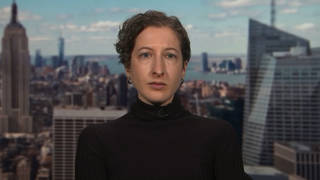
- Tala Dowlatshahi, the US Representative of Reporters Without Borders, the Paris-based media watchdog organization. The organization just published a major report titled “Two Murders and a Lie: An Investigation of the US Army’s firing at the Palestine Hotel in Baghdad on April 8, 2003.” Reporters Without Borders is calling for a full investigation into the deaths of two journalists by U.S. troops in Iraq
Related Story
 StoryFeb 05, 2024U.S. & Israel vs. Axis of Resistance: Biden Strikes New Targets in Middle East as Gaza War Continues
Transcript
AMY GOODMAN: We’re joined right now by the US representative of Reporters Without Borders, Tala Dowlatshahi. Welcome to Democracy Now!.
TALA DOWLATSHAHI: Thank you very much, Amy
AMY GOODMAN: Can you tell us about your report entitled, “Two Murders and a Lie”?
TALA DOWLATSHAHI: Yes. The report chronicles the situation of journalists prior to the Embedding Initiative and during the Embedding Initiative. On the 8th of April, the Palestinian Hotel was fired upon and journalists were stationed at the hotel, primarily foreign journalists. What ended up happening was that there were deaths of two journalists and that’s Taras Protsyuk from the Reuters television and José Couso from Spanish Telecinco television. Both were killed. And various speculations in terms of what journalists from the hotel were able to see in terms of the tank firing from them — on them from the Al Jumhuriya bridge. Now, speculations, once we at Reporters Without Borders went in to investigate the case, came back from the Pentagon from Brian Whitman that the situation was not — it was accidental. There was not criminal negligence involved. But since that time, we have received several reports back from foreign correspondents actually in the hotel who had said that the US military knew that they had been there for several weeks, stationed at the Palestine Hotel. And that several reports did not get back to the person who actually fired, Sergeant Gibson. So, it wasn’t a deliberate act, though we do feel that criminal negligence was part and parcel to this particular incident.
AMY GOODMAN: Can you tell us about the two men who died, José Couso and the Ukranian cameraman?
TALA DOWLATSHAHI: Taras Protsyuk. Yes, both were filming from the 15th floor balcony. They were filming the war as it was going, and what ended up happening was that the US military claimed that they had seen a spotter, an enemy spotter, with binoculars from the top of the Palestine Hotel, which, again, was very clear to the high ranking officials in particular, since the Pentagon initiated the Embedding Initiative to bring journalists on board. It was clear there were going to be a series and scores of journalists embedded and non-embedded in the region. The tank was fired, and both the journalists who were stationed at the balcony with very large cameras to view the war, one of them, Taras Protsyuk, received shrapnel in his stomach and died on the way to the hospital. And the other, José Couso, received a head wound and leg wound. His leg was subsequently amputated in the hospital and he died shortly thereafter.
JUAN GONZALEZ: I remember attending a conference, the annual conference of the American Society of Newspaper Editors last April where Dick Cheney was the vice-president. Cheney was the featured speaker. One of the editors specifically asked him about that situation, and Cheney’s response was that it would be ridiculous for anyone to think that the United States would actually target journalists for attack, and so — your report concludes that there was no deliberate targeting, but that the failure of the higher — higher levels of the military to communicate to their ground troops who were doing the firing, who was — that that was the Palestine hotel, that was the negligence involved?
TALA DOWLATSHAHI: Yes. That’s the primary conclusion. But also reports back from Victoria Clarke from the Pentagon spokesman, have been back and forth and a bit confusing. Some cases you see the US military that was interviewed subsequently directly after the incidents so that they knew that journalist were there. They knew that there had been several weeks that the journalists were stationed there. You have the other side of the military saying, from the higher ranks that, no, journalists—they were not there. They were not sure whether or not the records were accurate. So, the voice of opposition clearly in a time of war, people will get killed, and that is the voice of opposition and journalists who are covering war situations will be in the line of fire. But what I think is that the inaccuracy here is that this particular Pentagon initiative was to promote journalists to cover the war. The embedding initiative called upon scores and scores of journalists from all over the world to be in the region. The journalists who have provided the coordinates, for example, to the Pentagon, of their offices, of Al Arabia and Al Jazeera, both those offices were subsequently bombed on the 8th of April, killing one of their reporters, as well as scores of journalists coming in from neighboring regions like Iran were not allowed in the region if they were not embedded, in particular Arab-based journalists.
AMY GOODMAN: And I guess the real question is, it’s one thing to say that the man who open fired on the Palestine hotel, was it Sergeant Shawn Gibson?
TALA DOWLATSHAHI: Yes.
AMY GOODMAN: The question whether he knew exactly what he was doing, but he was in direct communication with higher-ups, and they knew exactly what the Palestine Hotel was, and you would think that they would tell everyone who was in Baghdad, all of the soldiers, exactly what that place was, and who it contained?
TALA DOWLATSHAHI: Exactly. But I think it’s really just the storybook analysis of the operation itself that a lot of information and mismanagement of information was not given to the proper authorities and people in charge. In particular, to the sergeant who was operating from the tank. He had no idea, based on his reports and testimonials, that there were any journalists stationed at the Palestine Hotel just across from the bridge.
AMY GOODMAN: I remember when Victoria Clarke was asked about this, it’s hard to remember, she was the Pentagon spokesperson, now she’s being called CNN consultants, or she has moved on to another consulting group. But saying that Baghdad is a dangerous place.
TALA DOWLATSHAHI: Well, for journalists it is a dangerous place, but it’s become more dangerous in the situation where journalists are now becoming juxtaposed to previous years, the direct targets of political opposition groups. This is worldwide. We are seeing this happen in the Democratic Republic of Congo, in Zimbabwe and so forth. The journalists are metaphorically the symbols of opposition.
AMY GOODMAN: What about the three Iraqi staff of Reuters that were detained by the US military just in the last week? Reuters contends that they were brutalized, that they were held incommunicado. Have you looked into that at all?
TALA DOWLATSHAHI: We are closely monitoring the situation. We have representatives in the region that are following up with the situation. Again, we are a press watchdog organization, so we will bark if we find there was a situation where we have to investigate this criminally. But, Amy, I want to make one additional point. Under the guise of Sir Kenneth Keith, the humanitarian fact-finding commission, Reporters Without Borders is asking that the cases be filed under the humanitarian fact finding commission. This commission was established under the Geneva Protocols in 1991. The unfortunate case about the commission is these cases cannot be investigated until both parties, and that is the transitional authority in Iraq and the US recognize its jurisdiction. And now the UK is on board for the commission, but these cases cannot just be investigated by the US, if the people who are being accused are the US military.
AMY GOODMAN: They’re calling for an international investigation of the killing of the two journalists.
TALA DOWLATSHAHI: Exactly, by an independent team, an international team to look into these cases, almost like the setup of the ICC, to bring forth these cases to the commission to investigate it under its jurisdiction.
AMY GOODMAN: Well, I want to thank you very much for being with us, Tala Dowlatshahi, US representative of Reporters Without Borders. The report is called, “Two Murders and a Lie”. The website, www.rsf.org . This is Democracy Now!.



 Top
Top
Media Options