






 Watch Full Show

Related
Topics
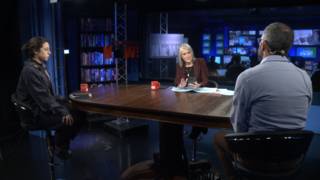
As the situation in Iraq continues to grow more bloody by the day, we hear an address by Columbia University professor Mahmood Mamdani discussing the corporate media’s coverage of Iraq and the U.S. assault on Fallujah. [includes rush transcript]
As the situation in Iraq continues to grow more bloody by the day, the unelected interim government of Iyad Allawi continues its crackdown on the Iraqi media. Last week, Allawi’s government threatened media organizations that do not report on the Iraqi governments spin on the siege of Falluja, saying reporters must differentiate between, “innocent citizens of Fallujah who are not targeted by the military operations and between the terrorist groups who infiltrated the city and took its people hostage under the pretext of resistance and jihad.”
But these instructions to journalists appear to be contradicted by the US military’s own statistics. Earlier this week, the military said that of the roughly 1,000 prisoners taken in Fallujah, only 15 are believed to be foreigners.
The Iraqi government also warned journalists not to add patriotic descriptions to members of the Iraqi resistance. Journalists were told to underscore that “these military operations did not come about until all peaceful means were attempted.” It is unclear what will happen to news organizations that break the new guidelines. Meanwhile, stark differences continue in how the embedded correspondents report on the siege of Fallujah and how Arab media are covering the US offensive. While most reports on US networks focus on what they call the house to house fighting in Fallujah, Arab media are showing images of bodies piled on the streets, dead children and corpses covered by flies, decomposing. One of the few unembedded correspondents in the city-an Arab reporter from the BBC- has described a stench in areas of Fallujah from the dead bodies.
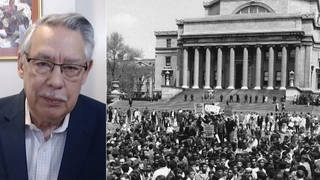
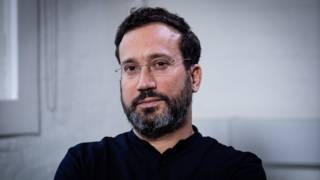
Earlier this week at a forum here in New York on The New York Times coverage of US foreign policy, Professor Mahmood Mamdani of Columbia University addressed the situation in Fallujah. Mamdani is the author of “Good Muslim, Bad Muslim: America, the Cold War, and the Roots of Terror.” Here is Professor Mahmood Mamdani.
- Mahmood Mamdani, Herbert Lehman Professor of Government at the Department of Anthropology at Columbia University. He is also the Director of the Institute of African Studies at SIPA. He is the author of Good Muslim, Bad Muslim: America, the Cold War, and the Roots of Terror.
Related Story
 StoryFeb 05, 2024U.S. & Israel vs. Axis of Resistance: Biden Strikes New Targets in Middle East as Gaza War Continues
Transcript
AMY GOODMAN: Earlier this week at a forum in New York, on the New York Times coverage US Foreign policy, Professor Mahmood Mamdani of Columbia University addressed the situation in Fallujah. He is the author of Good Muslim, Bad Muslim: America, the Cold War, and the Roots of Terror. Here is Professor Mahmood Mamdani.
MAHMOOD MAMDANI: For the last week, I have been thinking of the city of Fallujah, and thinking about Fallujah has not been easy while one reads The New York Times. I looked for an article which would tell me something about the history of resistance in the city of Fallujah. I didn’t find it in the Times. I found it in The Guardian in London, and the Guardian piece told me that this resistance began with the massacre of April 28, 2003, when parents and children in a school which had been occupied by American soldiers, had started demonstrating, and 18 of them were killed in cold blood, 60 were injured, and began the resistance to the US occupation in Fallujah. Before that, not a bullet had been fired. I then began to look for a story on the history of repression. Again, I didn’t find it in the Times, but I found it in The Independent. And The Independent of London informed me that actually the best model, the model suited to the kind of operation that was going on in Fallujah, I had thought it was Jenin, but actually The Independent informed me it wasn’t really Jenin, but it was the town of Hama in Syria, where in 1982, the Muslim Brotherhood had taken over the town and had called on the population to rise up against the government of Asaad. And the government surrounded the town with tanks, weaponry, and simply demolished it. 10,000 civilians died. One of the aftermaths of that operation was the US State Department put the government of Syria on its list of terrorist governments, and the next operation now to evoke Hama is what’s going on in Fallujah. I speak about Fallujah also because I think that it is symptomatic of a larger development. And I think that that development is best understood by contrasting our present current times with the situation during the war in Vietnam. I think of western empires, contemporary western empires and the American Empire also, as distinct from empires of old, even distinct from the Soviet Empire in one way, which is that they tend to combine despotism abroad with democracy at home. And to the extent that they do so, to the extent that democratic institutions at home breathe life, breathe democratic life, to that extent, these empires can be potentially self-correcting. And this was seen during the Vietnam period in the sense that there was a powerful anti-war movement and it was institutionally anchored, I think one in the media and, two, in the universities. Well, a lot has changed since the Vietnam War. And the change is reflected very well in the media. It is, I think, partly a result of a political shift. Successive administrations since defeat in Vietnam held the media responsible for the defeat. After the killing fields of Cambodia, this accusation had a ring of truth in it, because the accusation was that you exposed our atrocities, but you didn’t expose their atrocities. Since Cambodia, the tendency of the media has been to — since Cambodia, the tendency of the media has been to listen to and relay the administrations’ version of their atrocities and this trend came to a glorious conclusion with embedded reporters in Iraq. Partly the result has been a change in the marketplace, and the change in the marketplace is a change of ownership. Big corporate media has come to be owned in some cases by Hollywood, in other cases by defense contractors. For Hollywood, news has become entertainment, and defense contractors are shy of debates. The result, I think, for the American polity is a shrinking of the democratic arena, most evident in the recent elections. I noted that in the debates, neither Abu Ghraib nor Guantanamo nor Fallujah were ever matters of discussion. More and more political issues are framed in a language of no choice. They are framed in a language of evil. They are framed in a language of religion. The language of evil also began, I believe, the current round of the language of evil follows defeat in Vietnam. Ronald Reagan, speaking before the American Association of Evangelicals, recast the Soviet Union as an evil empire, and I think we should be quite aware, quite alert to the political uses of the notion of evil, the fact that evil is something with which someone cannot co-exist, the fact that the war against evil is a permanent war. It must go on until either victory or death. You can hear echoes of the War on Terror in this. And the language now, of course, is much more a language of culture. After 9/11, I was struck by reports in The New York Times about how the Koran had become a best seller item, about how more and more Americans were going to bookshelves to buy the Koran to get an understanding of the motivation of those who had hit the Twin Towers. And I wonder if the people of Fallujah are trying to find Bibles to read to understand the motivation. [Applause] And I think not. I think not. And I think the reason lies not in the people of the US. The reason lies in the public debate and the public intellectuals, and the way they have framed the public debate in this country. They have framed it in a culture talk. They have framed it with this supposition that it’s the culture of people, which is a clue to their politics. Except the peoples of the world are divided into three. There are those whose politics is simply their bodies, and is explained as a biological politics of tribalism. There are others whose politics is their community, understood as religious community. And then, of course, there is the western world, whose culture is historical, who make their culture, who are not trapped in their culture, like the rest of the world. Well, let me conclude. I know its five minutes and I just want to say in conclusion, that this is symptomatic of a larger crisis. And I believe the larger crisis is a crisis of the human rights movement. The human rights movement, which followed the end of the Second World War, was built on two pre-suppositions. One was that the violators of rights would be mainly third-world countries, newly independent third-world countries. And the second presupposition was that the enforcers of rights would be the big powers. Well, now we are in a world where the biggest power is the key major violator of rights. And in the face of this, I believe the human rights movement today is in a state of paralysis intellectually and politically. That is our challenge. Thank you.
AMY GOODMAN: Professor Mahmood Mamdani of Columbia University, author of Good Muslim, Bad Muslim: America, the Cold War, and the Roots of Terror. This is DemocracyNow!



 Top
Top
Media Options