






 Watch Full Show

Related
Topics
The fight over Puerto Rico’s gubernatorial election more than a month ago has brought the issue of the island’s official relationship with the United States front and center once again. We go to Puerto Rico to speak with independent political analyst Juan Manuel Garcia-Passalacqua. [includes rush transcript]
Some are calling it one of the most significant political battles in Puerto Rico since the 1950s. But instead of bullets, this time the battle is being fought with ballots. The fight over Puerto Rico’s gubernatorial election more than a month ago has brought the issue of the island’s official relationship with the United States front and center once again. For some observers, the election controversy in Puerto Rico evokes images from the controversy surrounding Florida in the 2000 US election. There are multiple court battles, recounts and, depending on who you ask, a lot at stake.
On one side of the official battle is the Popular Democratic Party candidate Anibal Acevedo Vila, whose party favors the status quo of free association with the United States. On the other side is the New Progressive Party and its candidate, former two-term Gov. Pedro Rossello. They favor US statehood for Puerto Rico. Also in the mix are the tens of thousands of Puerto Ricans who want full independence. When partial election results were certified, Vila’s party held a 3,800 vote lead. But Rossello’s party cried foul and said that some 7,000 ballots had not been properly counted.
The contested votes are so-called double-split ballots that have both a voter’s mark under a party insignia and marks for governor and resident commissioner from a different party. The resident commissioner is Puerto Rico’s nonvoting representative in the U.S. Congress, a position held by Vila for the last four years. Both parties have since also reported irregularities at voting places, including one in the northern town of Guaynabo where more ballots were cast than the number of registered voters.
The NPP, the statehood party, says the split ballots should not be counted. The PDP, which favors retaining Puerto Rico’s status as a U.S. territory, says they should be counted. Puerto Rico’s State Election Committee ruled they were valid votes and should be counted, and the Puerto Rico Supreme Court ordered them counted. But here is where a major twist enters the picture.
The United States District Court judge in San Juan said those contested ballots must be separated from the recount, until that same court determines whether they are valid. The case now goes to the 1st U.S. Circuit Court of Appeals in Boston, where a three-judge panel will hear arguments Monday regarding whether the federal courts have jurisdiction in Puerto Rico’s election.
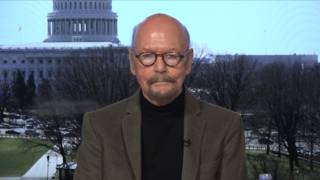
- Juan Manuel Garcia-Passalacqua, a Harvard-educated attorney and independent political analyst in Puerto Rico. He hosts one of the islands most popular radio programs, “Analyzing With Juanma,” on Noti Uno.
Transcript
AMY GOODMAN: We’re joined by Juan Manuel Garcia-Passalacqua, who is a Harvard-educated attorney, independent political analyst in Puerto Rico, hosts one of the island’s most popular radio programs. We welcome you to Democracy Now!
JUAN MANUEL GARCIA-PASSALACQUA: It’s a pleasure to be with you, Amy and Juan, and it’s — your description is perfect. It can only be understood if everybody reads Juan’s book, Harvest of Empire. Juan, congratulations! I hear it’s a textbook now in several universities in the United States.
JUAN GONZALEZ: Yes, it is. Thank you for that, Juan. I’d like to ask you in terms of this involvement of the U.S. courts in the Puerto Rico election, what has been the reaction in the population to that, and what is its significance?
JUAN MANUEL GARCIA-PASSALACQUA: It is a very tense moment in Puerto Rico. I think it’s very similar to the situation in the Ukraine. It is the first time, as you suggested, at the beginning, it seems the nationalist revolution in 1950 where the confrontation between those waving American flags and those waving Puerto Rican flags have ended up in some instances of violence in which some people are knocking over the head of the others with their respective flags. So, it is a very serious critical moment, and the situation here is tense, very tense.
AMY GOODMAN: Explain the issue, what it means to go into U.S. courts and how historic you think this moment is?
JUAN MANUEL GARCIA-PASSALACQUA: Well, the president is studying the elections of 1980. Exactly the same situation happened, and the American courts decided in 1980 to give what is known as the Doctrine of Due Deference to the Supreme Court of Puerto Rico, and therefore the decision of the Supreme Court of Puerto Rico prevailed. At this moment, no one knows whether the Supreme Court of the United States, this Supreme Court, which is certainly not the Supreme Court of 1980, will adopt the same theory and uphold the decision of the Supreme Court of Puerto Rico, or whether it will take jurisdiction and declare the ballots null and void. So, the hearing in Boston is just one more step towards a decision by the Supreme Court of the United States that in my estimation, based on my experience, since Judge Rehnquist is sick, may end up being four to four.
JUAN GONZALEZ: In other words, what’s happened is that the Pro-Statehood Party, very much like the George Bush and the Republican Party in 2000 feel that their best chance is for a solution that would put them in power, would be through the federal courts and the Supreme Court, rather than the local courts, just as the democrats were hoping in 2000 to keep the fight at the Florida Supreme Court level where they felt they had a better shot.
JUAN MANUEL GARCIA-PASSALACQUA: Exactly, Juan, exactly. But it’s a more profound issue, because since we’re not a state and we don’t have participation in the electoral college, the issue really boils down to whether Puerto Rico is or is not part of the American federal system. And the Supreme Court of the United States in 1922 in the case of Balzac v. Puerto Rico said that Puerto Rico is pertinent to but not part of the federal system of the United States. This race is the whole issue of the relationship between Puerto Rico and the United States, that again in my estimation will end up in a Supreme Court of the United States evenly split 4-4.
JUAN GONZALEZ: If the Supreme Court were split 4-4, would that leave the Puerto Rico Supreme Court decision standing?
JUAN MANUEL GARCIA-PASSALACQUA: Exactly. Exactly.
JUAN GONZALEZ: And in terms of again the public response, have there been mobilizations on the island?
JUAN MANUEL GARCIA-PASSALACQUA: Yes. Every day. Every day.
JUAN GONZALEZ: Could you talk a little bit about that? Because as part of the general blackout of news on international issues, we rarely get reports in the U.S. press about what’s going on in Puerto Rico.
JUAN MANUEL GARCIA-PASSALACQUA: Well, wait until it gets to the Ukraine point of boiling and then you will see it in the front pages everywhere. As a matter of fact, yesterday I saw correspondents from both The New York Times and The Washington Post here, and we discussed this issue. Last week, the Wall Street Journal issued an editorial supporting the statehooders. So we’ll see what The New York Times and Washington Post do Sunday, they promised me it would be a front page story on Sunday.
AMY GOODMAN: What about what you said at the top of the program, that this could lead to civil disobedience by a huge number of Puerto Ricans?
JUAN MANUEL GARCIA-PASSALACQUA: Yes. The Popular Democratic Party has convened an assembly on Sunday, in which the information that I have, and it’s a reliable source, says that already a resolution has been drafted calling all those opposing statehood to go into the streets in civil disobedience against obeying the order of the United States Circuit Court. So it begins on Sunday. It’s going to be rough.
JUAN GONZALEZ: And participation in this election, I think most Americans who see a little — low-level participation here would be surprised at how involved Puerto Ricans are in their electoral process. What was the participation rate this time?
JUAN MANUEL GARCIA-PASSALACQUA: Exactly, Juan. 8 of every ten registered voters participated in the elections. 80%, and the margin of the decision was less than 1%. Here we have a situation in which, and again in my estimation, 8 American judges will weigh more than 2 million Puerto Rican voters. And that, Juan, has only one sentence to adjudicate it. This is the harvest of empire.
AMY GOODMAN: Well, I want to thank you very much, Juan Manuel, for joining us. Juan Manuel Garcia-Passalacqua talking to us from Puerto Rico about the race for the governorship. It still has not been decided, and we’ll continue to follow that story.



 Top
Top
Media Options