










 Watch Full Show

Related
Topics
Guests
- Greg PalastInvestigative reporter with the BBC and the author of the Best Democracy Money Can Buy. He recently wrote an article titled “Khan Job: Bush Spiked Probe of Pakistan’s Dr. Strangelove, BBC reported in 2001
- Tariq AliAuthor of several books including Bush in Babylon: The Recolonization of Iraq_. He is also the editor of “_New Left Review”:
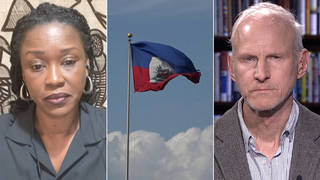
Armed gangs captured Haiti’s second-largest city Cap-Haitien and are threatening to march on the Haitian capital Port au-Prince within 15 days. We go to Haiti to hear a report from the ground. [includes transcript]
Gangs of armed groups captured Cap-Haitien, Haiti’s second-largest city on Sunday claiming their biggest victory in weeks-long violence that has driven government forces from half the country.
Gang leader Guy Philippe told the Associated Press “I think that in less than 15 days we will control all of Haiti” and fears are increasing that the democratically-elected government of Jean Bertrand Aristide could soon be overthrown in a violent coup d’etat.
A total of 12 known people were reportedly killed in a gunbattle when a force of about 200 insurgents met slight resistance at the Cap-Haitien airport.
All four police stations in the city were looted and set on fire, while hundreds of prisoners were reportedly set free.
A day earlier, Aristide accepted a U.S.-backed peace plan in which he would remain president with diminished powers, sharing a government with his opponents. The opposition reacted coolly to the proposal saying any plan must include Aristide’s resignation. They will make an official announcement later this afternoon.
- Kevin Pina, an independent journalist and filmmaker who has spent the past 4 and a half years living and working in Haiti. He joins us from the Haitian capital Port au-Prince.
Related Story
 StoryApr 03, 2024Haitians Resist Foreign Intervention as U.S. Pushes for Unelected “Transition Council” to Rule Island
Transcript
AMY GOODMAN: We go for a previous report from Kevin Pina in Port au-Prince, Haiti.
KEVIN PINA: Good Morning.
AMY GOODMAN: It’s good to have you with us.
KEVIN PINA: It’s clear as you said yesterday, there was an attack in the second largest city of Haiti, Cap-Haitien. We are receiving sporadic reports that the Jodel Chamblain and the paramilitary death squads attacked the main police station, set it afire and apparently withdrew. At the same time, it appears that the Haitian police have fled in their paths. I spoke last night with someone who is responsible for the presidential security in the palace. He had said there’s a lot of money that’s being thrown around right now. Several policemen have returned from Cap-Haitien and said several come raids have actually received sums of cash in order to abandon their posts. I cannot confirm that, but later this afternoon, they’re going to try to set up an interview with the policemen who are making that allegation.
At the same time, the Haitian government has all but directly accused the Dominican Republic, and by extension the United States of having aided and abetted and certainly having harbored Guy Philippe and Jodel Chamblain. Guy Philippe is the former head of the Haitian police in Cap-Haitien and Jodel Chamblain is the former second in command of FRAPH, the Front for Advancement. Which was created to forestall Aristide’s return in 1994. They are making this accusations citing the fact that Philippe and Chamblain and large contingents of armed former military and FRAPH were able to come from across the Dominican border. They also claim that last May 6, there was the largest hydroelectric facility in the country which was attacked by forces that crossed from the Dominican Republic into Haiti. They shut down the hydroelectric facility. The next day, the Dominican authorities arrested Guy Philippe. One day later, May 8, they released him again citing there was not enough evidence. The Haitian government believes that what the Dominican government has been doing is harboring and aiding and abetting what they consider to be the terrorists, who have used the Dominican Republic to make armed incursions across the border, and assassinating officials and returning to the safe haven of the Dominican Republic.
AMY GOODMAN: We just have 15 seconds. I want to ask about today, the U.S.-backed peace plan that Aristide says he will accept. Opponents say they won’t unless Aristide resigns.
KEVIN PINA: Well, they have been giving signals they are not going to accept anything short of his resignation. At the same time, President Aristide has made it clear that if he were to resign, it would only — he believes it would only open up another period of coup d’etat in the country. He believes the best way to establish democratic conditions in the country is for him to return to office.
AMY GOODMAN: Guy Philippe says within 15 days he will have taken Port au-Prince.
KEVIN PINA: I don’t know if that’s possible. Certainly not without a lot of deaths. I don’t believe that they’re going to go gentle into the night.
AMY GOODMAN: I want it thank you for being with us. We’ll continue to follow the story. That was Kevin Pina, reporting from Port au-Prince, Haiti. This is Democracy Now!.



 Top
Top
Media Options