








 Watch Full Show

Related
No charges have yet been brought against former Enron chairman Ken Lay who was a close friend of President Bush and a major Republican campaign contributor, while Martha Stewart, who is a major Democratic contributor, faces up to 20 years in prison for lying to a federal investigator. [includes transcript]
The Bush presidency has been marked by war. The invasion and occupation of Afghanistan and Iraq and now the apparent overthrow of Jean-Bertrand Aristide in Haiti. But these three years have also been marked by rampant corporate crime. Enron, Tyco, Adelphia, WorldCom have all become household names. The Bush administration has said that it is a priority of the president to crack down on corporate crime. But most of the CEOs and corporate officials responsible for the collapse of huge companies and the loss of thousands of jobs walk the streets with no criminal charges and no jail sentences hanging over their heads.
No charges, for instance, have been brought against Ken Lay, who was chairman of Enron when its $9 billion collapse in 2001 ended the jobs of more than 5,000 workers and decimated the retirement savings of millions of investors. Lay is a close friend of Bush and a major Republican campaign contributor. In fact, Lay was one of his closest advisers, one of his “pioneers,” raising hundreds of thousands of dollars for Bush’s campaign. After Enron collapsed, Kenny Boy—as Bush referred to his friend—became Mr. Lay.
Instead, the poster-child for this new crack-down on corporate crime is Martha Stewart. She is facing up to 20 years in prison after a jury found her guilty on all charges last week for covering up her sale of ImClone stock just before the price plummeted. Quite the opposite of Lay, who is deeply tied to the Republicans, especially the Bushes, Martha Stewart is a major contributor to the Democrats. She has given more than $150,000 in political contributions—all of it to the Democrats. This according to United Press International.
The Stewart decision was frontpage news across the country. Headlines screamed “Martha Stewart convicted on all counts in stock-trading trial.” But what many people don’t know is that the government did not charge Stewart with insider trading. In addition, the judge threw out the most serious charge in the case–securities fraud. So what was Martha Stewart guilty of?–Basically, of lying to a federal investigator. The law, which lawyers usually call 1001, for the section of the federal code that contains it, prohibits lying to any federal agent, even by a person who is not under oath and even by a person who has committed no other crime.
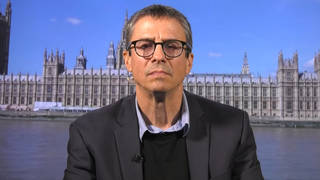
- * Harvey Silverglate*, a criminal defense and civil liberties attorney based in Cambridge, Mass.
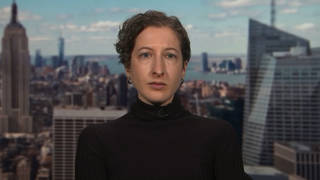
- Elaine Lafferty, Editor-in-Chief of Ms. Magazine.
- Bethany McLean, co-author of “Smartest Guys in the Room: The Amazing Rise and Scandalous Fall of Enron.” She is also a staff writer for Fortune magazine.
Related Story
 StoryApr 11, 2024“We’re Responsible for This”: American Surgeons Return from Gaza, Call for End of U.S. Culpability in Genocide
Transcript
AMY GOODMAN: We turn first to Harvey Silverglate, who is a civil liberties attorney based in Cambridge, Massachusetts. Welcome to Democracy Now!
HARVEY SILVERGLATE: Good to be on.
AMY GOODMAN: Can you explain what this rule or law is?
HARVEY SILVERGLATE: Yes, it is a statute that has been on the books for decades, which makes it a serious felony, punishable by up to five-years in prison to lie to a federal official. And what is crucial to understand is that the lie can be told without being put under oath. That is, it is simply a lie that’s told in ordinary conversation, rather than in a formal setting where you’re put under oath and you’re told that you have to tell the truth, otherwise you’ll be punished. So, you have no warning, no oath, no particular solemn setting, any conversation that you have. Now the only restriction is the lie has to be material to some federal investigation. That is to say if you meet with an investigator, and you say, “It’s raining out today,” and it’s not raining, it turns out that has nothing to do with the investigation, that is not a material lie. But anything you lie about in relation to the investigation becomes a felony and this is a statute that has been used, abused, and misused for decades in a lot of contexts, not just the Martha Stewart-type investigation.
JUAN GONZALEZ: So, in other words, you don’t have to have actually already been read your rights by a federal agent. If you just misrepresent something material to an investigation that he or she is conducting, you can be in violation of this law?
HARVEY SILVERGLATE: That is correct, and it is the lack of a warning that makes the statute particularly dangerous. And I should point out it was used in the Martha Stewart case this year. It has been used in the past against political dissidents, who were incautious enough to speak to an investigator and later claimed to have lied. Now you find it popping up in connection with the interview of people in national security and terrorism investigations. People who are asked whether they’ve been to certain countries, they list the countries. They leave out, let’s say, Afghanistan and then they are charged with violation of 18 U.S. Code 1001 for making a material omission. Because remember, a misstatement includes an omission. Not only an error of co-mission.
AMY GOODMAN: Harvey Silverglate is on the phone with us. This is quite astounding, just for everyday people in this country. To know that if you’re not told you are under oath, and you’re talking casually to a federal agent, whatever you say… And in the case of Martha Stewart, I would say at this point, most people would say she was accused of insider trading and she was convicted of that.
HARVEY SILVERGLATE: What is so interesting about the case is that the applicability of this case to the insider trading rules is very dubious. By that, I mean this. It is not at all clear in the criminal law that it is a crime to trade securities the way Martha Stewart did. It is not so clear that the information she had, even if one believes that her broker told her that her friend Sam Waksal, the C.E.O. of the Imclone Company, was trying to sell his stock. Now there is no question Waksal was an insider, he was the head of the company. But the mere fact that he was trying to sell, it isn’t clear at all that that constituted insider information because Stewart didn’t know the reason that he was trying to sell, the reason being that the company was about to get hit by bad news. So, the government decided not to charge her with insider trading, because they probably would have lost that case. Instead, they charged her with lying during an investigation, concerning this trade, whether it was insider trading or not. So she probably didn’t commit a crime, but because they claim she lied about it during the investigation, she is guilty of a crime. And I want to point out something else that is particularly pernicious about the statute and about the way The Feds operate. They almost never tape record interviews with witnesses. What happens, if you’re visited by an F.B.I. agent, almost invariably, you’re visited by two agents, not one. Why two agents? Because one of them asks you questions, and the other one takes notes. And the agent who takes notes then goes back and…
JUAN GONZALEZ: If I could just interrupt you for one second, Harvey Silverglate, because we’d also like to bring into the conversation Elaine Lafferty, the editor in chief of “Ms.” Magazine. First of all, welcome to Democracy Now!
ELAINE LAFFERTY: Thank you. Good to be here.
JUAN GONZALEZ: And get your perspective on why you think the government targeted Martha Stewart given this pantheon of corporate criminals that we’ve been watching the past few years.
ELAINE LAFFERTY: We said Martha Stewart has never been exactly a feminist icon. She’s never made the short list for “Ms” Magazine woman of the year, so this was not a natural thing. But seeing this prosecution and conviction and seeing what’s not happened with Enron, Adelphi, Halliburton, Dick Cheney and the trades of 2000, we said we really have to speak out on a feminist basis. She is an unlikable woman to many Americans, as 55% Gallup Poll was unfavorable towards her. There is a web poll that rated her right next to Osama Bin Laden for being annoying. I think that they focused on her. I think they taped into a reserve of hostility towards a successful, powerful woman. I think they knew a jury would be inclined to look at her unfavorably, and make her the poster child for this, and then get to sell it to the public as this, “We’re going after the big corporate bad guys,” and this is a victory for the little guy, this is a victory for the little investor. In fact, I don’t think it’s that at all. I do think it sends a message, but I think the message has to do with creating a climate of fear and terrorism in this country.
AMY GOODMAN: We’re also joined on the telephone by Bethany McLean, who is author of “Smartest Guys in the Room: The Amazing Rise and Scandalous Fall of Enron.” She is a staff writer for “Fortune” Magazine. We’ve watched the fall of Martha Stewart, yet Ken Lay has not been charged. Can you explain?
BETHANY MCLEAN: Well, it’s complicated because the Enron case has been extremely complicated, where as the Martha Stewart case seemed, on the surface, somewhat straightforward. That is the sort of easy, superficial explanation for what’s happened. The Enron investigation is not over yet, I should note that, but what seems to be the case is that the government really took the opportunity to get creative and really push the limits of the law on Martha Stewart. And we have not seen that same sort of focus brought to Ken Lay, and I think that’s a travesty if Martha Stewart ends up spending time in jail for maybe saving is $50,000 on a trade. And Ken Lay who helped bankrupt a $70 billion company ends up walking away scot-free. There is something that doesn’t feel right about that. And you can extend that line of arguing to Frank Quattrone, the guys in the Tyco trial, even Bernie Ebbers of Worldcom. A couple of those cases are still ongoing. But compare the magnitude of what they did wrong versus Martha Stewart’s alleged misdeeds and it is pretty shocking.
AMY GOODMAN: In one minute on the issue of Ken Lay and the magnitude of his alleged crimes, and the lives he affected, can you sum it up for us versus what happened with Martha Stewart?
BETHANY MCLEAN: Sure. Ken Lay was the C.E.O. of Enron for most of the company’s 15, 16 years of existence. He says he was ignorant of all the things that happened at the company. But he was the C.E.O. And ignorance is a little bit of a perverse defense for a C.E.O. During the final year of Enron’s life, he was surreptitiously selling some $80 million of stock while telling the Enron Employees to buy the stock. He’s cried poor, but he is still living in a multimillion-dollar River Oaks condominium, while many Enron people lost their life’s savings in the company’s bankruptcy.
AMY GOODMAN: Last comment to the editor of “Ms” Magazine and what you’re going to be writing in your next issue.
ELAINE LAFFERTY: Well, actually, we have an open letter in support of Martha Stewart that’s up on our website right now, on Msmagazine.com and it talks a little bit about more of these issues and a little bit about the cultural hostility towards women that this prosecution and conviction has tapped into.
AMY GOODMAN: I want to thank you very much for being with us, Elaine Lafferty editor-in-chief of “Ms” Magazine, Harvey Silverglate, criminal defense and civil liberties attorney based in Cambridge, Massachusetts and Bethany McLean, author of “Smartest Guys in the Room: The Amazing Rise and Scandalous Fall of Enron.” And you are listening to Democracy Now!




 Top
Top
Media Options