






 Watch Full Show

Related
Topics
As violence escalates in Iraq, we take a look at the United Nations special envoy to Iraq, Lakhdar Brahimi’s post June 30 plan for a UN-appointed Iraqi caretaker government until national elections scheduled for January 2005. We speak with Phyllis Bennis, fellow at the Institute for Policy Studies in Washington DC. [includes rush transcript]
The United Nations special envoy to Iraq, Lakhdar Brahimi two weeks ago proposed a possible way for the US to hand over power in Iraq after June 30. Under the proposal, the US-appointed Iraqi Governing Council would be dissolved and replaced by a transitional government appointed by the UN until national elections scheduled for January 2005. The Bush administration has backed the plan, which would allow the US to remain in charge of military and security matters.
Brahimi met with the UN Security Council Tuesday and said the Iraqi caretaker government could be named by the end of May, a month ahead of the so-called handover of sovereignty from the United States.
Yesterday, Brahimi called for an end to military hostilities in Iraq, affirming that there must be a voice for the city of Fallujah in the new Iraqi government. He also said that the deteriorating security situation would not be allowed to postpone the transfer of sovereignty.
The proposed plan is running into heavy opposition from the US-appointed Interim Governing Council, most of whom would be excluded under Brahimi’s rules.
Iraqi National Congress leader Ahmad Chalabi said this week on Fox News Sunday “Mr. Brahimi is an Algerian with an Arab nationalist agenda. He already is a controversial figure in Iraq. He is not a unifying figure. He is supposed to be a unifying figure, so he can choose a government that will be effective.”
NBC has a new story out this evening which reports that members of Chalabi’s INC in Iraq are currently being investigated by the Iraqi police for abduction, robbery, “stealing 11 Iraqi government vehicles” and “assaulting police by firing on them during a search”.
- Phyllis Bennis, fellow at the Institute for Policy Studies in Washington DC, specializing in Middle East and United Nations issues. She is the author of the book Before and After: U.S. Foreign Policy and the September 11th Crisis.
Related Story
 StoryFeb 05, 2024U.S. & Israel vs. Axis of Resistance: Biden Strikes New Targets in Middle East as Gaza War Continues
Transcript
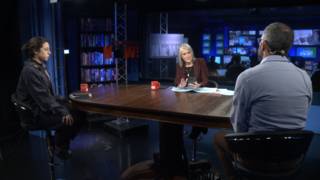
AMY GOODMAN: Phyllis Bennis joins us now, fellow at the Institute for Policy Studies. Welcome Phyllis.
PHYLLIS BENNIS: Good to be with you, Amy. Good to have you in Washington.
AMY GOODMAN: It’s great to be here. What is happening right now with Lakhdar Brahimi and the campaign, it looks like, against him. Juan Gonzalez, by the way, also in New York.
PHYLLIS BENNIS: Juan, good to be with you. There’s a huge campaign, as you say, against Lakhdar Brahimi. It emerged from the ambassador of Israel to the United Nations. The New York Times columnist William Safire has weighed in. And aside from the rather racist remarks that, 'Well, he's an Arab so you must expect this sort of thing,’ there have been specific attacks on Brahimi that he has targeted the Israeli occupation as a major problem in his work in the region as a whole. In doing so, many people, including the Israeli ambassador, Safire and others, have come out and said, 'Well, this proves that the United Nations is not neutral,' which, of course, is true. The United Nations has never been neutral on the question of illegal occupation. As any UN official should, Brahimi has come out and condemned that occupation and said that it’s making the solution of the Iraqi occupation much worse. Now, what Brahimi is proposing has several components. Some of them are very important. He has called, as you said, for the dissolution of the illegitimate governing council. That’s a major step forward from the earlier positions, the demands from the US that the governing council or an expanded version remain in power. That’s a significant advance. The real problem is the issue of sovereignty. Brahimi’s proposal — Brahimi is ultimately a very pragmatic man, a pragmatic diplomat. His position ultimately does not challenge this idea of being a little bit sovereign, which is essentially like being a little bit pregnant. A country is either sovereign or it’s not sovereign. If there are 150,000 foreign troops occupying its territory, I would say that’s not sovereignty.
JUAN GONZALEZ: Phyllis, in terms of — I mean, being from Puerto Rico, having been born there I know this issue of what is sovereignty, and what is autonomy when you have US troops on your soil. But I’d like to ask you, in some recent polls from Iraq–— even though it’s hard for me to understand how polls in Iraq, taken with so much battling and warfare going on could be valid — are indicating that many Iraqis seem to support the position of Brahimi, of possibly having this transitional phase. What do you make of that?
PHYLLIS BENNIS: I assume that many in Iraq are reacting in very much the same way that we’re discussing it today that, they believe that the US is simply not going to withdraw its troops, and therefore, the question is what level of sovereignty, what level of legitimacy could be picked out in small amounts, absent real sovereignty. I think people in Iraq are being very pragmatic, and saying what’s realistic here. If we are serious about legitimacy and we’re serious about sovereignty, in my view, that requires the end of the US occupation, not a change in its name, not saying that on June 30, we will transfer authority when there is no authority to be transferred and no one to transfer it to; but say there must be a real end to the US occupation, and then and only then, after the US occupation, could we look at the possibility of a United Nations team leading — led by the United Nations, but with the participation of the Arab League, the Organization of the Islamic Conference, the other regional organizations, to provide the Iraqis with real support for reclaiming their sovereignty. In a situation where those international forces are not trying to steal their resources, claim their oil as their own, and occupy the country, I think that the level of violence would be severely diminished. We would not see a situation where we’re told now, the UN could not answer this level of violence. Well, of course not, nor should they be expected to, but there would not be this level of violence, because the violence is directed at the occupying army. Absent the occupying army, I think it’s inevitable that the level of violence would be significantly reduced.
AMY GOODMAN: Although the UN was blown up.
PHYLLIS BENNIS: That’s right. The UN was blown up and attacked terribly. 22 staff members, including Sergio de Mello, killed last August 19, almost a year ago now. But that was in the context of the UN being seen by the Iraqis and others around the world as doing the work of the US occupation. The key is to separate those, and say that the UN is not going to send in significant — not only troops or police, but significant staff to run elections to help with economic development, all of those things, until the end of US occupation.
AMY GOODMAN: Phyllis Bennis, I want to thank you very much for being with us. Phyllis is a fellow at the Institute for Policy Studies in Washington, D.C. She’s also author of the book, “Before and After: US Foreign Policy and the September 11 Crisis.” This is Democracy Now!.



 Top
Top
Media Options