







 Watch Full Show

Related
Thousands of U.S. troops have launched a major attack on the Iraqi city of Najaf, one of the holiest cities in the Muslim world. We go to Iraq to get a report on the latest fighting and we speak with professor As’ad AbuKhalil about the U.S. assault on one of the holiest cities in the Muslim world. [includes rush transcript]
Thousands of U.S. troops have launched a major offensive in the Iraqi city of Najaf vowing to defeat a week-long uprising by supporters of Shiite cleric Moqtada al Sadr.
Tanks backed by helicopter gunships moved to seal off the revered Imam Ali Shrine in the centre of the city on Thursday. Aircraft and artillery pounded the city’s historic cemetery where militiamen have taken up positions in recent days.
Fierce fighting erupted in Najaf on Aug. 5 between U.S. troops and militants of Sadr’s Mahdi army. U.S. commanders accused the militia of launching attacks from the cemetery and swept though it, killing hundreds, according to the military. Sadr’s forces put the death toll only in the dozens. Five U.S. troops have also been killed, along with about 20 Iraqi officers.
The latest clashes broke out in the early morning today in Iraq as US forces launched the offensive after initially calling it off last night. The New York Times reports the U.S. has tripled its force around the city to some 5,000 troops. There are also a few hundred Iraqi soldiers. Using loudspeakers, troops have been warning residents to leave the area saying “To the residents of Najaf: Coalition forces are purging the city from Mahdi Army.” This according to USA Today. Thousands have fled the city. Sadr has called on his followers to keep fighting, even if he himself is captured or killed.
In what could prove to be a dangerous escalation of the conflict, the US is saying that marines have been given permission by the Najaf governor to enter the shrine of Imam Ali to launch an attack. Iraq’s interim deputy prime-minister Ibrahim Jaafari earlier called on the US to pull out of Najaf completely.
The thousand year-old mosque of Imam Ali and its nearby cemetery where hundreds of thousands of Muslims are buried is one of the holiest sites the Muslim world. Shiite leaders around the world, including Iran’s top cleric, have condemned the U.S. presence in Najaf and warned against hitting the mosque.
One Shiite told the Los Angeles Times “Any attack on that city will destroy America’s future in Iraq completely. It will completely discredit America and make it the new tyrant in the eyes of Shias worldwide.”
- Donald MacIntyre, correspondent for the London Independent. He joins us on the phone from Baghdad. He is headed to Najaf today.
- As’ad AbuKhalil, professor of political science at California State University, Stanislaus and visiting professor at UC, Berkeley. He is the author of several books, his latest is The Battle for Saudi Arabia: Royalty, Fundamentalism, and Global Power. He runs a new blog called “The Angry Arab News Service.”
Related Story
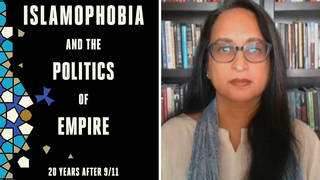
 StorySep 14, 2021“Islamophobia and the Politics of Empire”: Deepa Kumar on How Racism Fueled U.S. Wars Post-9/11
Transcript
AMY GOODMAN: We’re going to go first to independent reporter, The Independent of London, Donald MacIntyre, who is in Baghdad. He’s headed to Najaf right now. Can you give us the latest reports on what’s happening?
DONALD MACINTYRE: Well, I think to some extent, it’s more of the same, but I think what has been evident over the last few hours is that the U.S. forces have really tried to tighten this cordon that they have put around the Imam Ali compound, the mosque compound, which your report referred to, and the cemetery, which the two areas together being the base of the Shiite guerrillas who are led by Moqtada al Sadr. And what is unclear, I think, still is how far the Americans are really prepared to risk the kind of reaction your report is talking about, if they really move into, in a heavy way, the compounds of the Imam Ali shrine itself. At the moment, that does not seem to be happening. I mean, they don’t seem to be either bombarding or overrunning it in a sense that would cause enormous destruction to the shrine itself. Now, U.S. military said earlier this week that the governor of Najaf had permission to do that because the — al Sadr’s people were using it as a military base effectively, and that therefore, they had forfeited their right, really, or the right in international law to keep the American forces out of it. They now had the right. Well, although the military have said that, I think there is considerable doubt — I mean, there must be some hesitation on the part of the U.S. forces about doing this operation in that way, precisely because of the kind of worldwide Muslim reaction it would provoke. So, this is a very difficult situation, literally, for the American, if they are determined as they say they are, to keep Moqtada al Sadr’s forces.
AMY GOODMAN: Donald MacIntyre speaking to us from Baghdad, headed to Najaf today, of The London Independent.
AMY GOODMAN: Our guest is the author of several books, his latest, The Battle for Saudi Arabia: Royalty Fundamentalism and Global Power. He is running a new blog called “The Angry Arab News Service” at angryarab.blogspot.com. Welcome. Can you talk about the significance of the mosque?
AS’AD ABUKHALIL: Before I proceed, I should say there is an update from what I saw in the Arabic media before got on the phone. First, it is absolutely not clear that there is even permission by the proper Iraqi government for the U.S. forces to enter into the shrine. In fact, a high official in the ministry of interior set up by the Americans, confirmed there is no permission by any Iraqi for the U.S. forces to enter. The deputy governor of Najaf himself, handpicked by the Americans, today resigned and accused U.S. Forces of terrorism. We also should mention that for the Arab world watching and the Iraqis, there is a war outside of the confines of Najaf. U.S. forces over the last several hours have bombed various areas, Al-Kut, in Iraq, in Baghdad, as well as in Najaf. We are talking about a city of over 600,000 people living there. It’s easy to say that we can do whatever we need to do. This is of paramount importance not only for the Shiites of the world, who are some 15% of all Muslims, but this man’s shrine is also holy for all Muslims worldwide. He happens to be the son-in-law, the first male convert to Islam after Mohammed’s first wife. He is also married to Mohammed’s daughter. His lineage is considered to be extremely sacred for all Muslims worldwide. And there is even significance to the cemetery where all U.S. Forces are hunkered down. These are millions of people over the centuries of Muslims worldwide who will they want to be buried in grounds that are holy because of its proximity to the shrine. So, with all of that going on, one it imagine how Shiites and non-Shiites are reacting to the scenes of bloodshed and to the destruction occurring to the historic areas as well as the killing of innocent civilians. I mean, the United States two days ago bragged that 300 were killed in one night or two. Of course, it leads one to ask, how does the United States know they were all terrorists? I mean, do they have special devices where they can pinpoint from the air to determine who are the terrorists and who are the innocent people? Apparently not.
JUAN GONZALEZ: Professor, AbuKhalil, I’d like to ask you in terms of the potential for the battle of Najaf creating deeper schisms in the Iraqis who support the occupation. There has been talk of some provincial governors in the south separating from the occupation government. What is the potential for greater fragmentation within Iraqi society as a result of this battle?
AS’AD ABUKHALIL: I personally think that most Iraqis will work against that, and in fact a source in Sadr’s quarters yesterday denied any business like that. This was a threat issued in the various massive spontaneous demonstrations that erupted in cities in Karbala and Nasiriyah and elsewhere trying to put pressure on the Iraqi puppet government to desist from encouraging the Americans to do so. We have to say that the events in Iraq are dictated by American electoral politics, very much like the American-declared war on terrorism. The capture of somebody in Pakistan wouldn’t have gotten the attention it got if it wasn’t an election year and George W. Bush wants to get credit and make it a bigger deal than it is. Similarly, if anybody thinks there was some uprising declared and Americans are responding to it, the person hasn’t been following what’s going on in Iraq. It seems that the American forces are looking for a fight. Hoping to capture Al Sadr or kill him just before the republican convention so he can be crowned without any disturbances from Iraq. But if that was the intention, it’s going to backfire, because even if you kill Muqtada Al Sadr there is a mass movement in Iraq today and it’s putting pressure on the Shiite members of the Iraqi puppet government itself. And let us remember, that the high-flying Shiite in the government, the deputy president Ibrahim Jafaari yesterday, on Al-Jazeera itself and the selection of Al-Jazeera is significant because it was closed down by the Americans said he called on all Americans to leave Najaf entirely. In fact, the headquarters of the party of the Iraqi puppet prime minister, Iyad Allawi was burned in the city of Nasiriyah twice in the last two days. There were massive demonstrations in Karbala. Just now, the Arabic immediate are reporting about a statement put out by one of the highest Shiite authorities in the world today, Mohammad Hussein in Lebanon, also strongly condemning what the Americans are doing. And the last addition is Ayatollah Sistani’s representatives in Karbala came out strongly against the Americans calling on them to leave the city, too.
AMY GOODMAN: Let’s talk about Sistani for a minute. The “Washington Post” is reporting that some within the U.S. Military believe that Iraq’s leading Shiite cleric, the grand ayatollah Ali Sistani grave them a green light to carry out the attack on Sadr’s forces. Last week just as the U.S. attacks began, Sistani left Iraq for London, reportedly for treatment of a heart condition. The trip marks Sistani’s first trip out of Najaf in six years.
AS’AD ABUKHALIL: I wouldn’t believe that to be the case. My impression, and I interviewed a lot of people in Lebanon when I was there recently, including the head of Hezbollah, the party of god, who keeps close touch with people in Iraq. The impression I got is that ayatollah Sistani is not from as distant suburb as we are led to believe by the American press and the Americans. He told me in the last showdown that Sistani himself made it clear he would not stand for a crackdown that would lead to the American forces entering into the city of Najaf. What I read in the Arabic press is a different story. The British learned because of logistic cal preparations that Sistani was leaving for medical reasons into the United Kingdom. They told the Americans. The Americans thought they would take the opportunity of his absence in order to launch this massive attack on the city. But that’s going to backfire, because that is not going to end the movement that extends into various areas of Iraq. In fact, American commissioned public opinion services in Iraq, in the last showdown indicated that Sadr is extremely popular in areas or Shiites dominate as well as in areas where Sunnis dominate. Popularity reaches 70 or 75%. If Sistani is seen to be complicit in what is going on, I would say his leadership would be severely shattered, if not undermined. AMY GOOMAN: As’ad AbuKhalil, I want to thank you very much for being with us. Again, professor of political science at California State University, Stanislas, visiting professor now at U.C. Berkeley. His angryarab.blogspot.com, thank you for joining us.
AS’AD ABUKHALIL: Thank you.



 Top
Top
Media Options