








 Watch Full Show

Related
Topics
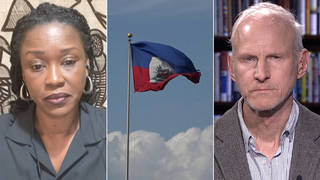
Former death squad leader Louis Jodel Chamblain who twice helped coups against Jean Bertrand Aristide was acquitted of murder in a secretive trial held during the middle of the night. We speak with Brian Concannon, an international lawyer and director of the Institute for Justice and Democracy in Haiti. [includes rush transcript]
Former death squad leader Louis Jodel Chamblain who twice helped coups against Jean Bertrand Aristide was acquitted of murder Tuesday in a secretive trial held during the middle of the night.
Chamblain was second in command of the paramilitary group FRAPH, the Front for the Advancement and Progress of Haiti. In 1991 the group overthrew Jean Bertrand Aristide’s government and went on to kill thousands of Aristide supporters.
After years in exile, he returned to Haiti earlier this year to play a key role in the February coup against Aristide, who was Haiti’s first democratically elected president.
In 1995, Chamblain and former police chief Jackson Joanis were convicted in abstentia of assassinating pro-democracy activist Antoine Izmery, who was a former justice minister under Aristide.
But this week, the convictions were overturned during the secretive proceedings. Chamblain praised the outcome, telling The Associated Press that “it was a true trial, just and equitable.”
But Amnesty International criticized the actions of the new U.S.-backed Haitian government and said, “This is a very sad day in the history of Haiti.” The U.S. State Department also publicly criticized the proceedings. A spokesperson said “We deeply regret the haste with which their cases were brought to retrial, resulting in procedural deficiencies that call into question the integrity of the process.”
Both Chamblain and Joanis remain in prison to face other charges.
- Brian Concannon, director of the Institute for Justice and Democracy in Haiti. He formerly worked at the International Lawyers Office in Haiti, where he has spent the last several years prosecuting crimes committed during the 1991-1994 coup. Among the cases he has prosecuted are those stemming from the 1994 Raboteau massacre in Gonaives for which Chamblain is facing charges.
Related Story
 StoryApr 03, 2024Haitians Resist Foreign Intervention as U.S. Pushes for Unelected “Transition Council” to Rule Island
Transcript
JUAN GONZALEZ: We are joined by Brian Concannon, who works for the International Lawyer’s office in Haiti where he spent the last several years prosecuting crimes committed during the 1991, 1994 coup. Welcome to Democracy Now!, Brian.
BRIAN CONCANNON: Thank you, Juan. It’s great to be here. If I may correct, right now I’m director of the Institute for Justice and Democracy in Haiti, which is a successor to the B.A.I. Because of the Haiti’s coup, we’re not able to do the same type of work, so we created a new organization.
JUAN GONZALEZ: Your reaction to this shotgun trial that occurred of Chamblain?
BRIAN CONCANNON: It was a no-show trial. What they did. There was plenty of evidence, they did not produce it. There were plenty of witnesses. They did not call those witnesses in. Some of the witnesses they did call were dead. Several others were out of the country or didn’t really know anything. The investigating judge didn’t do what he was supposed to do under the law. The prosecutors did not prosecute. It was clear that the intent from the beginning was that this be— that there be no risk of conviction. In fact, the justice minister hedged his bets by saying even if there was a conviction he might pardon Chamblain, but he also said that when Chamblain turned himself in back in April, the justice minister said he had nothing to hide, which was a clear sign to the prosecutor which the prosecutor obviously got.
JUAN GONZALEZ: Now, the trial started — there were conflicting reports, some that was in the middle of the night, then that it started late in the afternoon and went through late into midmorning or into the early hours of the morning. Could you talk about that?
BRIAN CONCANNON: Yeah. They started doing some of the procedural things like picking the jury in the afternoon and it stretched and they kept going until I think it was a little bit before dawn when it finally ended. Which was a serious handicap to people who wanted to monitor the trial. It was also a handicap because they announced it — usually these things are announced weeks or months in advance — they announced it unofficially a few days in advance. So, human rights groups and journalists did not have the ability to really mobilize and organize to monitor this trial, and then as it stretched into the night, a lot of people had to leave because as you know, Haiti’s streets are very dangerous places with political persecution and kidnapping and murders. And a lot of people said, yeah, I’d like to monitor the trial to see how safe it is, but I’m not going to put my life on the line for it.
JUAN GONZALEZ: It’s unheard of here in the United States for any trial, especially a murder trial, to go on through the middle of the night to reach a verdict in one day.
BRIAN CONCANNON: In Haiti, there’s actually some tradition of that, but it’s tradition that we had broken. During the democratic government when there was a serious trial, they did in fact take a break, and make sure that everybody was fresh. Because obviously, a jury, even if it’s trying to do a good job, by 4:00 in the morning, when you have been listening to testimony or watching procedures for 12 or 18 hours, you’re obviously not going to have the same powers of concentration.
JUAN GONZALEZ: I want to thank you very much, Brian Concannon, for being with us and updating us on the Chamblain trial.




 Top
Top
Media Options