





 Watch Full Show

Related
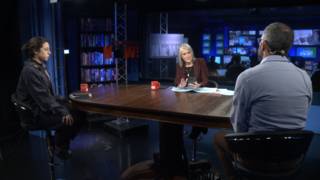
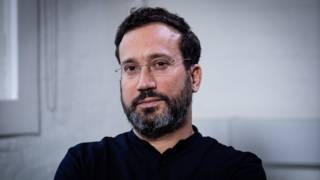
Veteran independent filmmaker Rick Rowley who has traveled around the world telling the stories of resistance movements discusses coverage of protests and the importance of independent media. His new film “The Fourth World War” produced with his partner Jacquie Soohen, premieres tonight in New York. [includes rush transcript]
In an open letter to journalists released yesterday, protest organizers urged the mainstream media to ensure fair, balanced and accurate coverage of the demonstrations at the Republican Convention.
The letter reads “We are concerned by the slant of some of the media coverage that has focused on potential violence or made unsubstantiated and sensationalist claims about the activists who will be demonstrating…”
Along with the hundreds of thousands of protesters expected in New York, well over a thousand unembedded journalists will be working out of the New York Independent Media Center.
The IMC last week published 200,000 copies of a special edition of its newspaper the Indypendent. It features guides on everything from the schedule of protests to where people can stay as well as news and analysis of the election and presidency.
- Rick Rowley, independent filmmaker and journalist who has traveled around the world telling the stories of resistance movements. Most recently, he spent several months in Iraq. He is one of the founders of Big Noise Tactical Media. His new film, produced with his partner Jacquie Soohen, premieres tonight in New York. It’s called “The Fourth World War.”
Related Story
 StoryJan 13, 2023Legendary Prosecutor Luis Moreno Ocampo on “Argentina, 1985” and Why Democracy Is at Risk Today
Transcript
AMY GOODMAN: Rick Rowley, you’re an independent filmmaker. You will be covering the protests in the streets around the convention. But you have been doing this all over the world for years. Because of the whole debate over the permit, it’s become a discussion of logistics as opposed to content. Your film The Fourth World War, is opening tonight at the Anthology theater in New York, is all about why people protest. From Argentina to Mexico, South Africa, Palestine, Korea. Can you talk about why?
RICK ROWLEY: Yeah. Well, the — I think the use of fear here in New York and in the States — and I think actually it’s amazing to see the way that movements respond in other parts of the world. I mean, like the movements in Argentina, their analysis is that fear is the tool that corporate globalization, that neo-liberalism, that this empire, it is the tool it uses to achieve political consensus, that it’s the way that it enters in, and whether it’s fear of violence in the street or whether it’s economic fear of losing your job, fear that your family won’t have a future, fear of losing your house. And that moments of uprising, the moments of uprising that we’ve documented in The Fourth World War and we try to film everywhere, are moments when that fear breaks, when collective networks of solidarity are capable of breaking that fear and of creating a space where it’s safe for people to go out and put their voice and their bodies in street against these machines.
AMY GOODMAN: I want to go to a clip of Fourth World War. This from Argentina.
NARRATOR: [clip] Something broke. Illusion that corporate globalization was going to bring us happiness, the illusion that this was democracy. But fundamentally what broke on the 19th was the last element of state terror. Those in power attempt to spread the idea in the entire population that their way of life is the only way. There is only one homogenous linear moment in which everything in the future is the same as the present and the past. You cannot hope for any kind of change; there are no ruptures in history. But there are ruptures, tremendous ruptures that shatter this dominant history. And there are no routines. There can be no predictions and things happen that no one understands.
AMY GOODMAN: A clip from Fourth World War in Argentina. And then, Rick, you go to Palestine.
NARRATOR: [clip] Occupation, curfew, settlement, administrative detention, preemptive strike, terrorist infrastructure, attrition, transfer. Their war destroys language, speaks genocide with the words of a quiet technician. Occupation means that you cannot trust the open sky or any open street beneath the gaze of their sniper towers. It means that you cannot trust the future, or have faith that the past will always be there. Occupation means you live out your life under military rule and the constant threat of death. A quick death from a sniper’s bullet or a rocket attack from an F-16. A crushing, suffocating death beneath the rubble of a bulldozed building. A slow, bleeding death in an ambulance held for hours at a checkpoint. A dark death on the torture tables of an Israeli prison. A random, arbitrary death as their tanks spray a crowd with machine gunfire. A cold, calculated death from malnutrition and curable diseases. A thousand small deaths as you watch your family die around you. Occupation means that every day you die, and the world watches in silence, as if your death were nothing, as if it were a stone falling to the earth, or water falling over water. And if you face all of this death and indifference, and keep your humanity and your love and your dignity, and refuse to surrender to their terror and despair, then you know something of the courage that is Palestine.
AMY GOODMAN: And that, the Palestinian poet Suheir Hamad together with Michael Frante. They narrate this film, Fourth World War. Rick Rowley, how you cover these resistance movements around the world from South Korea to Palestine to South Africa.
RICK ROWLEY: There’s two things to say. The first is that media is a weapon of war and that everything about the way that the corporate media covers these places, conflicts at home and abroad, participates in a military logic of terror, isolation and fragmentation. I mean, we see the war abroad shot from the noses of bombs in Iraq. We hear it narrated by generals. So as an intervention against the politics of fear and isolation, we wanted to create the possibility for an identification with people on the other side of that massive military and media machine. So we put the cameras in the streets with people who are putting their bodies on the line every day. When you go and cover a war zone or a protest, you decide before you go about whose side you’re on, whether you are with the people or the military, the people or the protesters. And then you assume the risks or it is your responsibility in as much as is possible to assume the risks of the people who you are filming with, so the corporate media films with the police, and all they risk are their souls. We film with people in the streets, and you know, I mean, I go to Palestine and I go armed to the teeth with the weapons of privilege. I come with my skin and my passport, which makes me not impossible to kill, but a lot more difficult to kill. But it’s our responsibility there to at least put our bodies and our cameras, you know, on the front lines with people. That is the least that we owe to these people who are part of our movement around the world.
JUAN GONZALEZ: And how do you deal with the limitations inherent in film itself? That you are obviously holding a camera, that whether it’s the repressive forces or those who are fighting against oppression, they see you pointing that camera at them, how do you reach a certain degree of invisibility so what you are chronicling is not in essence to some degree, whether the people realize it or not, staged?
RICK ROWLEY: Well, we don’t think of ourselves as journalists in the same kind of way. We are making collaborative media in conjunction with movements. We’re media produced in, through movements. So, this is a film that would have been impossible to make even five years ago. It was made possible through a global network of activists in movements, independent media people around the world that really has not existed before. When we arrive in a place like South Africa, the day we arrive, we’re traveling around and filming with South Africa Indymedia, which is basically a wing of the anti-eviction campaign and the anti-privatization movement is connected with grassroots movements on the ground. We go — there’s a long and really exploitive history of ethnography and a kind of film that goes down and tries to capture the indigenous heart of darkness in one place or another. We go down and we make these films as self-consciously as part of a global movement that’s connected to people. Not as observers on the outside, but as participants. The message should not be the war is not 3,000 miles away. The war isn’t in some jungle or some mountain or some desert. The war is right here in the streets of New York City under our feet.



 Top
Top
Media Options