





 Watch Full Show

Related
Topics
At her confirmation hearing for Secretary of State, Condoleezza Rice was questioned about the situation in Haiti and the 2004 coup d’etat that ousted the democratically-elected President Jean Bertrand-Aristide. We play an excerpt of the hearing and speak with Larry Birns of the Council on Hemispheric Affairs. [includes rush transcript]
At the hearing, Rice was also questioned about another country in the Western hemisphere: Haiti. Last year the democratically-elected president of Haiti, Jean Bertrand Aristide, was overthrown in what he calls a modern-day kidnapping in the service of a coup d’etat backed by the United States.
Since then, the situation in the country has deteriorated rapidly under the new, unelected government, which the Caribbean Community bloc CARICOM refuses to recognize.
A new report released by the Center for the Study of Human Rights at the University of Miami School of Law describes the situation like this “Haiti’s people churn inside a hurricane of violence. Gunfire crackles, once bustling streets are abandoned to cadavers, and whole neighborhoods are cut off from the outside world. Nightmarish fear now accompanies Haiti’s poorest in their struggle to survive in destitution. Gangs, police, irregular soldiers, and even UN peacekeepers bring fear.”
At Rice’s Senate confirmation hearing yesterday, Democratic Senator Bill Nelson of Florida was one of those who questioned her about Haiti.
- Sen. Bill Nelson (D-FL) questioning Secretary of State nominee Condoleezza Rice about the situation in Haiti, January 18, 2005.
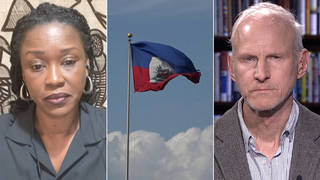
- Larry Birns, Director of the Council on Hemispheric Affairs in Washington DC.
Related Story
 StoryApr 03, 2024Haitians Resist Foreign Intervention as U.S. Pushes for Unelected “Transition Council” to Rule Island
Transcript
AMY GOODMAN: Well, at Dr. Rice’s Senate confirmation hearing yesterday, democratic Senator Bill Nelson of Florida, was one of those who questioned her about Haiti.
SENATOR BILL NELSON: Elsewhere in the hemisphere, and you can appreciate this, since I represent the State of Florida, Haiti is a disaster. And it’s going to continue to be a disaster until we get engaged and do something seriously, along with particularly the other nations of the western hemisphere, financially and politically to help them. I have had a difference of opinion with the administration. I think you did have a policy of regime change, and although Aristide was a bad guy, you know, it’s kind of hard to say we support democracy and elections and then we go and push him out, but that’s done. Looking forward, we’re getting close to the authorized support now under the U.N. peacekeeping force of 6,700 military and 1,600 civilian police. Do you think that’s an adequate number?
CONDOLEEZZA RICE: Well, I believe that the number that has been determined, 6,700 or so, led by Brazil, as a stabilization force now after the initial stabilization was done by the United States and the French and others, is judged to be adequate to the task. The question has really been about more what can that force do. I think the expansion a bit of a more aggressive stance by that force in going into areas that are particularly violent and dealing with the violence and the militias in those areas is probably really the question that we have to deal with. I’m glad, Senator, you mentioned the police forces, because in the long run, what really will help Haiti is that it needs a professional, civilian police force that can be counted on to enforce law, not to break law. And we have, as you well know, dispatched civilian police trainers from the United States, and from other places, to try and engage in that activity. But I agree completely. Unfortunately, Haiti seems to be a place where natural and manmade disasters have come together in a really terrible way for the Haitian people. They do have a new chance now. They have a transitional government that is trying to arrange elections in the fall. We need to support that process.
AMY GOODMAN: Condoleezza Rice talking about Haiti. She went on to talk about the economy and trade issues of Haiti.
CONDOLEEZZA RICE: I think we believe at this point that the best course with Haiti is to work with them to take full advantage of the Caribbean Basin Initiative, to work with them on job creation through some of the programs that we have out of our economic support fund for Haiti. They — they will benefit in a — in a secondary way from what happens in Central America with trade, if CAFTA can be taken — can be passed. So, at this point, we think we have the right tools. We just have to make it work. I understand fully the concerns about Haiti both from a humanitarian point of view and also from a stability point of view. We probably dodged a bullet in the earlier days with the ability to get Aristide out peacefully, because he had lost the ability to control that country, to govern authoritatively in that country, but we have a lot of work ahead of us in Haiti. I would be the first to admit it.
AMY GOODMAN: Dr. Rice being questioned about Haiti. She was being questioned by Florida democratic Senator Nelson. Larry Birns of the Council on Hemispheric Affairs, your response.
LARRY BIRNS: Well, my response to all of the testimony that we have seen is it’s kind of literate gobbledy gook. For example, she talks about we are supporting a democratic revolution in Latin America, when, in fact, in El Salvador, in Bolivia, in Ecuador, Nicaragua, the U.S. ambassadors on station told the political parties, yes, we are in favor of free elections, but we want the party that we favor to win; if it doesn’t win, we cut off all aid. In regard to Haiti, there is a totally failed, superimposed interim government, the Latortue government. There is a minister of justice, who is really the minister of injustice. You talk about a failed state under Aristide. In fact, the United States froze all aid to Haiti, and wouldn’t even send riot control gear to Aristide. He did not have the weapons to defend himself against a resuscitated military force of the old Haitian military under the military junta that ruled from 1991 to 1994. This junta was approaching — these forces were approaching Port-au-Prince, and Colin Powell said we will not permit a gang of thugs, the military, to overthrow a constitutional president, which is precisely what he allowed to happen.
AMY GOODMAN: And Condoleezza Rice’s direct involvement in dealing with, even pressuring the prime minister of Jamaica not to keep — allow Aristide to stay there.
LARRY BIRNS: Yes, yes. That was when Aristide was allowed to visit Haiti — Jamaica for 30 days. She described that as an unconstructive act. Unmitigated — that is, unremitting pressure was brought upon the prime minister to get rid of Aristide.
AMY GOODMAN: Larry Birns of the Council on Hemispheric Affairs. We thank you for being with us. We will continue to cover the Rice hearings tomorrow on Democracy Now!, as well as the confirmation hearings of others in President Bush’s cabinet.



 Top
Top
Media Options