








 Watch Full Show

Related
Several dozen government officials have vacated their posts since the Bush administration took office. We speak with Nick Turse about some of the more well-known figures who compile the list of “the fallen.” [includes rush transcript]
As the possibility that officials high up in the Bush administration face indictments this week, we take a look at other officials who were forced out or resigned because of the stances they took against policies of the administration. In an article posted on TomDispatch.com, titled the “Fallen Legion,” writer Nick Turse compiled a list of these people and their reasons for leaving. Nick writes about “a seemingly endless and ever-growing list of beleaguered administrators, managers, and career civil servants who quit their posts in protest or were defamed, threatened, fired, forced out, demoted, or driven to retire by Bush administration strong-arming. Often, this has been due to revulsion at the President’s policies — from the invasion of Iraq and negotiations with North Korea to the flattening of FEMA and the slashing of environmental standards — which these women and men found to be beyond the pale.”
- Nick Turse, associate editor of TomDispatch.com. His most recent article is titled “The Fallen Legion: Casualties of the Bush Administration.”
Here are some of the names of those listed at TomDispatch.com. The complete list of 42 officials can be found at the website.
- Bunnatine (“Bunny”) Greenhouse, the top official at the U.S. Army Corps of Engineers in charge of awarding government contracts for the reconstruction.
- Richard Clarke, he held the position of the president’s chief adviser on terrorism on the National Security Council — a Cabinet-level post.
- Paul O’Neill, served nearly two years in George W. Bush’s cabinet as Secretary of the Treasury.
- Flynt Leverett, Ben Miller and Hillary Mann: A Senior Director for Middle East Affairs on President Bush’s National Security Council (NSC), a CIA staffer and Iraq expert with the NSC, and a foreign service officer on detail to the NSC as the Director for Iran and Persian Gulf Affairs.
- Larry Lindsey: A “top economic adviser” to Bush.
- Ann Wright: A career diplomat in the Foreign Service and a colonel in the Army Reserves.
- John Brady Kiesling: A career diplomat who served four presidents over a twenty year span.
- John Brown, 25 veteran of the Foreign Service.
- Rand Beers, he National Security Council’s senior director for combating terrorism.
- Anthony Zinni: A soldier and diplomat for 40 years, Zinni served from 1997 to 2000 as commander-in-chief of the United States Central Command in the Middle East, called back to service by the Bush administration to assume one of the highest diplomatic posts, special envoy to the Middle East (from November 2002 to March 2003).
- Eric Shinseki, the Army’s chief of staff
- Karen Kwiatkowski: A Lieutenant Colonel in the Air Force who served in the Department of Defense’s Near East and South Asia (NESA) Bureau in the year before the invasion of Iraq.
- Charles “Jack” Pritchard: A retired U.S. Army colonel and a 28-year veteran of the military, the State Department, and the National Security Council, who served as the State Department’s senior expert on North Korea and as the special envoy for negotiations with that country.
- And more…
Related Story
 StoryApr 16, 2024Yanis Varoufakis Banned from Germany as Berlin Police Raid & Shut Down Palestinian Conference
Transcript
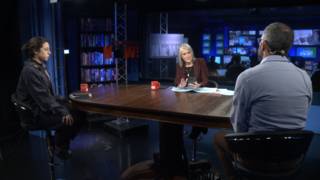
AMY GOODMAN: Nick Turse is the Associate Editor of TomDispatch.com, and then I wanted to get Mel Goodman’s response to this. Nick, can you go through the list?
NICK TURSE: Thanks so much for having me in, Amy. You know, basically at TomDispatch.com, we put together a list of 42 individuals, to start, who were either forced out or quit in protest. These are people from across the government. This is the full spectrum, from the intelligence agencies to the military, State Department to the E.P.A. and the Forest Service, just about every level of government.
AMY GOODMAN: You call them the “Fallen Legion.” Go through some of them.
NICK TURSE: Some of the best known, I’ll start with Richard Clarke, perhaps the best known of them. He was the President’s chief advisor on terrorism on the National Security Council, but he became disillusioned at what he said was the, quote, “terrible job of fighting terrorism exhibited by the Bush administration,” and he ended up quitting in protest. There was Paul O’Neill, who was the Secretary of Treasury, but when he opposed the President’s tax cuts, he was asked to resign. Flint Leverett, Ben Miller and Hillary Mann were senior officials on the National Security Council, and they ended up locking horns with Elliott Abrams, Bush’s N.S.C. advisor on Middle Eastern affairs. Basically what they said was that the administration was going to renege on commitments to European and Arab partners. And they just couldn’t live with that, so they were basically given the choice to be fired or resign.
AMY GOODMAN: So they were forced out by a man who was convicted of perjury in the Reagan-Bush years?
NICK TURSE: Yes, that’s right.
AMY GOODMAN: Elliott Abrams.
NICK TURSE: Yes. There were very principled career diplomats for the foreign service. Ann Wright, she resigned on the day that the U.S. launched the Iraq war. She wrote in her letter of resignation to Colin Powell that the administration’s policies were making the world more dangerous and not safer place. John Brady Kiesling, a career diplomat, he served four presidents over a 20-year span. And on the eve of the invasion of Iraq, he tendered his resignation and said that the policies that we’re now asked to advance are incompatible, not only with American values, but also with American interests.
AMY GOODMAN: You also mention Larry Lindsey. Some might remember him, the “top economic adviser” to Bush, who was ousted when he revealed to a newspaper that a war with Iraq could cost $200 billion. Haven’t we passed that point now?
NICK TURSE: Yes.
AMY GOODMAN: Mel Goodman, as you listen to this list — it goes on. John Brown, the veteran of the Foreign Service who served in London, Prague, Krakow, Kiev, Belgrade, resigned from his post. Rand Beers, the National Security Council’s senior director for combating terrorism, resigned. He declined to comment but one former intelligence official noted, “Hardly a surprise. We’ve sacrificed a war on terror for a war with Iraq. I don’t blame Randy at all,” he said. Anthony Zinni, a soldier and diplomat for 40 years, served 1997 to 2000 as Commander-in-Chief of the U.S. Central Command in the Middle East. The retired Marine Corps general was then called back to service by the Bush administration to assume one of the highest diplomatic posts. He said, in the lead-up to the Iraq war and its later conduct, “I saw, at a minimum, true dereliction, negligence and irresponsibility; at worst, lying, incompetence and corruption.” I leave you, Mel Goodman, with the last word on this “Fallen Legion.”
MELVIN GOODMAN: Well, the real hero on the list for me is Ann Wright, and I don’t think many people in the country know who Ann Wright is. She’s a former military officer and Foreign Service officer. She was in the Airborne. She took all of the toughest diplomatic assignments. And when she left, she did write an important letter of resignation. But she has never gotten her day in court, in terms of the press really making an attempt to understand, who is Ann Wright? And why did she leave? And why would someone who really didn’t have an axe to grind, other than the fact that she wanted to tell truth to power and that the Bush administration was misusing power.
The sad thing about the list, and it’s an important list, and this is good work to put it together, is the resignation that didn’t take place. And that’s Colin Powell. So, you have the great American story. And Colin Powell is that. But he’s always going to have to live with the fact that he used the phony intelligence that the C.I.A. prepared for him, and he had to know that some of this was really bogus, that he was really stretching a point. And he had John Negroponte, the U.N. ambassador, sitting behind him, along with George Tenet, while these lies were told to an international community, therefore jeopardizing American credibility.
AMY GOODMAN: Mel Goodman, Nick Turse, I want to thank you both for being with us



 Top
Top
Media Options