









 Watch Full Show

Related
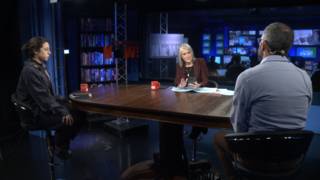
Village Voice columnist Nat Hentoff and law professor Jamin Raskin discuss the case of Terri Schiavo, who died today (shortly after we went off the air). Two weeks ago courts order the removal of the feeding tube of the brain-damaged woman sparking a national debate. In a new column Hentoff wrote, “For all the world to see, a 41-year-old woman, who has committed no crime, will die of dehydration and starvation in the longest public execution in American history.” [includes rush transcript]
Terri Schiavo has just died after going two weeks without any nutrition or hydration and her parent’s legal options are virtually gone. Yesterday, they faced another setback when the U.S. Supreme court for the 6th time denied their request for an emergency order allowing her feeding tube to be reinserted while they further appealed the case. Earlier in the day, a federal appeals court turned down their latest effort to have their case reviewed and the feeding tube reinserted. One of the judges in the 11th Circuit Court of Appeals wrote in a separate opinion that he believed that the special law hastily passed by Congress on March 21and immediately signed by President Bush, allowing Schiavo’s parents to seek federal review is unconstitutional and violates the principal of separation of powers.
It is the first time in the long legal drama that any judge has described the Schiavo legislation in such terms. Judge Stanley Birch wrote, “It is my judgment that despite sincere and altruistic motivation, the legislative and executive branches of our government have acted in a manner demonstrably at odds with our Founding Fathers” blueprint for the governance of a free people–our Constitution.” Judge Birch added that the courts “are without jurisdiction in this case.”
In recent days, a number of progressive figures have come out in one way or another against the removal of Terri Schiavo’s feeding tube and the denial of water. Among them, the Rev. Jesse Jackson and Ralph Nader. We are joined on the phone by long time Village Voice columnist Nat Hentoff. In his latest piece in the Village Voice, he calls the Terri Schaivo case judicial murder and the longest public execution in history. We are joined now by Nat Hentoff and American University law Professor Jamin Raskin.
- Nat Hentoff, author of the “The War on the Bill of Rights and the Gathering Resistance” and syndicated columnist who frequently writes on First Amendment issues for the Village Voice, Editor & Publisher and other publications. His latest column is “Terri Schiavo: Judicial Murder”
- Jamin Raskin, professor of Law at American University.
Related Story
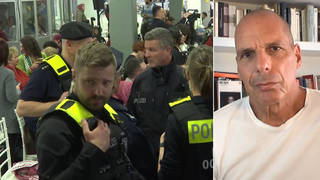
 StoryApr 16, 2024Yanis Varoufakis Banned from Germany as Berlin Police Raid & Shut Down Palestinian Conference
Transcript
AMY GOODMAN: We are joined on the phone by long time Village Voice columnist Nat Hentoff. In his latest piece in the Voice, the Village Voice, he calls the Terri Schiavo case judicial murder and the longest public execution in history. Nat Hentoff is with us, as well as American University law professor Jamin Raskin. Let’s begin with Nat Hentoff. Well, tell us where you stand at this point and why you feel that this is judicial murder. Nat Hentoff?
NAT HENTOFF: …comparing the opinions, two of them said it is fully within Congress’s power to dictate standards of review for federal courts. Indeed if Congress cannot do so, the fate of hundreds of federal statute would be called into question, and I’m sure you all remember that during the Civil Rights period, when the states court were conducting malfeasance, it was only the federal courts that intervened. Now you ask where I stand now. I have been covering the disability rights beat for many years. This is a disability rights case much more than a “right to die” case. One of the areas in which the media in all of its various forms have been really functioning lazily in covering this, very few people I think know that just about every major disability rights organization filed legal briefs in support of Terri Schiavo. The problem here has been a systemic failure, particularly of the media. The polls, for example, most Americans agree with the husband, etc., and with the courts’ decisions, but the phrasing of the questions are, for example, she is in a — she is without any kind of cognition. She is on life support. She was never on life support, it was just one feeding tube. So my concern has been that this is going to affect who knows how many people including me, you, and other listeners. I don’t know if you saw this front page story in the Times a few days ago. Increasingly — you know, there is talk of living wills. Increasingly, many hospitals and bioethics committees are ignoring living wills under the futility doctrine. They figure as professionals they know better than what the patient wanted or what their relatives wanted. My advice, unsolicited to people, is get a durable power of attorney, not a living will. That means that you trust somebody to make those decisions for you. But I’m really — I have — you know, I cover a lot of stories. I’m not part of the Christian right. I’m a Jewish atheist. I think I have a civil liberty’s record. And the disinformation that has come out of this, if we had time, I would give you a long list of the conflicts of interest of Michael Schiavo, not only that he is living with another woman and has two children. He has violated a long list of regulations in the state of Florida for a guardian. He has been her guardian. And the judge in this case, George Grier, the circuit court judge, on whose ruling all of the rest of these decisions have been made has ignored all of these violations, and as for the judge’s determination that Terri Schiavo is in a persistent vegetative state, there is a very interesting court record exchange when he made that decision. They were — testifying had been five neurologists. Two were appointed by the parents of Terri Schiavo, two by Michael Schiavo, and one by the judge. And it was 3-2. Three said she is, two said she is not in a persistent vegetative state. So, at the time her Guardian ad Litem, Terri Schiavo’s guardian said to the judge that that’s not clear and convincing evidence. The State of Florida needs clear and convincing evidence, that’s a high standard. The judge was not interested, just as he refused to consider a testimony under oath from one of her best friends, and I covered this one a year and a half ago, she and Terri were watching a documentary on the Karen Ann Quinlan case, as Michael Schiavo says they were, as well, and Schiavo said, oh, she — Terri said, “I don’t want to be in a state like that.” Her friend says just the opposite. What I’m saying here is Ralph Nader said, “This case is rife with doubt.” So one of the things missing has been due process, the basis of our whole system.
AMY GOODMAN: Well let’s take that issue, due process. Jamin Raskin, you are a law professor at American University. What is your concern in this case?
JAMIN RASKIN: Well, let me first say that Nat Hentoff, whom I respect a lot, obviously knows a lot of the details of this case. So I speak from the perspective of someone who has followed it only in the newspapers.
NAT HENTOFF: A-ha! Jamie, you know better. Jamin Raskin is the leader of student rights and civil liberties for students, and I got to give him credit for that. But go ahead.
JAMIN RASKIN: Well, thanks for that, Nat. But here is my concern. I think everybody agrees that if someone has a living will or has given durable power of attorney to someone else, then we know precisely what to do. And lots of people get into that situation.
NAT HENTOFF: Jamie, don’t get yourself into a living will. If you want to call me later, I will tell you what is going on in hospitals around the country. But go ahead.
JAMIN RASKIN: Okay, well, in any event, a lot of people get into this kind of situation without making any expressed instructions as to what should be done. It has come out in the last few days, for example, that Tom DeLay’s father was in this situation after being in a terrible accident, and the family made the decision to withhold life extending care, because they were told that there was no hope. And lots of people get into that situation. It is a common situation to be in. Now in the Schiavo case, I guess what I’m curious about is the claim that there hasn’t been due process. You know, there have been more than a dozen courts that have looked at this at every level. I mean, regardless —
NAT HENTOFF: But they haven’t done a de novo review. They just took what Grier said. That’s the problem here.
JAMIN RASKIN: Right, but I mean, the federal courts did hear the claim that the state courts had not acted properly, and —
NAT HENTOFF: What did they know if they didn’t look into the facts of the case?
JAMIN RASKIN: Okay, now my question for you would be this, which is —- Your position seems to be based on the idea that Judge Grier and the panel of doctors who looked at it, who said she was in a persistent vegetative state and was permanently brain damaged -—
NAT HENTOFF: Again, two — three of them, and I have interviewed neurologists on both sides. I have been on this case for 2 1/2 years. And a number of them say she is not. The Florida State law says — let me finish — the Florida State law says you have to be irreversible and without any cognition at all. And at least, good Lord, by now, 35 neurologists and radiologists who have done more than read the newspapers, they have at least looked at some of the records of the case, say, “Hey, this woman is not in a P.V.S.” And another thing — I’ll end with this.
JAMIN RASKIN: Can I just finish my thought?
NAT HENTOFF: Please, let me finish. Persistent vegetative states is one of the hardest things to diagnose. The last big survey in England, there is a 43% error rate. So this is very, very amorphous, and one life is at stake.
JAMIN RASKIN: Now, let me just ask you, if the trial court judge was correct —- just assume hypothetically the trial court judge was correct, and the doctors were correct -—
NAT HENTOFF: Which doctors?
JAMIN RASKIN: The majority of doctors who said that she was in a persistent vegetative state, which has been the ruling that has been upheld by every court that has looked at it. If they are correct —- I understand that you believe they are not -—
NAT HENTOFF: I know they’re not.
JAMIN RASKIN: But if they were correct, would you agree they’re doing right thing? If they were correct.
NAT HENTOFF: If… you know, forget even the federal legislation —
AMY GOODMAN: We have five seconds.
NAT HENTOFF: Wait a minute. Wait a minute. If any of the judges on the appellate level had said, well, we have to look again at the case, look — have another hearing, that’s all that was really required here is another —- the conflict of interest of judge Grier is a whole other story. If you ever saw Jack Nicholson’s movie Chinatown, he and Felos have been a part of a “right to die” movement in Florida for a long time. Felos -—
AMY GOODMAN: Nat, we’re going to have to leave it there, because we have come to the end of the show. But we would like to have you both back on to continue this discussion, because there is a lot to talk about. Nat Hentoff, author of The War on the Bill of Rights and the Gathering Resistance, attorney Jamin Raskin of American University.




 Top
Top
Media Options