









 Watch Full Show

Related
New details have emerged concerning the timing of John Roberts’ interviews for his Supreme Court post with senior Bush administration officials which call into question his impartiality in a crucial case concerning military tribunal at Guantanamo Bay. We speak with Georgetown University law professor David Luban and Michael Ratner, president of the Center for Constitutional Rights. [includes rush transcript]
We turn now to the latest on Supreme Court nominee Judge John Roberts. Roberts received a “well qualified” rating from the American Bar Association on Wednesday, clearing another hurdle in his path to the nation’s highest court.
Senator Patrick Leahy of Vermont, the senior Democrat on the Senate Judiciary Committee, said it was “regrettable” the ABA did not review Roberts’ documents that have been provided to the Senate.
Leahy on Tuesday said the documents “paint a picture of John Roberts as an eager and aggressive advocate of policies that are deeply tinged with the ideology of the far right wing of his party then and now.” A huge volume of papers relating to Roberts’ work as a lawyer in the Reagan administration in the 1980s is scheduled to be released today.
In another Roberts development, new details are emerging over a potentially serious conflict of interest. Since 2003, Roberts served on the US Court of Appeals for the DC Circuit.
As we reported previously, Roberts was part of a three-judge panel that handed President Bush an important victory the week before he announced Roberts’ nomination to the bench. The appeals court ruled in the Hamdan V. Rumsfeld case that the military tribunals of detainees held at Guantanamo Bay, Cuba, could proceed. The decision also found that Bush could deny terrorism captives prisoner-of-war status as outlined by the Geneva Conventions.
Well, new details have emerged concerning the timing of Roberts’ interviews for the Supreme Court post with senior Bush administration officials which call into question his impartiality in the Hamdan case. Roberts” answers to a Senate questionnaire reveal that he met with Attorney General Alberto Gonzales six days before hearing oral arguments. The Hamdan case was argued on behalf of the administration by a top Gonzales deputy, Assistant Attorney General Peter Kiesler.
In addition to Gonzales, he met with Vice President Dick Cheney, the vice president’s chief of staff Lewis “Scooter” Libby, White House chief of staff, Andrew Card, Bush’s top political strategist, Karl Rove and White House legal council Harriet Miers. And, on the day the ruling was issued in favor of the administration, Bush himself conducted the final job interview with Roberts.
Salon.com describes it like this: “Imagine that you’re a party to a lawsuit. Now imagine that, once the case is over and you’ve lost, you find out that the judge who ruled against you was interviewing for a job with your opponent at the same time he was presiding over your case. Would you feel, just maybe, that the judge had a conflict of interest? And how would you feel knowing that the judge got the job he was seeking — and that the job was a lifetime appointment as an associate justice on the U.S. Supreme Court?”
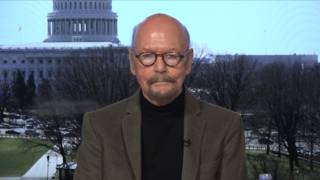
- David Luban, Professor of Law at Georgetown University Law Center. He co-wrote an article for online magazine Slate titled 'Improper Advances; Talking Dream Jobs with the Judge out of Court'.
- Michael Ratner, president of the Center for Constitutional Rights.
Related Story
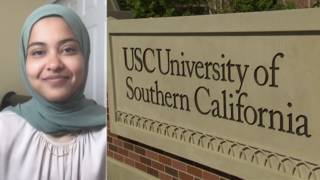
 StoryApr 18, 2024Meet USC Valedictorian Asna Tabassum: School Cancels Commencement Speech by Pro-Palestinian Student
Transcript
AMY GOODMAN: We’re joined on the phone right now from Maryland by Georgetown University Law Professor, David Luban. He co-wrote an article for the online magazine, Slate, entitled “Improper Advances: Talking Dream Jobs with the Judge Out of Court.” We’re also joined on the phone by Michael Ratner, President of the Center for Constitutional Rights, which represents Salim Hamdan, the Guantanamo detainee who brought the case against the Bush administration. Let’s start with David Luban.
DAVID LUBAN: Good morning.
AMY GOODMAN: Hi. Talk about what you understand of this chronology of events of Judge Roberts’ meetings, as he was weighing a case with the Bush administration, his meetings with the Bush administration.
DAVID LUBAN: Well, he knew that he was on the three-judge panel as early as last December. The case was argued, the oral argument was on April 7. Six days before that, as Juan mentioned, he had an interview with Attorney General Gonzales. And then while the case was being deliberated on, there’s a gap between April 7, when the oral argument took place, and July 15, when the court issued the decision. He had numerous other interviews for the Supreme Court judgeship. Now, that’s the period of time in which he is deliberating and presumably discussing with the other judges on the panel what the ruling should be in the case.
One of the important things about it, the three-judge panel, the case raised a number of different issues. They were unanimous on most of the issues. There was just one really crucial issue, though, in which they split two-to-one, with judge Roberts among the two. So, if he had recused himself from the case, then that issue would have been a one-to-one issue, and it wouldn’t have been settled, and that’s the issue about whether the Geneva Conventions give al Qaeda captives any rights at all. So, now it is decided that, on the basis of this case, that Geneva doesn’t give any rights at all, including the rights against cruel and humiliating and degrading treatment, along with the rights to a fair trial that Mr. Hamdan was litigating about. So, this is an important issue that Judge Roberts’ vote really swung.
JUAN GONZALEZ: But, David Luban, some legal experts say, number one, the discussions occurred before there was even a vacancy on the court. Sandra Day O’Connor did not announce her retirement until much later on. And the — and are federal judges to not have these kinds of discussions when — for the possibility of promotions within the federal judiciary while they’re holding — while they’re handling cases, especially in the D.C. Circuit, where much of the caseload is about the federal government.
DAVID LUBAN: Yeah. That’s a fair question, but I don’t think the chronology quite bears that out. Remember that Justice O’Connor’s retirement came as a surprise, but what wasn’t a surprise was that there was very likely going to be an opening on the court, and that’s because the Chief Justice developed thyroid cancer and it was unclear whether he was going to resign or not. Now, as early as February 22nd of 2005, the New York Times mentioned that Roberts was a prominent possible successor to Chief Justice Rehnquist. So, at least from February on — that’s a couple of months before the Hamdan case is argued — it’s already being reported that there’s very likely going to be an opening on the Supreme Court and that Judge Roberts is a candidate for the opening.
Now, one of the other things that’s important: You said correctly the case is called Hamdan v. Rumsfeld, but President Bush was himself a defendant in the case along with Rumsfeld. That’s because the President personally signed the finding that there was reason to think that Mr. Hamdan was a terrorist. So, here you don’t just have a case of a lawsuit against the government. You know, the government could be anything. It could be any of thousands of offices. This is a case against the President, the President personally, among other defendants; and the people who are conducting the interviews with Judge Roberts while this case is going on, are the President’s very top aides.
AMY GOODMAN: David Luban is with us, Georgetown University law professor who co-wrote a piece in — on Slate, the online magazine. Michael Ratner, you’re with the organization Center for Constitutional Rights that is representing the man who brought the case before the Supreme Court, Salim Ahmed Hamdan, in Guantanamo. Your response.
MICHAEL RATNER: Well, to be more accurate, Amy, we represent many Guantanamo detainees, and the issue we represent them on, in many cases, are the application of the Geneva Conventions. Hamdan was actually represented by one of David’s colleagues at Georgetown, Neal Katyal, who actually argued the case in the D.C. Circuit.
I mean, my reaction is just with utter amazement, to be honest. I mean, here you have on April 1, a week before the argument, you have Roberts meeting with Gonzales, Gonzales the Attorney General who was the architect of the entire policy that the Geneva Conventions should not apply to the people in Guantanamo, that they should use military commissions, and he’s meeting with this guy at the same time that he is sitting on a case that’s going to determine whether or not the Geneva Conventions apply. So, at a minimum, as David’s article clearly says on Slate, that his impartiality might reasonably have been questioned — that is, Judge Roberts — and he should have disqualified himself. There’s not any issue about it.
But I would go further. It reminds me of a case when Ellsberg, the man who revealed the Pentagon Papers, was on trial for espionage, and during the trial President Nixon, briefly, but other people in his office, Ehrlichman and others, meet with the trial judge to offer him to be the head of the F.B.I. Well, the outcry in the community was huge about that when it was discovered, and it wasn’t just looked at as, 'Well, he might — His impartiality might reasonably be questioned,' but it was looked at as essentially the offering of a bribe to the President — to the judge — the offering of a bribe by offering him a head of the F.B.I. And that is — was an impeachment offense, really, and it was one of the offenses listed in the impeachment.
So, this goes, I think, way beyond the question of impartiality be questioned. This looks really bad. This was the central policy of this administration, which the Center has been challenging since day one: the non-application of Geneva Conventions to the people in Guantanamo. So, I — and the fact that so little has been made out of it so far. There was David’s Slate article; there was a piece in the Washington Post that in my view, while it exposed some of it, was very mealy-mouthed; and almost nothing today. I can’t understand it, actually.
AMY GOODMAN: I wanted to ask you about this other development, just your informed comments on it. The Washington Post, reporting about the documents missing. The scandal involving two Bush administration lawyers going to the Reagan Library to look at documents, among them on affirmative action and John Roberts’ stance during the Reagan administration. They leave, the documents go missing. What is your response?
MICHAEL RATNER: Well, my response is it’s obviously very, very suspicious. I mean, they were — they are releasing 38,000 pages of documents in the next day or two that will be very important, but they’re holding back many. And the question is: What did these documents say, and why are they being — in my view, why were they all of a sudden, these documents, suppressed or lost? It sounds very, very suspicious to me; but, you know, when you look at the chicanery that’s going on in this administration, even on just this appointment, such as happened with this — meetings with Gonzales and even the President at some point, I would put nothing short of what this administration is willing to do to get this confirmation in. So, my suspicions are very high that these documents were intentionally, (quote), “lost.”
AMY GOODMAN: Well, I want to thank you, Michael Ratner, President of the Center for Constitutional Rights, for joining us, and David Luban, Georgetown University Law Professor who co-wrote a piece for Slate called, “Improper Advances: Talking Dream Jobs with the Judge Out of Court.”




 Top
Top
Media Options