






 Watch Full Show

Related
Topics
The Department of Homeland Security is spending billions on domestic spying and counter terrorism — is disaster relief getting sidelined? We look at the first major test of the massive homeland security bureaucracy with Matthew Brzezinski, author of “Fortress America.” [includes rush transcript]
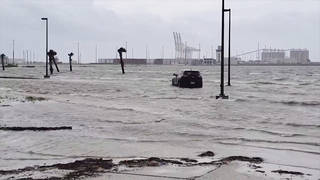
New Orleans mayor Ray Nagin estimated Tuesday that hundreds, maybe thousands of people have died since Hurricane Katrina hit the city. The Federal Emergency Management Agency is scrambling to find temporary housing for tens of thousands of people and to rescue people stranded on roofs and in the now-uninhabitable Super Dome. We turn now to the politics behind FEMA’s relief efforts and ask the question–would Katrina have been so devastating if disaster relief had not been incorporated into the Department of Homeland Security?
FEMA was created in 1979 by President Jimmy Carter and President Bill Clinton elevated the head of FEMA to a cabinet-level position in 1992. But after September 11, 2001, President Bush moved the agency under the umbrella of the newly created Department of Homeland Security. While FEMA oversees both disaster preparedness and relief, it may soon be reduced to coordinating only post-disaster efforts. Critics say this narrower mandate would limit the effectiveness of FEMA’s work and that operating within the Department of Homeland Security consigns disaster relief to a lower priority than counter-terrorism related activities.
- President Bush, speaking yesterday afternoon about the strategy of the federal government in coordinating relief efforts:
“The people in the affected regions expect the federal government to work with the state government and local government with an effective response. I have directed Secretary of Homeland Security Mike Chertoff to chair a Cabinet-level task force to coordinate all our assistance from Washington. FEMA Director Mike Brown is in charge of all federal response and recovery efforts in the field. I’ve instructed them to work closely with state and local officials, as well as with the private sector, to ensure that we’re helping, not hindering, recovery efforts. This recovery will take a long time. This recovery will take years.” - Michael Chertoff, Secretary of Homeland Security speaking at a news conference Wednesday in Washington:
“Truckloads of water, ice, meals, medical supplies, generators, tents, and tarpaulins. There are currently over 1700 trailer trucks, which have been mobilized to move these supplies into position. The coast guard has worked heroically for the last 48 hours rescuing or assisting well more than 1000 people who were in distress and held high and dry above the flood waters.”
Thousands remained stranded in New Orleans, in homes and in hospitals with no running water or electricity. We turn now to a look at the new infrastructure for disaster management in the United States.
- Matthew Brzezinski, author of “Fortress America: On the Frontlines of Homeland Security-An Inside Look at the Coming Surveillance State.” He is a contributing writer for The New York Times Magazine and former foreign correspondent at The Wall Street Journal.
Related Story
 StoryAug 30, 2021Hurricane Ida Slams Native Communities in Louisiana as New Orleans Loses Electricity & COVID Rages
Transcript
AMY GOODMAN: President Bush spoke yesterday afternoon about the strategy of the federal government in coordinating relief efforts.
PRESIDENT GEORGE W. BUSH: The people in the affected regions expect the federal government to work with the state government and local government with an effective response. I have directed Secretary of Homeland Security, Mike Chertoff, to chair a Cabinet-level task force to coordinate all our assistance from Washington. FEMA Director, Mike Brown, is in charge of all federal response and recovery efforts in the field. I have instructed them to work closely with state and local officials as well as with the private sector to insure that we’re helping, not hindering recovery efforts. This recovery will take a long time. This recovery will take years.
AMY GOODMAN: Secretary of Homeland Security, Michael Chertoff, highlighted the efforts of the Coast Guard at his news conference in Washington on Wednesday.
MICHAEL CHERTOFF: Truckloads of water, ice, meals, medical supplies, generators, tents and tarpaulins. There are currently over 1,700 trailer trucks which have been mobilized to move these supplies into position. The Coast guard has worked heroically for the last 48 hours, rescuing or assisting well more than a thousand people who were in distress and held high and dry above the floodwaters.
AMY GOODMAN: Homeland Security Chief, Michael Chertoff. Thousands remain stranded in New Orleans in homes and hospitals with no running water and electricity. We now turn to look at the new infrastructure for disaster management in the U.S. We’re joined by Matthew Brzezinski. He’s author of Fortress America: On the Frontlines of Homeland Security — An Inside Look at the Coming Surveillance State. Welcome to Democracy Now!
MATTHEW BRZEZINSKI: Good morning, Amy.
AMY GOODMAN: It’s good to have you with us. You have written for The New York Times Magazine, you have written for The Wall Street Journal about the Department of Homeland Security. What is happening here?
MATTHEW BRZEZINSKI: Well, I mean, I think that what we may be seeing is, as you mentioned earlier, is the first real test of, you know, whether this new department actually works. If you remember, you know, the reason it was created was to streamline all of the operations, to put everything under one umbrella so that, you know, so that there is a clear chain of command, so that there’s coordination and communication between all the various agencies. And this is the first time now we are going to see this put to the test, and you know, I worry that in its growing pains, the Department of Homeland Security has not been very successful in amalgamating all 22 agencies. You know, these have vastly different corporate cultures. These often have been very competitive with one another in the past, and you know, it takes a little bit of time to get everybody — everybody reading off one script. And you know, now we have this moment where really it is critical that, you know, we act quickly and efficiently, and it remains to be seen whether we will do so.
JUAN GONZALEZ: Well, FEMA has always been a troubled agency, even from its inception. Through many natural disasters in decades past, it’s been criticized for getting there late and often having a huge bureaucracy around it in terms of disaster relief. What do you think has dramatically changed in its ability to function, even though I think in previous years it had improved to some degree?
MATTHEW BRZEZINSKI: The short answer is more bureaucracy. I mean, at least before, FEMA answered to itself and to the President. But now FEMA has to answer to Mike Chertoff and the Department of Homeland Security, and there are all sorts of political considerations. As we heard, the President had to make very clear that while Mike Chertoff is in charge, but Brown was going to be down in New Orleans. And, you know, unfortunately, politics often come into play. Who will get the credit? Who will get the blame? Whose jurisdiction? Who has authority over what? And so, I think that, you know, we’ll see one added layer of bureaucracy, and as I said earlier, it remains to be seen whether that makes it more effective or even less effective.
AMY GOODMAN: Matthew Brzezinski, I mean, we know a lot about the Department of Homeland Security because of monitoring — some say “spying on” — people here in this country, dealing with issues of terrorism, as they define it, but this — isn’t this the first major test of the Department of Homeland Security? Whether this was a bomb or a hurricane, it’s being in charge of all of the forces to deal, and the question is: Where were all of those forces? I watched an interview with Michael Green* last night, the head of FEMA, and it was astounding to see that he said when he woke up on Monday morning, he understood — Michael Brown — he understood that this was going to be a catastrophe. President Bush was at Crawford for two more days. He said he understood on Monday that this could be a massive disaster. Now they’re talking about bringing in the National Guard, now, with so much of the National Guard all over this country in Iraq. But what about this?
MATTHEW BRZEZINSKI: Well, I mean, I think — you know, I think that you raise a good point. And I think we have been a little slow off the ball here, and, you know, this is one of the criticisms levied against the Department of Homeland Security is that it tries to be sort of all things to all problems. You know, DHS does everything from tracking foreign sex offenders to levying taxes on goods coming into the country, to, as you said before, monitoring, you know, potential terrorists, and you know, now disaster relief.
AMY GOODMAN: Defining affirmative action groups as terrorists. That’s the latest.
MATTHEW BRZEZINSKI: And you know, and so it’s got this huge agenda, and the problem is maybe it’s just not focused enough. And I think something like this will highlight not only the need for perhaps a refocused either Department of Homeland Security, where you hive off certain duties from it or you just narrow it, and I think it will also highlight something that’s extremely important and that’s been overlooked in Washington for a number of years now, and that is the importance of first responders. You know, this catastrophe, like the subway bombing in London, showed that, you know, either terrorist acts or acts of nature, while they’re not preventable, but you can mitigate the consequences if you’re prepared. And getting people timely medical attention can save lives. And I think we saw that in London.
Unfortunately, the first responders — and by first responders, it’s a fairly wide category which includes everything from firemen to ambulance drivers, EMS, local police, etc. — they have really been at the bottom of the totem pole in terms of the money that we have been spending on homeland security. Part of the problem again is it’s just not a sexy topic. It doesn’t grab the media’s attention, okay, you know, the way that, say, WMDs do, weapons of mass destruction, or the same way that the TSA, the airport screeners, do. And airport screeners get $5 billion a year. The first responders, in fact, are getting budget cuts. And again, because who ultimately has to pay that? Is it the municipal, is it state, is it federal? So again, there’s jurisdictional sort of overlap, and people can blame each other.
And I spent a lot of time with the first responders, and what I heard time and time again is “Give us the right equipment. We don’t have the right equipment. We can’t even talk to each other on our radios.” So that a policeman can’t necessarily talk to a fireman or an ambulance driver or an EMS or the Coast Guard, and how can you coordinate if you are not even on the same frequency?
AMY GOODMAN: We’re going to have to leave it there, but I want to thank you very much, Matthew Brzezinski, for joining us, author of Fortress America.



 Top
Top
Media Options