










 Watch Full Show

Related
Longtime Republican fundraiser Cheryl Halpern was elected the new chair of the Corporation for Public Broadcasting earlier this week. Halpern has overseen such government-funded media projects as Voice of America, Radio Marti in Cuba and Radio Free Iraq. She has also accused National Public Radio of anti-Israel bias. We speak with Celia Wexler of Common Cause. [includes rush transcript]
Earlier this week, longtime Republican fundraiser Cheryl Halpern was elected the new chair of the Corporation for Public Broadcasting, replacing Kenneth Tomlinson whose two-year term had ended. Before President Bush appointed Halpern to the CPB in 2002 she served on the Broadcasting Board of Governors overseeing such government-funded media projects as Voice of America, Radio Marti in Cuba and Radio Free Iraq. Halpern is also the former national chair of the Republican Jewish Coalition and she has accused National Public Radio of being biased against Israel. Like her predecessor, Kenneth Tomlinson, Halpern has also criticized the journalism of Bill Moyers.
Two years ago she publicly agreed with Senator Trent Lott’s comment that Moyers is “the most partisan and nonobjective person I know in media of any kind.” Halpern has given over $300,000 dollars in political contributions in recent years almost all to Republicans. Recipients have included President Bush, Senator Trent Lott of Mississippi and Sam Brownback of Kansas. The group Common Cause warned Monday that the selection of Halpern may “mean more politicizing for public broadcasting.”
The CPB also elected Gay Hart Gaines, a member of the Heritage Foundation, as Vice Chair. Gaines has served as president of the Palm Beach Republican Club and is a former chairwoman of Newt Gingrich’s GOPAC, the GOP political action committee that raised millions of dollars for Republican candidates across the country.
- Celia Wexler, Vice-President of advocacy at Common Cause.
- Read Celia Wexler’s statement before the CPB Board
Related Story
 StoryApr 18, 2024Meet USC Valedictorian Asna Tabassum: School Cancels Commencement Speech by Pro-Palestinian Student
Transcript
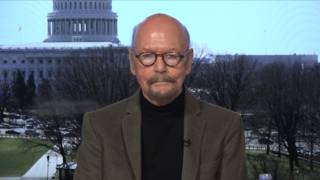
JUAN GONZALEZ: We’re joined now in our DC Studio by Celia Wexler. She’s the Vice President of Advocacy for Common Cause. Welcome to Democracy Now!
CELIA WEXLER: Thank you for having me.
JUAN GONZALEZ: Well, could you expound a little bit on your views on the dangers of this new — of Miss Halpern assuming her new position?
CELIA WEXLER: Well, the danger is this: is that the Corporation for Public Broadcasting was set up specifically to be a heat shield protecting Public Broadcasting from editorial interference. The visionaries that started Public Broadcasting wanted that kind of function for the board of the Corporation for Public Broadcasting. Well, Cheryl Halpern, as her predecessor, Ken Tomlinson, bring a totally different mindset to that job. Instead of being a heat shield, they put the heat on. You know, and that’s the problem. We want a Public Broadcasting that feels free to speak truth to power, whether it’s a Democratic administration or a Republican administration, but Tomlinson and Halpern have no concept of that.
JUAN GONZALEZ: In terms of whether this is more of a problem now, having her replace Tomlinson, or less, your perspective on that?
CELIA WEXLER: Well, I think what you get with Halpern is a very — much more effective Tomlinson. You know, Mr. Tomlinson was a little bit bumbling. He kind of made sort of major mistakes about going about things. And as a consequence, you have an Inspector General, the CPB’s own Inspector General, looking into what he did. My take on Ms. Halpern is that she’s much more subtle. She says the right thing, but I think that she’s just going to be more effective at fulfilling the goals that they both share.
AMY GOODMAN: And Celia Wexler of Common Cause, what about the Vice Chair, coming together, the Chair and the Vice Chair of the CPB being chosen?
CELIA WEXLER: Yes. Well, Gay Hart Gaines is a very interesting lady. She was an ardent fundraiser for Newt Gingrich in the days when Gingrich was really all about zeroing out the funds for Public Broadcasting. He has changed his tune on that, but when she was working very hard for Gingrich and GOPAC, that’s where he was at. Gay Hart Gaines is a huge donor, even out-shadowing the Halperns in terms of how much she and her family members have given to Republican causes over the years. She is now Vice Vhair.
She has no background at all in broadcasting. She is an interior designer by profession, which is, you know, perfectly honorable, but I’m always tickled because when people interviewed her about getting this job, she said, “Gee, it’s great I don’t have to leave the country,” with the implication being, well, you know, you give a lot, maybe you get to be an ambassador, but this is even better, because you know, I get to be on the CPB board and I can stay at home.
I think that the fact that the Vice Chair now is not held by a person of another party or an independent, it sends a very bad signal. As you know, there was a move by Ernie Wilson, one of the Democratic members on the board, to put in the Vice Chair position Beth Courtney, who is a very effective public broadcaster, who is an independent and would have made a very good Vice Chair. When the vote came in, the secret ballot came in, Courtney lost that position, and Gay Hart Gaines assumed it. And to us, it sends the signal again that being partisan is part of what the Corporation for Public Broadcasting is all about these days.
AMY GOODMAN: One of the things the media has reported on the Chair, Halpern, is that she has been criticizing NPR before she became Chair, for, quote, “anti-Israel bias”. Your response, Celia Wexler?
CELIA WEXLER: Well, I think again, you know, you look at where she is coming from. She has been a very ardent, pro-Israeli person. She obviously started with — was very involved in the Republican Jewish Committee. She has a particular point of view. She is entitled to that point of view. The problem is can she separate that point of view, which is an advocacy point of view, from understanding how journalists do their job, and that their fact-based reporting that sometimes is going to be critical of Israel. And I am very — we are very concerned about that. I know when she was talking to reporters after she was elected Chairman, I think she gave the impression that any, you know, complaint about this kind of coverage she got, she would refer to the ombudsman that Tomlinson got appointed to work for the CPB. So, I think it is a concern.
AMY GOODMAN: Celia Wexler, I want to thank you very much for being with us, Vice President of Advocacy at Common Cause.





 Top
Top
Media Options