










 Watch Full Show

Related
Topics
Guests
- Kenneth Rothexecutive director of Human Rights Watch.
- Scott McClellanWhite House press secretary.
- Craig Murrayjoins us today in his first interview in the United States since he posted the memos online. - For more information: CraigMurray.co.uk
- Link to classified documents
- Craig Murray is testifying at the International Commission of Inquiry on Crimes Against Humanity Committed by the Bush Administration.
*- Link to letter from Enron CEO Kenneth Lay to George W. Bush
Haitians await the outcome of the first presidential election since the U.S.-backed ouster of Jean Bertrand Aristide two years ago. Voters were frustrated by voting stations opening late and other major problems, leading to crowds storming polling stations and voting continuing late into the night. We get a report from Port-au-Prince, Haiti. [includes rush transcript]
There were no polling stations Tuesday in the Lavalas stronghold of Cite Soleil, home to at least 200,000 people. Voters swarmed out of that poor neighborhood as well as Bel Air and other areas to discover that voting stations had failed to open, election officials had no ballots, registration lists were incorrect and lines stretched for blocks. Angry crowds stormed the gates of the voting stations. At least four people died, including a police officer who was killed by a mob after fatally shooting a voter.
In many polling centers, vote counting continued late in the night. Doors remained open far longer than planned in order to accommodate voters still lined up outside. Thousands of armed UN troops were deployed to watch over the election process, which has been delayed four times since October. Official results are expected on Friday.
Voters in Haiti were choosing a new president, as well as a 129-member parliament. The frontrunner in the election is an ally of Aristide named Rene Preval. He served as Aristide’s first prime minister and succeeded Aristide as president in 1996. However Preval never joined Aristide’s political party Lavalas. He has said he would not prevent Aristide’s return to Haiti. A factory owner named Charles Henri Baker is polling second. He was a leader of the anti-Aristide Group of 184 and is the only white candidate in the race.
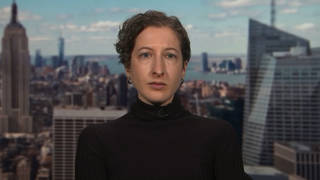
- Andrea Schmidt, independent journalist currently in Haiti. She reports from Port-au-Prince, Haiti.
Related Story
 StoryApr 03, 2024Haitians Resist Foreign Intervention as U.S. Pushes for Unelected “Transition Council” to Rule Island
Transcript
AMY GOODMAN: We go first to Haiti to speak with independent journalist Andrea Schmidt. She joins us on the ground from Port-au-Prince. Welcome to Democracy Now!, Andrea.
ANDREA SCHMIDT: Thank you.
AMY GOODMAN: Can you describe what happened yesterday, election day in Haiti.
ANDREA SCHMIDT: Well, I want to say to start the day at 4:30 and to roam the streets of Port-au-Prince was one of most incredible experiences of my life, because it was extremely inspiring to see, after two years of political repression in many areas and human rights abuses and a disintegrating — further disintegrating infrastructure, to see Haitians come out to vote and to be in the streets, lined up, ready to vote by 5:00 A.M. It was extremely powerful. Then we arrived in Cité Soleil or rather, on the outskirts of Cité Soleil because, as you mentioned in the introduction, there was a decision made by the C.E.P., the Provisional Electoral Council, to not have voting stations inside Cité Soleil for alleged reasons of insecurity, but of course, there is always a question of how politically motivated these things are.
So people had to leave their neighborhood and walk to the outskirts to one of four voting centers, and the scene, when we arrived [inaudible] was, again, incredibly inspiring. At 5:00 a.m., people waiting to vote. By 6:00 a.m., the voting stations, the polling booths were supposed to open. There’s, I believe, 43 different polling stations within that one voting center. Which means that over 2,000 people — sorry, 20,000 people would have been set to vote in that area. People became very, very inpatient when they realized that it was 6:00 a.m. They wanted to vote before the sun got too hot because they were in a warehouse area, no shade whatsoever, except inside. And they realized that the voting booths hadn’t even been set up yet.
The questions about why these failures in logistical planning took place remain. One of the things I observed later on in the day was going up to [inaudible] going up the hill to the wealthy areas of the city where voting was going on in a very orderly fashion, where people were able to go into a building, line up, vote within half an hour of arriving, is that if you plan to hold an election in a warehouse where there are no walls and you assume that the poorest people in the city should have to use the poorest infrastructure in the city, you are going to have elections that look like people taping cardboard boxes up to create private polling stations. You are going to have the sort of elections that are very, very vulnerable to all sorts of spoiling and a sort of disenfranchisement based on class, and that’s what we observed yesterday.
By about 8:30 in the morning, I’d been doing [inaudible] and as far as I could observe, no had yet been able to vote. People became very frustrated. There was a remarkable demonstration of, I’d say, about 10,000 people that grew as it went from Cité Soleil, where it picked up people who had not yet been able to vote, up to Bellaire and was about to go to the C.E.P. headquarters on Del Meaux when the demonstration turned around, and people returned to their neighborhoods, saying that they were going to try to vote again. And then as you mentioned, polling stations closed two hours later. Then foreseen at least in Cité Soleil, or in the environs, where we were watching the closings. Again, some very poor infrastructure and security arrangements made for increased frustration, increased disenfranchisement where, you know, people were basically having to wrestle with Jordanian soldiers who had been patrolling their neighborhoods, shooting for several months.
AMY GOODMAN: Andrea Schmidt, I want to thank you very much for being with us. Speaking to us from Port-au-Prince, in Haiti.



 Top
Top
Media Options