












 Watch Full Show

Related
Topics
After more than two years in prison and a fifteen month hunger-strike, former Haitian Prime Minister Yvon Neptune was freed Thursday. The most high profile political prisoner detained by the U.S.-backed interim government in Haiti, Neptune was jailed shortly after the 2004 coup that ousted Haitian President Jean Bertrand Aristide. He was never charged with a crime. [includes rush transcript]
Haiti’s former Prime Minister Yvon Neptune has been freed after spending more than two years in prison. On Thursday, Neptune walked out of the National Penitentiary. Two UN peacekeepers then helped him into an ambulance that took him to a hospital. He was frail and barely able to speak, after spending much of the past 15 months on a hunger strike. Yvon Neptune was jailed shortly after the 2004 coup that ousted Haitian President Jean Bertrand Aristide.
He was never charged with a crime and was the most high profile political prisoner detained by the U.S.-backed interim government. Supporters and relatives celebrated his release less than two weeks after over 3,000 people marched in Port-Au-Prince calling for the return of Aristide and the release of all political prisoners. Many of the demonstrators were members of Aristide’s Lavalas party.
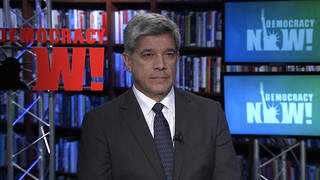
- Patrick Elie. Human rights activist in Haiti who campaigned for Neptune’s release, and former Haitian Undersecretary for Defense and Drug Czar under Aristide.
Related Story
 StoryApr 03, 2024Haitians Resist Foreign Intervention as U.S. Pushes for Unelected “Transition Council” to Rule Island
Transcript
JUAN GONZALEZ: This is Yvon Neptune’s cousin, Marie Josette.
MARIE JOSETTE: Finally, justice prevailed. I am very happy. For 15 months he has been without food. He is drinking only water and was taking vitamins.
JUAN GONZALEZ: Yvon Neptune was jailed shortly after the 2004 coup that ousted Haitian President Jean-Bertrand Aristide. He was never charged with a crime and was the most high-profile political prisoner detained by the U.S.-backed interim government. His release comes less than two weeks after over 3,000 people marched in Port-au-Prince, calling for the return of Aristide and the release of all political prisoners. Many of the demonstrators were members of Aristide’s Lavalas party.
AMY GOODMAN: Patrick Elie joins us now on the line from Port-au-Prince. He is the former defense minister in Haiti, as well as anti-drug czar, and he campaigned for the release of Yvon Neptune. We welcome you to Democracy Now!, Patrick Elie.
PATRICK ELIE: Thank you for the invitation.
AMY GOODMAN: How did you get Yvon Neptune out of prison? What is his condition? What is he saying?
PATRICK ELIE: Well, I think that, you know, the liberation of Yvon Neptune is a result of his own very courageous fight for justice. It’s the result of the last election, and it’s the result of the pressure that lately has been put on the legitimate government to act on this. Mr. Neptune is, as you might guess, very weak physically, but I think that his morale is high, and also he has not lost his bearings, you know, as his fight against injustice is concerned. His first concern, when they came to announce his liberation, was for the other, the thousand other political prisoners.
JUAN GONZALEZ: And, Patrick, what about the situation with President Aristide? Is there any indication — because I know the demonstration also called for the return of President Aristide — any indication that the new government is considering allowing him to come back to the country?
PATRICK ELIE: First of all, you know, I heard you mention that — I think I heard 3,000 people. It was more like 30,000 people who took to the street with the demand that President Aristide come back to the country. Now, it’s not only a matter for the current government to allow President Aristide to come back. On that issue, Mr. Preval has been very clear. But now, some things should be actively undertaken to address the issue and also to make sure that when President Aristide comes back, his security and his freedom of movement will be guaranteed. So, you know, let’s not make believe that it is going to be an easy matter. We know that President Aristide’s ouster was organized by very powerful forces, including within the U.S. and in Haiti proper. So it is something that is going to require some active work by the current government.
AMY GOODMAN: What is the relationship between Rene Preval, the current president, and Jean-Bertrand Aristide? And also these other political prisoners, like the famous singer, the Haitian singer So Anne, will she be released?
PATRICK ELIE: We will keep on the pressure for her to be released, because, you know, if that could be — So Anne’s case is even more scandalous than that of Yvon Neptune, because Neptune was arrested on an arrest warrant, you know, as flawed as it was, whereas So Anne was arrested in the dead of night by U.S. Marines, you know, which had no legal mandate to operate such an arrest, and she’s been in jail for even longer than Mr. Neptune.
And the charges are preposterous. They’ve ranged from, as you know, squashing a baby in a mortar and pestle, which was so ridiculous that, of course, nobody could consider that, and now she is accused of being involved, I believe, in the affair at the university back on December 5, 2003. And, of course, these accusations are so shallow that the prosecutor himself has asked for them to be dropped, but obviously other people are pulling strings so that the process be dragged on.
But now, the group that initiated the last campaign for the release of Mr. Neptune is going to get on the case of So Anne to secure a release, and we hope that these high-profile prisoners will help spring loose the anonymous one, the one that comes from the popular neighborhood and who have almost no backing in their fight against injustice.
AMY GOODMAN: And Yvon Neptune’s health right now, only speaking in a whisper in the hospital?
PATRICK ELIE: Yes, and, you know, it’s no wonder. The man has been only drinking water with sugar and vitamins, and you know you cannot survive really — you can survive, but you cannot thrive on such a diet. So he is very weak. We are waiting for a medical assessment. But obviously, the first task at hand for him is to regain some of his forces so that he becomes more efficient in this next step in the fight that he is waging against injustice.
AMY GOODMAN: Patrick Elie, I want to thank you for joining us from Port-au-Prince, former defense minister under President Aristide and former anti-drug czar, one of those who worked to get the former prime minister, Yvon Neptune, freed.





 Top
Top
Media Options