







 Watch Full Show

Related
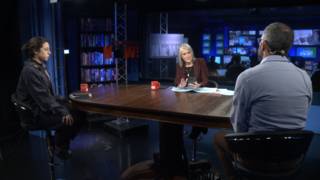
United Nations Secretary General Kofi Annan arrives in Beirut for talks aimed at shoring up the ceasefire between Israel and Hezbollah. We speak with Lebanese parliament member Ghassan Moukheiber about the future of Lebanese politics, Hezbollah, and the continued Israeli occupation of southern Lebanon. [includes rush transcript]
United Nations Secretary General Kofi Annan arrived in Beirut Monday for talks aimed at shoring up the ceasefire between Israel and Hezbollah.
Annan will discuss the planned deployment of fifteen thousand UN peacekeepers in south Lebanon. Israel has said it will not pull out its troops until the UN force deploys alongside the Lebanese army.
The force was authorized under the ceasefire earlier this month that ended the month-long conflict. More than one thousand Lebanese, the majority of them civilians, were killed in the war and many thousands more injured. Over one hundred twenty Israelis died, the majority of them soldiers.
Amnesty International has accused Israel of committing war crimes for deliberately targeting civilian infrastructure in Lebanon and the head of the UN Mine Action Co-ordination Centre in Lebanon said he had “no doubt” that Israel’s use of cluster bombs in civilian areas violated international law.
The Lebanese government is now considering possible legal procedures to sue Israel for war crimes and crimes against humanity. Lebanese parliament member Ghassan Moukheiber is leading the charge in the case. He is an attorney and a member of the parliamentary human rights committee. Democracy Now!’s Ana Noguiera caught up with him in Beirut.
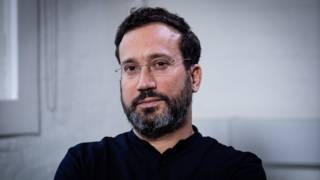
- Ghassan Moukheiber, member of Lebanese parliament.
Related Story
 StoryApr 18, 2024Meet USC Valedictorian Asna Tabassum: School Cancels Commencement Speech by Pro-Palestinian Student
Transcript
AMY GOODMAN: Lebanese parliament member Ghassan Moukheiber is leading the charge in the case. He’s an attorney and a member of the parliamentary human rights committee. Democracy Now!’s Ana Nogueira caught up with him in Beirut.
GHASSAN MOUKHEIBER: I’m not a party member. I am part — I’m a member of a parliamentary bloc, which is the Change and Reform bloc, which includes members of the Free Patriotic Movement party, which I am not part of.
Anyways, the Free Patriotic Movement, and mainly Michel Aoun, has signed an understanding, a memorandum of understanding, with Hezbollah several months ago, but that contains Hezbollah into the boundaries of limited Lebanese interest, to the exclusion of Syrian or Iranian interests, and also that attaches it to the promotion of democracy, freedoms, and the rights for Lebanese, including Lebanese detainees in Syria, Lebanese that have fled to Israel, defining the context of the rebirth of the reconstruction of a state. These were limited to ten points within an understanding. They cannot — they do not extend to the limits that some call an alliance that is not an alliance. There are areas in which, within the document, there has been an understanding with Hezbollah. There still remains a huge lot of others where understanding must be reached together with the other components of the political spectrum of the Lebanese body politics, and it has to deal with the way we need to protect Lebanon.
The question is, how do you protect Lebanon from the ongoing incursion and aggressions of Israel? This is the fifth war in Lebanon. This is not the first. There’s been always, between wars, a continued aggressions along the border. The questions for us should lead to the establishment of a democratic, strong and free state that is free of any foreign interference, be it Syrian, Iranian, Israeli, Egyptian, Saudi or whichever. This sovereign nation we’ve been working for is under way. It requires the attention and the assistance of the international community, but the greatest weight is on the Lebanese themselves. It will be up to the Lebanese to make sure that the state that we are hoping to bring about will be one that controls the use of force that no one, including — not only Hezbollah, but the Palestinians. There are many armed Palestinians within Lebanon that need to relinquish their weapons to the state.
However, part of our grievances towards Israel is that we still have occupied land. So for as long as Israel retains the occupation of portions of the Lebanese territory, particularly those territories now known by the Shebaa farmlands, they would still remain legitimacy within Lebanon for any group of Lebanese doing operations of resistance against Israel. This is the case for Hezbollah, and it has been recognized by all political parties. The only way that Resolution 1701 can be appropriately implemented is to address the interests of all parties, but also including the Lebanese, meaning that, for as much as 1701 calls for a cessation of hostilities between the Hezbollah and the Israelis, the cessation of hostilities must be accompanied with a longer term solution, and that includes the exchange of prisoners, both the Israeli and the Lebanese that are still remaining in Israeli jails, and the liberation of the occupied Lebanese territories still occupied by Israel at the level of the Shebaa farmlands. And these alone can bring an appropriate solution of the underlying reasons for which we have ongoing problems with Israel.
And Israel must also get into a mood of quitting acts of warfare for anything it wants to achieve. Diplomacy is the only way that peace can be achieved. Diplomacy is the only way where we can find an understanding at the regional, but also at the international level, to bring about peace in the region.
AMY GOODMAN: Lebanese parliament member Ghassan Moukheiber speaking from Beirut.



 Top
Top
Media Options