








 Watch Full Show

Related
Topics
Last week, the U.S. government announced that it was going to cancel a $50 million dollar contract with Bechtel, after a federal audit exposed gross mismanagement of a project to build a Children’s Hospital in Basra, Iraq. The auditors plan to expand their investigations to all of Bechtel’s $2.85 billion in Iraq contracts. Author and Activist Antonia Juhasz joins us from San Francisco. [includes rush transcript]
Sunday began a week of events marking the anniversaries of the U.S. atomic bombings of Hiroshima and Nagasaki. Activists have targeted facilities run by the Bechtel Corporation, one of the world’s leading leading nuclear weapons contractors and engineering firms. Protests took place over the weekend at the Lawrence Livermore Laboratory in California, Los Alamos Laboratory in New Mexico and Bettis Atomic Power Laboratory in Pennsylvania-which is operated by Bechtel under a 4.2 billion dollar contract. On Wednesday there will be protests at Bechtel’s corporate offices in San Francisco and New York City.
Last week, the U.S. government announced that it was going to cancel a $50 million dollar contract with Bechtel, after a federal audit exposed gross mismanagement of a project the company was overseeing in Iraq. Bechtel had been contracted to build a Children’s Hospital in Basra, but the report found numerous schedule and budget irregularities. The auditors plan to expand their investigations to all of Bechtel’s $2.85 billion in Iraq contracts. Author and Activist Antonia Juhasz joins us from San Francisco.
Her book “The Bush Agenda: Invading the World, One Economy at a Time,” was published last spring. Her articles have appeared in numerous publications–and her latest article, “Bechtel Takes a Hit for War Profiteering” is posted now on Alternet.org. More information of the Bechtel protests is at http://www.august6.org.
- Antonia Juhasz. Author of “The Bush Agenda: Invading the World, One Economy at a Time,” published last spring. Her articles have appeared in numerous publications–and her latest article, “Bechtel Takes a Hit for War Profiteering” is posted now on Alternet.org.
Related Story
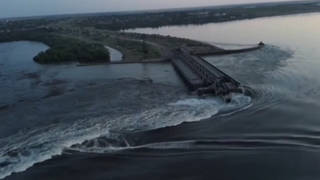
 StoryJun 06, 2023Catastrophic Flooding Feared as Critical Ukrainian Dam Is Destroyed; Zaporizhzhia Nuke Plant at Risk
Transcript
AMY GOODMAN: Author and activist Antonia Juhasz joins us from San Francisco right now. Her book is called The Bush Agenda: Invading the World, One Economy at a Time. We welcome you to Democracy Now!
ANTONIA JUHASZ: Thanks for having me. Good morning.
AMY GOODMAN: Can you talk about this audit?
ANTONIA JUHASZ: Yes, absolutely. This was the July report of the Special Inspector General for Iraq Reconstruction, completing only about its 50th project assessment out of some almost 2,000 U.S. government projects in Iraq. And in this assessment, the first to target Bechtel, as you reported, they found gross mismanagement: a planned critical children’s hospital in Basra, simply mismanaged, incomplete; a chain of subcontractors that led to no work being done, and they canceled the contract. And the fact is, as the Special Inspector General has looked more closely at each contract, more and more and more of the U.S. contracts are being canceled.
However, while the U.S. has spent about $15 billion on reconstruction in Iraq, there’s a time limit. September 30th is when all un-obligated funds are going to revert back to the U.S. Treasury. So now is a time that the audits have to be completed of these projects. The bad projects have to be canceled, and the money needs to be immediately turned over to Iraqi companies.
AMY GOODMAN: Antonia Juhasz, this week marks the anniversary of the U.S. atomic bombings of Hiroshima and Nagasaki, also marking a week of activities around facilities run by Bechtel. Why Bechtel?
ANTONIA JUHASZ: Well, why Bechtel? Because, first of all, of their horrific war profiteering, their push that brought us into the war in Iraq, their profiting from that war, and, as I explain in my book, their utter failure in providing the services that we and the Iraqis have paid them $2.8 billion to provide. And that includes the most basic services in Iraq: water, electricity, sewage.
As the Special Inspector General reports found, in these sectors, only 50% of projects have even been completed, and in the electricity sector, a full third have not yet even begun. This means that Iraqis, for example, in Baghdad, only have eight hours of electricity a day, again, after we have spent, just in this sector alone, $3 billion. We might recall that it was just three months after the 1991 U.S. invasion of Iraq that the Iraqi companies got these services up and running right away.
Electricity in Iraq controls water and sewage. So that means that without electricity, the country doesn’t have these other services, as well. Many people across Iraq over and over again in regular public protests point to the lack of electricity as one of the key sources of unrest and the insurgency in Iraq.
Bechtel also happens to be the nation’s largest nuclear power purveyor and also heavily, heavily involved in nuclear weaponry across the United States. So what we’re seeing in actions in some 24 states across the U.S. are targets at Bechtel’s headquarters, which we’re going to be doing here in San Francisco on Wednesday, but also the nuclear facilities that Bechtel manages. And there are several actual Hiroshima survivors that are involved in these protests, saying we cannot allow Bechtel and the U.S. government to push for more nuclear weapons, more nuclear war, when we, the Hiroshima and Nagasaki survivors, can tell you firsthand what that means.
AMY GOODMAN: Antonia Juhasz, I want to thank you for being with us. Ten seconds — there is an atomic plant, a nuclear plant in Pennsylvania run by Bechtel?
ANTONIA JUHASZ: That’s right, the Bettis Atomic Laboratory, where there was an action yesterday. Several hundred people came, and if people want to find out more about the different actions happening, there’s a website, august6.org, and also my website, thebushagenda.net. But right now is a time when we can demand Bechtel’s contracts canceled, the money returned to the U.S. Treasury and then straight to Iraqi companies for real reconstruction.
AMY GOODMAN: Antonia Juhasz, I want to thank you for being with us. Again, her book is The Bush Agenda: Invading the World, One Economy at a Time.




 Top
Top
Media Options