







 Watch Full Show

Related
Lieutenant Ehren Watada, the first officer to publicly refuse to serve in Iraq, has been charged again by the military, this time for 'conduct unbecoming an officer and a gentlemen.' We speak with Watada about the latest charges. [includes rush transcript]
Conduct unbecoming an officer and a gentlemen. That is the latest charge that Lieutenant Ehren Watada was hit with on Friday by the Army. Watada is the first officer to publicly refuse to serve in Iraq. On June 22nd, Watada refused to deploy with his Fort Lewis based unit and he was subsequently charged with one count of missing troop movement, two counts of speaking contemptuously of the president and four counts of acts unbecoming an officer. Army spokesman Joe Piek said that this latest charge is based on Watada’s remarks last month at the national convention for Veterans for Peace. At that convention Watada attacked the Bush administration for waging a war “for profit and imperialistic domination” and urged soldiers to refuse to fight. Watada faces eight years in prison.
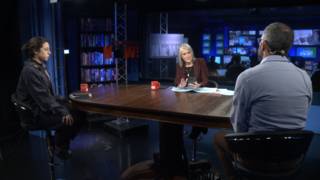
I spoke to Lieutenant Watada on Saturday night at the Seattle Town Hall. I began by asking him his response to the latest charges.
- 1st Lieutenant Ehren Watada, first officer to publicly refuse to serve in Iraq.
Related Story
 StoryApr 24, 2024Naomi Klein: Jews Must Raise Their Voices for Palestine, Oppose the “False Idol of Zionism”
Transcript
AMY GOODMAN: Lieutenant Watada faces eight years in prison. I spoke to him on Saturday night in Seattle at Town Hall. I began by asking him his response to the latest charge.
1ST LT. EHREN WATADA: On Friday, yesterday, I was charged with conduct unbecoming an officer and a gentleman, another count that was added onto the charges already that the military has referred to me based on the speeches that I had made kind of saying why I was not deploying, my beliefs on what the administration was doing. And I made another speech recently at the Veterans for Peace conference. And because of that speech, they then charged me again.
AMY GOODMAN: What is your response to that charge, conduct unbecoming an officer? What did you say at the Veterans for Peace convention?
1ST LT. EHREN WATADA: I said many things. Basically I was talking to the peace activists, people who I believe are on the frontlines working for an end to this war and for peace and justice in general. And I was speaking to them generally to say that all Americans have a responsibility to support those service members who are trying to do the right thing. And I was basically saying why I believe this and telling them how they can help out soldiers, service members, who are resisting this war.
AMY GOODMAN: How did you come to the conclusion — you are the first officer to resist deploying to Iraq. How did you come to the conclusion that it was wrong?
1ST LT. EHREN WATADA: For me, there were many things. The most important thing for me is that in our democracy, according to our constitution, one person, one man, cannot hold absolute power, hold himself above the law, including in actions in declaring war or waging war on another country. And it is my belief that in deceiving the American people, through which a majority of us now know to be true, the leaders of our country were violating their oath to this country and violating constitutional law. That was the main reason. Other things that led me to this decision was the rampant abuses of American and international law and the conduct of the occupation and then the conduct of this war. And I just felt that the policies that were made were forcing soldiers, including myself, to commit actions that violated international and domestic laws.
AMY GOODMAN: So what happens to you now? How many counts, how many charges have been brought against you?
1ST LT. EHREN WATADA: Basically, there’s one count of missing movement, which has a maximum penalty of two years; two counts of contempt against officials, which is another two years, specifically contempt against the President of the United States; and now four charges of conduct unbecoming an officer and a gentleman, all total about eight-and-a-half years.
AMY GOODMAN: Will you be court-martialed?
1ST LT. EHREN WATADA: That remains to be seen. It’s entirely up to the commanding general of Fort Lewis and also the political forces that are swirling around him. We certainly hope not. We certainly hope that the military will see that it is the duty of every service member to refuse unlawful orders and to speak out against leadership, which is not held to account, which is not held accountable.
AMY GOODMAN: You live in Olympia. Are you allowed to leave the state of Washington now?
1ST LT. EHREN WATADA: No. I cannot leave the state of Washington. I have tried to request to go home to visit friends and family, for which will probably be the last time I will see them if I’m incarcerated. And they have restricted me from going anywhere outside of the state on the basis that they don’t want me making any speeches that will incite people or inspire people. But they have not put any limitations on what I can do in the state of Washington.
AMY GOODMAN: You’ve got a tremendous response here at town hall of over 1,000 people. What is your response to that? And are you ready to go to jail?
1ST LT. EHREN WATADA: First of all, I think with the response of the people in general, I’m eternally grateful. There has been so much warm, encouraging words of support from all over the country, all over the world and even within the military itself. And that strengthens me, and it gives me more courage to do what I’m doing. Certainly I don’t think anybody is ready for prison, but I feel it’s a necessary sacrifice, if that’s what it comes down to, and one that I’m willing to make, and to do whatever I can to bring democracy back to this country.
AMY GOODMAN: Have people in the military expressed their support to you publicly or privately?
1ST LT. EHREN WATADA: Not publicly. I think a lot are taking a risk in using the military email servers to communicate to me their words of support and encouragement. But, yes, all over — I don’t know about the other services, but I know in the Army, there has been tremendous support from all ranks, from soldiers all around the country, all around the world, even veterans just coming back from Iraq, and certainly not in the majority, I would assume, in the military, but they are out there, many of them.
AMY GOODMAN: And specifically, the charge, conduct unbecoming an officer and a gentleman, and the charge, expressing contempt towards the President of the United States, can you address this conduct?
1ST LT. EHREN WATADA: The charges — or that article that they charged me with is very arbitrary. They basically list and quote things that I have said, to wit, as they say. And they say that it’s conduct unbecoming, because those words are disgraceful and dishonorable. But those terms are so ambiguous, and they could mean different things. The ACLU has really — has come out to my defense publicly, and they’ve even written an amicus brief, which we presented at the Article 32 hearing, saying that past instances of which officers have been charged with conduct unbecoming really have no jurisprudence for this case in regarding free speech. Usually things like if an officer fails to pay child support or they commit adultery or they’re caught stealing, those are really what they have charged or what they used to charge officers with. Something concerning your free speech is unprecedented.
AMY GOODMAN: Lieutenant Ehren Watada, what gives you your strength?
1ST LT. EHREN WATADA: The opportunity to make a difference. I see the path that our country is taking is so wrong and so destructive, all from the conduct and the ideology of our leadership. And I just think anything I can do to put a stop to this, to make things right, I’ll do it.
AMY GOODMAN: Lieutenant Ehren Watada, speaking on Saturday night. We were in the back of Town Hall, the historic site in Seattle, Washington.



 Top
Top
Media Options