







 Watch Full Show

Related
Topics
Guests
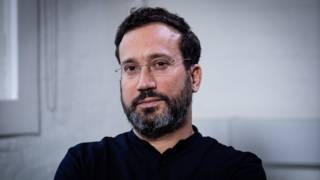
- Bert Sackspeace activist who was fined by the U.S. government for bringing humanitarian aid to Iraq. He is petitioning the Supreme Court to take up his case. More information at BertOnIraq.blogspot.com.
While First Lieutenant Ehren Watada faces court-martial for refusing to deploy to Iraq to fight, Bert Sacks was fined $10,000 for going to Iraq to bring humanitarian aid. In 1997, Bert Sacks brought medicine to Iraqi civilians in defiance of the U.S. sanctions. Sacks is now petitioning the Supreme Court to take up his case. [includes rush transcript]
Related Story
 StoryFeb 05, 2024U.S. & Israel vs. Axis of Resistance: Biden Strikes New Targets in Middle East as Gaza War Continues
Transcript
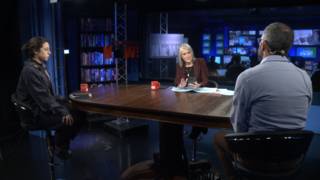
AMY GOODMAN: While First Lieutenant Ehren Watada faces court-martial for refusing to deploy to Iraq, my next guest was fined thousands of dollars for going to Iraq to bring humanitarian aid. In 1997, Bert Sacks brought medicine to Iraqi civilians in defiance of the U.S. sanctions. The U.S. government fined him $10,000, but Sacks has refused to pay. He has argued the actual crime was not his humanitarian efforts but the U.S. sanctions. It’s been estimated the sanctions led to the death of some 500,000 Iraqi children. Sacks is now petitioning the Supreme Court to take up his case. His petition questions whether it was legal for the U.S. to have knowingly caused the deaths of Iraqis through sanctions. Bert Sacks also joins us from the studio in Seattle.
We called the Treasury Department to invite them on the program. Molly Millerwise, a spokesperson of the Office of Foreign Assets Control, declined to be on.
Bert Sacks, can you explain your case? What are you taking to the Supreme Court?
BERT SACKS: Yes. Thank you, Amy. I think the first thing to understand is that the deaths in Iraq were not caused simply by the sanctions, but by the deliberate actions of the U.S. military during the 1991 Gulf War. When you bomb a country’s electrical generating plants, taking out almost all of them, you are making it impossible for a country to process water, process sewage. And so, I’ve been to Baghdad and seen the awful scenes where raw sewage flows through a big pipe into the Tigris River, and I’ve been downstream to Basra, where you see the hospitals and the clinics filled with children that are drinking this water. And it creates a cycle of illness, water-borne disease, that has led to, New England Journal of Medicine told us, 47,000 children dying in less than a year. And you compare that with the carnage we’re hearing about now, you begin to have an understanding. A hundred ninety-five children a day were dying in ’91, and we knew it.
And we continued that policy through 12 years, as a tool of coercion. And it was a lethal tool of coercion. Well, when you do that for 12 years and contribute to the deaths of something like 500,000 children, and you maintain that policy, you’re guilty of a number of different crimes. And we’re asking the Supreme Court to hear the case and to hear whether or not we have, in fact, violated significantly international law by doing this.
AMY GOODMAN: Well, today is the deadline for you to pay $10,000 for violating economic sanctions against Iraq, for taking in $40,000 worth of medicine to Iraq. What are you going to do?
BERT SACKS: I think there’s a mistake, Amy. The deadline was in 2002, and I came to Washington, D.C., to have a news conference to announce that I wouldn’t pay then. And I submitted what I’ve recently reread, what I consider a very good letter, explaining all my reasons with a lot of attachments. People can read that at concernforiraq.org/ofac. And that refusal actually garnered a significant amount of media attention. It was a lead story in the Seattle Hearst newspaper, the P-I, and on Common Dreams. And lawyers from the law firm, Garvey Schubert Barer, came to me and offered me pro bono advice. I thought about it for about 15 seconds, and I said yes. And they have been with me ever since, through the district court, the appeals court and now to the Supreme Court.
And if I could follow up on the issue that I think is so central to the case, it’s the issue of international law. We have argued that our actions, the actions of the United States government, violated the rights of the child, the Convention of the Rights of the Child, the Genocide Convention, the Geneva Convention and customary international law. And the judge in district court gave a ruling that’s really stunning, particularly on the most powerful of those, the Genocide Convention. He didn’t say that this was not genocide. He hadn’t even heard the evidence, so he had to accept that what we had done, in fact, was genocide. And he ruled in a sentence that stays with me so clearly, that in enacting the Genocide Convention, we created the condition that it would create no substantive or enforceable rights for any party in any proceeding **. That is, as I understand it, the government of United States may prosecute people for genocide, but no one can prosecute the government for genocide. As well as — excuse me, go ahead.
AMY GOODMAN: Bert, I wanted to ask you about comments made by Madeleine Albright, the secretary of state under President Clinton. In 1996, 60 Minutes aired an interview with her. Albright at the time was Clinton’s U.N. ambassador. Correspondent Lesley Stahl asked her about the sanctions the U.S. had imposed. Stahl said, “We have heard that a half million children have died. That’s more children than died in Hiroshima. And, you know, is the price is worth it?” Madeleine Albright replied, “I think this is a very hard choice, but we think the price is worth it.”
Well, two-and-a-half years ago, I caught up with Madeleine Albright outside the 2004 Democratic convention in Boston and asked her about her statement.
AMY GOODMAN: The question I’ve always wanted to ask: Do you regret having said, when asked do you think the price was worth it, the killing of children in Iraq —
MADELEINE ALBRIGHT: I have said 5,000 times that I regret it. It was a stupid statement. I never should have made it. And if everybody else that has ever made a statement they regret would stand up, there would be a lot of people standing. I have many, many times said it, and I wish the people would report that I have said it. I wrote it in my book that it was a stupid statement.
AMY GOODMAN: Do you think it laid the groundwork for later being able to target Iraq and make it more acceptable on the part of the Bush administration?
MADELEINE ALBRIGHT: What? You’ve got to be kidding.
AMY GOODMAN: Well, the sanctions against Iraq.
MADELEINE ALBRIGHT: The sanctions against Iraq were put on because Saddam Hussein had invaded Kuwait. But there never were sanctions against food and medicine. And you people need to know there never were sanctions against food and medicine, and I was responsible for getting food in there and getting Saddam Hussein to pump oil.
AMY GOODMAN: Madeleine Albright, saying there were never sanctions on Iraq against food and medicine. Bert Sacks, your response?
BERT SACKS: I have long wanted to get this into a court of law, where rules of evidence govern, and so you can ask somebody: Well, if there never were sanctions on medicine, why is there a fine on Mr. Sacks and other people?
There are a number of other things actually that are quite remarkable in Ms. Albright’s statement. In her memoirs — I think it’s page 275 — where she discusses just this statement, she also says nobody would die in Iraq if Saddam just complied. Well, on that same page down below, she explains, we were continuing the policy that James Baker III initiated in May of '91, right after the end of the Gulf War, saying that we're going to use sanctions to depose Saddam Hussein; we’ll keep the sanctions forever, until Saddam is gone. Now, that’s a violation of the U.N. Security Council resolutions. That’s A. And B, it meant there was no incentive for Iraq or Saddam to disarm, because the sanctions would be there forever.
It also sealed the fate of hundreds of thousands of children in an act that was lethal coercion of children to get something from the government. That’s terrorism *.
Now, those are strong words, but I think that those are the issues I really hope the Supreme Court would be prepared to deal with on the basis, not only of U.S. law, but international overarching law that’s called jus cogens, laws that can’t be violated by any country, no matter what laws they themselves pass domestically.
AMY GOODMAN: Well, Bert Sacks, I want to thank you very much for being with us, peace activist petitioning the Supreme Court to take up his case. In 1997, he brought medicine to Iraqi civilians, in defiance of U.S. sanctions. The government fined him $10,000. He has refused to pay. Thank you for being with us and joining us from Seattle.



 Top
Top
Media Options