









 Watch Full Show

Topics
Yes–The New York Times is at a 152-year low — but is it thanks to Jayson Blair? Or is it because the paper has become the Pentagon’s most effective mouthpiece?
The two top editors of the country’s most influential newspaper resigned yesterday after a series of scandals that have severely undermined the paper’s credibility.
The resignations of New York Times’ Executive Editor Howell Raines and Managing Editor Gerald Boyd come after reporting scandals involving journalistic fraud, plagiarism, and pandering to the U.S. government.
Five weeks ago, the New York Times discovered that 27-year old reporter Jayson Blair had fabricated details in more than 30 articles. The paper referred to the incident as a new low in its 150-year history.
Then, one of the paper’s star reporters, Rick Bragg, resigned after he acknowledged he’d relied heavily on young stringers who did not receive byline credit. The paper announced the formation of an internal investigation that vowed to restore the trust of the readership.
Finally, Washington Post reporter Howard Kurtz published an internal email communication between Baghdad Bureau Chief John Burns and veteran, star Times reporter Judith Miller. In recent months, Miller had written several stories about alleged weapons of mass destruction in Iraq. They relied heavily on unnamed sources. In perhaps her most remarkable front-page story, Miller suggested that the main reason US forces have failed to find WMDs is that they were destroyed just before the invasion or sent off to Syria. The story conveniently met the Bush administration’s needs as it was facing increased questioning about the whereabouts of the alleged WMDS, and as it was ramping up the rhetoric against Syria.
In the email to Burns cited by the Washington Post, Miller admitted that the main source for all of these articles was Ahmad Chalabi. Ahmad Chalabi is the exile leader who the Pentagon and the Bush administration had hoped to install as the new ruler of Iraq.
The national and international media have treated these three journalistic scandals in starkly different terms. The New York Times itself published an extraordinary four-page account detailing how Jayson Blair had defrauded the newspaper. Executive Editor Howell Raines formed a committee to investigate how Blair was able to commit such repeated journalistic fraud. He convened a two-hour long meeting of newsroom staff and accepted blame for the allowing Blair’s fraud to occur. But there has been no news of meetings regarding the Judith Miller scandal; indeed, the Times has given little or no mention to it at all.
Even as the Times was faced with one of the biggest challenges to its credibility in its history, the rest of the U.S. media continued to follow its lead. Jayson Blair become the subject of major news exposes and talk shows for weeks, and graced the cover of Newsweek. The revelations about Judith Miller’s reporting had minor reverberations.
Jayson Blair reported on stories that had few if any global, geo-political implications. But Miller’s reporting seemed to provide the Pentagon and the Bush administration with an excuse for the U.S. invasion of a sovereign country.
Race is also central in this story. Jayson Blair is black, Judith Miller is white. After the Blair scandal erupted, columnists and talk shows debated whether Blair’s fraud was a case of affirmative action gone awry.
- ??Condace Pressley, president of the National Association of Black Journalists.
- ??David Nasaw, professor at the CUNY graduate center and the author of The Chief: The Life of William Randolph Hearst.
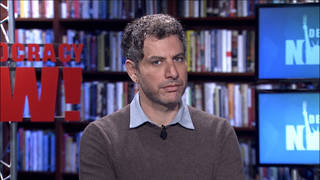
- ??John “Rick” MacArthur, publisher of Harper’s Magazine
??Link:
Related Story
 Web ExclusiveMar 21, 2025Human Rights Attorney Wolfgang Kaleck on Double Standards in International Law, from Russia to U.S.



 Top
Top
Media Options