





 Watch Full Show

Topics
President Bush arrives in Nigeria today. As he wraps up his five-day Africa tour, he is accompanied by a large entourage of corporate executives. Front and center are the oil executives. Bush is set to meet with ChevronTexaco CEO and chairman Dave O’Reilly. Other transnational corporations attending include ExxonMobil and Shell Petroleum.
Bush is joined by his National Security Adviser, Condoleezza Rice. Rice is a former board member of Chevron. The company named an oil tanker after her, The Condoleezza Rice.
Nigeria is Africa’s largest oil producer, cranking out more than two million barrels a day. Nearly 750,000 barrels of Nigeria’s oil go to the United States every day. That is eight percent of total US crude oil imports.
A former US diplomat in Africa, Vincent Farley told Cox News Service, “If the US intervention in Iraq does not bring peace in the Middle East, then the US may have to look to other sources of oil.” He said, “And Africa is at the top of the list.”
Today, we spend the hour with the Democracy Now! documentary Drilling and Killing: Chevron and Nigeria’s Oil Dictatorship. [includes rush transcript]
On the ground in Nigeria, there is an oil war raging. Villagers in the oil-rich Niger Delta are rising up, demanding an end to a system that keeps them in poverty as their government pumps Nigeria’s natural resources to Western nations, enriching itself and oil executives. In unprecedented acts of resistance, villagers have seized oil rigs, barges and helicopters belonging to transnational oil corporations.
The oil companies are fighting back. Today, we’re going to take an in-depth look at one of these cases.
In 1998, Democracy Now! revealed for the first time that Chevron played a role in the killing of two Nigerian villagers. The San Francisco-based oil company helped facilitate an attack by the feared Nigerian navy and notorious Mobile Police (MOPOL).
In a interview with Democracy Now!, a Chevron official acknowledged that on May 28, 1998, the company transported Nigerian soldiers to their Parabe oil platform and barge in the Niger Delta, which dozens of community activists had occupied. The protesters were demanding that Chevron contribute more to the development of the impoverished oil region where they live. In the interview, Chevron spokesperson Sola Omole was asked:
Q: Who took them in, on Thursday morning, the Mobile Police, the Navy?
A: We did. We did. Chevron did. We took them there.
Q: By how? A: Helicopters, yes, we took them in.
Q: Who authorized the call for the military to come in?
A: That’s Chevron’s management.
Soon after landing in Chevron-leased helicopters, the Nigerian military shot to death two protesters, Jola Ogungbeje and Aroleka Irowaninu, and wounded several others. The eleven activists were detained for three weeks.
During their imprisonment, one activist said he was handcuffed and hung from a ceiling fan hook for hours for refusing to sign a statement written by Nigerian federal authorities.
Nigerian activists charge that Chevron’s oil operations pollute their land, severely hampering fishing and farming, their only means of livelihood. The US multinational ChevronTexaco is the third-largest oil producer in Nigeria. Oil money provides roughly 80 percent of the dictatorship’s revenue.
“It is very clear that Chevron, just like Shell, uses the military to protect its oil activities. They drill. And they kill,” Nigerian environmental attorney Oronto Douglas told Democracy Now!
In May 1999, family members of those killed in the attack, along with one of those injured, filed a landmark lawsuit against Chevron Texaco. The lawsuit was filed in a US court using the Alien Tort Claims Settlement Act. ChevronTexaco has repeatedly attempted to have the suit thrown out, without success.
Just two months ago, a court in San Francisco heard oral arguments to decide whether the victims can sue the parent company, ChevronTexaco, rather its Nigerian subsidiary, ChevronTexaco Nigeria Ltd. According to the Center for Constitutional Rights, if the court backs the victims, it will greatly aid several other human rights cases currently pending in US courts that seek to hold multinational corporations responsible for their involvement in human rights abuses abroad.
Today, as Bush arrives in Nigeria with oil at the top of his agenda, we play an excerpt of an interview with Ogoni activist Ken Saro-Wiwa and the Democracy Now! exposé Drilling and Killing: Chevron and Nigeria’s Oil Dictatorship.
- Interview with Ogoni activist Ken Saro-Wiwa, who led the movement against Shell Oil in Ogoniland. This interview was conducted months before he was executed by the Nigerian military on November 10th, 1995.
- Drilling and Killing: Chevron and Nigeria’s Oil Dictatorship, produced by Amy Goodman and Jeremy Scahill in 1998 and engineered by Dred-Scott Keyes.
Related Story
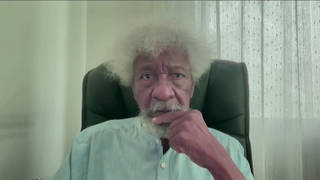
 Web ExclusiveNov 03, 2025Nigerian Nobel Laureate Wole Soyinka Likens Trump to Idi Amin, Shares Tips for Defying Authoritarianism
Transcript
AMY GOODMAN: President Bush arrived in Nigeria today, as he begins to wrap up his five-day, five-nation tour through Africa. The Nigerian government deployed 2,000 police ahead of Bush’s visit. Riot police, sniffer dog handlers, intelligence agents and bomb disposal teams swarm around the capital of Abuja.
Bush’s visit comes just four days after police fired rifle rounds and tear gas at strikers during protests in Abuja, Lagos and the southern oil city of Port Harcourt, killing at least ten people. Some estimate as many as sixteen. The Nigerian police report no lives were lost, drawing condemnation from Lagos residents.
The general strike was triggered when President Obasanjo announced an increase of more than 50 percent in gas prices. The protests shut Nigeria’s sea ports, banks, shops and industries, but oil terminals operated by ExxonMobil, ChevronTexaco, Agip and the Nigerian unit of Royal Dutch Shell stayed open. The strike was called off Tuesday after a deal was reached over fuel prices.
Though Nigeria is Africa’s largest oil producer, cranking out more than two million barrels a day, it suffers from massive fuel shortages for its own people. Perhaps the most powerful symbol of the Niger Delta is the gas flare, hundreds as high as buildings burning night and day. In some of these cases, these flares have roared continuously for forty years, since oil was discovered in Nigeria. Ogoni activist Ken Saro-Wiwa spoke often of the irony of children in the Delta growing up without electricity, but who have never known a dark night living in the shadow of the flame.
But a new fire is burning in the Delta. It’s the rage of millions of people kept in desperate poverty, providing power to the most powerful countries in the world while being kept powerless themselves. A decade after the hanging of Ken Saro-Wiwa and eight other minority rights activists, communities from the Delta have shut down a third of the country’s oil production through unprecedented acts of resistance, infuriating transnational oil corporations and their Nigerian military business partners. Helicopters, barges and oil-mining facilities belonging to corporations like Shell, Chevron and Texaco are being seized in protest of horrid living conditions and environmental devastation.
In an unprecedented protest in July of 2002, women peacefully occupied four ChevronTexaco oil pumping stations in the Niger Delta for ten days. They demanded Chevron build schools and hospitals in their villages, employ more of their people, and pay cash compensation for the pollution they say has destroyed their fishing industry. The women maintain control of the terminal by threatening to remove their clothes, a powerful traditional shaming method which would have humiliated Chevron in the eyes of the community.
The ties between Bush and Chevron are close. Bush’s National Security Adviser, Condoleezza Rice, is a former board member of Chevron for many years. The company even named an oil tanker after her, The Condoleezza Rice. Bush’s entourage to Africa includes scores of corporate executives hungry for Nigeria’s business. Tomorrow in Nigeria, Bush will meet with the chair and chief executive of ChevronTexaco, Dave O’Reilly, along with twelve African leaders and other corporate executives who have traveled with Bush to Africa. Other transnational corporations attending the summit include Archer Daniels Midland, ExxonMobil, Coca-Cola and Shell Petroleum.
Today we’ll take a look at one of the protests that took place in May of 1998 in the Niger Delta and the response of one of the transnational corporations, Chevron, the largest oil company — today we’ll take a look at one of the protests against Chevron that took place in the Niger Delta in May of 1998, and we’ll look at the response of Chevron, the third-largest oil company in Nigeria. But before we go to that documentary, Drilling and Killing: Chevron and Nigeria’s Oil Dictatorship, we wanted to play for you a brief excerpt of an interview I did on Pacifica station WBAI, along with WBAI’s Bernard White, with Ogoni activist Ken Saro-Wiwa. Ken came to the United States for the final time to let this country know what transnational corporations were doing in his country, Nigeria. This is Ken Saro-Wiwa in the United States just before he returned to Nigeria, was arrested and executed.
KEN SARO-WIWA: Shell does not want to negotiate with the Ogoni people. Each time they’ve come under pressure from local people, their want has always been to run to the Nigerian government and to say to the Nigerian government, “Oil is 90 percent of your foreign exchange earning. If anything happens to oil, your economy will be destroyed. Therefore, you must go and deal with these people, these troublemakers.” And most times, the government will oblige them and visit local communities of poor, dispossessed people with a lot of violence.
And when these communities then protested and said, “Look. Look at the amount of violence that is being used against us, even though we are only protesting peacefully,” then the oil companies will come and say, “Well, there is no way we can determine how much violence a government decides to use against its own people.” So, basically, the local communities have no leverage with the oil companies at all.
AMY GOODMAN: Who is the government now of Nigeria?
KEN SARO-WIWA: There is a military government in power at this time. And indeed, military people have been in power in the country for a long time.
AMY GOODMAN: Because they suspended the results of the elections?
KEN SARO-WIWA: Yes, indeed. But for a long time now, Nigeria has been under military dictatorships. And the oil companies like military dictatorships, because basically they can cheat with these dictatorships. The dictatorships are brutal to people, and they can deny the rights of — human rights of individuals and of communities quite easily, without compunction.
AMY GOODMAN: Ken Saro-Wiwa, how does the oil companies — how do Shell and Chevron deal with you as the president of the Movement for the Survival of the Ogoni People?
KEN SARO-WIWA: Well, recently, when the protests started, Shell, they had a meeting. And the operatives of Shell in Nigeria and of those at The Hague in the Netherlands, and in London, held a meeting, and they decided that they would have to keep an eye on me, watch wherever I go to, follow me constantly, to ensure that I do not embarrass Shell. So, as far as I’m concerned, I’m a marked man.
AMY GOODMAN: Ken Saro-Wiwa and eight other Ogoni rights activists were executed by the Nigerian military on November 10th, 1995. It was that interview that inspired me to one day go to Nigeria, the meeting of Ken Saro-Wiwa, as he explained what was happening in his country. Four years later, in August of 1998, I got a chance to go to Africa’s largest nation with Democracy Now! producer Jeremy Scahill. This is the documentary that comes from that trip.
OGONI MAN: Who killed Abiola?
CROWD: Soldier!
OGONI MAN: For oil money?
CROWD: Soldier!
OGONI MAN: Who killed Saro-Wiwa?
CROWD: Soldier!
OGONI MAN: For oil money?
CROWD: Soldier!
OGONI MAN: Who killed my nation?
CROWD: Soldier!
OGONI MAN: For oil money?
ORONTO DOUGLAS: Chevron, just like Shell, uses the military to protect its oil activities.
STEVE LAUTERBACH: The policy for all embassies overseas to support American companies and their operations abroad and to, as far as possible, promote American exports.
ORONTO DOUGLAS: Don’t pollute my water. Don’t destroy our mangrove forest. Don’t devastate our ecology.
They drill. And they kill.
AMY GOODMAN: Drilling and Killing: Chevron and Nigeria’s Oil Dictatorship.
JEREMY SCAHILL: An investigative report produced by Amy Goodman and Jeremy Scahill.
AMY GOODMAN: Nigeria, Africa’s most populous country, a nation that’s lived more than thirty years under a succession of military dictatorships, infamous for their corruption and ruthlessness.
JEREMY SCAHILL: Oil was discovered in Nigeria just before the country gained independence from the British in 1960. Since then there have been several coups and assassinations. But one thing has remained constant: the role of multinational oil companies in propping up the country’s military dictatorships.
CHIMA UBANI: They are simply continuing what theTransatlantic slave trade and British colonialism did to us in the past.
JEREMY SCAHILL: Chima Ubani is a member of Nigeria’s oldest human rights group, the Civil Liberties Organization. He has been imprisoned several times resisting military regimes.
CHIMA UBANI: And the struggles of our people today to rid ourselves of these agencies is merely an extension of our struggle for national independence. And our independence is not yet won, until we send these exploitative forces packing from our soil.
AMY GOODMAN: Oil is the lifeblood of the Nigerian regime, supplying the military with nearly 80 percent of its revenue, pumping more than $10 billion a year into the government, enriching corrupt generals and their cronies.
JEREMY SCAHILL: For nearly forty years, oil giants like Shell, Mobil and Chevron have worked in joint ventures with Nigeria’s dictatorships to exploit the country’s vast petroleum resources, often against the wishes of the local communities of the oil-rich Niger Delta. Protest against these oil giants has often resulted in a bloody response from their military business partners. Again, pro-democracy activist Chima Ubani.
CHIMA UBANI: Yes, it is the same kind of relationship that the slave masters had with those traditional rulers and local chiefs of that period who actually sold our people into slavery to the European and American slave masters. That is exactly what has happened all over. What we find is that the Nigerian military creates the conducive environment for these multinational companies to come and exploit our people. They impose laws that favor such an exploitation and disempower our people. And most importantly, when our people rise to fight against this exploitation, it is the Nigerian government that uses its own troops to suppress and kill our people for fighting against exploitation by foreign companies.
AMY GOODMAN: On November 10th, 1995, Nigerian dictator Sani Abacha hanged Ogoni activist and playwright Ken Saro-Wiwa and eight others. They were convicted by a kangaroo military court of murder. But their real crime was protesting the presence of Shell Oil on their land and the oil giant’s support for the military junta. Three years later, Ken Saro-Wiwa has become a martyr in the cause for justice in the Niger Delta.
And resistance to multinational oil companies is on the rise. Oronto Douglas is the founder of the Chicoco movement, named after the rich soil of the Delta.
ORONTO DOUGLAS: The Chicoco movement is a pan-Niger Delta resistance movement committed to reclaiming our humanity. We — over the years we have been dehumanized, our environment has been plundered, our people raped, some jailed, others hanged. And we feel the time has come that we should put our hands together to struggle together so that we can achieve justice together, because we live on the same ecosystem right across the Niger Delta.
OGONI MAN: Who killed Abiola?
CROWD: Soldier!
OGONI MAN: For oil money?
CROWD: Soldier!
OGONI MAN: Who killed Saro-Wiwa?
CROWD: Soldier!
OGONI MAN: For oil money?
CROWD: Soldier!
OGONI MAN: Who killed my nation?
CROWD: Soldier!
OGONI MAN: For oil money?
JEREMY SCAHILL: What follows is the story of a group of communities from the Niger Delta known as Ilajeland that plays host to a hungry guest: Chevron, the San Francisco-based multinational oil corporation. Last May, the company facilitated the killing of two indigenous activists who dared to demand compensation for the use of their oil-rich land.
AMY GOODMAN: Lagos is a city that reeks of fuel. Its busy streets are full of the commotion of motorcycles whizzing back and forth. Air-conditioned Mercedes Benzes and Peugeots crash through pothole-covered streets alongside decrepit buses stuffed with people. Children chase cars up and down the streets, selling everything from newspapers to bread to toothpaste. Little girls weave in and out of slowed traffic with large bowls of peanuts balanced carefully on their heads.
JEREMY SCAHILL: Many of the merchants on the street gravitate toward the long lines at gas stations, where people wait hours, sometimes days, for gas. These lines tell the sad story of a country that exports more oil than almost any other country on the continent, but suffers severe shortages for its own people. It is not unheard of in Nigeria for a gas station attendant who tells a soldier there is no gas left at his station to be shot and killed for bearing the bad news.
Nigeria has four oil refineries that refine fuel for domestic consumption, but it is rare that more than one is fully operational at any given time. This makes importing fuel a necessity for Nigeria.
AMY GOODMAN: And so the odd picture: in one of Africa’s largest oil-producing countries, gas stations with no gas are set against a backdrop of the headquarters of the world’s most powerful multinational oil corporations.
JEREMY SCAHILL: In August and September, we traveled to Nigeria to trace the flow of billions of petro-dollars back to its source, the heartland of oil country: the Niger Delta.
AMY GOODMAN: After searching Lagos for a car that would have enough fuel for a long trip, we drive five hours south of the city. Along the way, we pass more than a dozen military roadblocks manned by soldiers holding semi-automatic machine guns and horsewhips. At some of these roadblocks along the way, soldiers force our driver out of the car and demand money from him in order to pass.
JEREMY SCAHILL: We knew the reports of soldiers murdering drivers who refused to pay. Nigeria is one of the most corrupt countries in the world. The extortion at these stops can be as routine as paying a toll. The difference is the imminent threat of violence at every point.
AMY GOODMAN: Approaching the port town of Igbokoda, we’re forced out of the car. This particular checkpoint is manned not only by the military, but also by the police, the feared state security service, and a Nigerian customs agent. As they demand to see our passports, one of the officers begins to let the air out of our tires. Even with angry threats of detention, our guides manage to diffuse the situation, and we move on to Igbokoda.
JEREMY SCAHILL: There we rent a speedboat. As we head down one of the hundreds of creeks of the Niger Delta, we pass women canoeing slowly by, many transporting large plastic containers for water. The water in these riverain communities is too polluted to drink, as canals dug by Chevron have caused the saltwater of the Atlantic Ocean to invade the freshwater of Ilajeland. Villagers also complain that the canals, which the oil company contends facilitate local commerce, have led to severe erosion, causing whole communities to up and move.
AMY GOODMAN: Dead pigs dot the shallow banks. Villagers say the pigs and other animals have been dying in droves after a recent Chevron oil spill.
VILLAGER: I depend on the pigs and some other domestic animals for my livelihood. And now all of them are dead. I don’t know how I can survive, I am hungry.
JEREMY SCAHILL: This recent spill hits especially hard, coming just two months after two members of the community were shot dead protesting the desperate conditions in Ilajeland. That is what the villagers want to talk about today.
AMY GOODMAN: We walk along planks above the swampy ground to a shack on stilts with walls of raffia palm. As the sun goes down, villagers crowd into the dimly lit space to tell us their story.
MALUMI: We welcome you on behalf of the forty-two communities in the Chevron operational area in Ilajeland. We thank you sincerely for taking the pains to come to our community. And you can see our environment, how it is. It has been devastated. But once again, we welcome you on behalf of the forty-two communities.
JEREMY SCAHILL: The room is packed with people. It is a sweaty, hot Delta evening. Little kids peer over the shoulders of their parents outside the windows as one of the elders of the community recounts their story. It begins on Monday May 25th, 1998. The villagers say on that day more than 100 youths from forty-two communities of Ilajeland traveled by canoe and speedboat miles into the Atlantic Ocean, where Chevron has an offshore drilling facility known as the Parabe platform. The youths then proceeded to occupy the barge that was servicing the platform. Chief Nicolas Amamoa is an Ilaje elder.
CHIEF NICOLAS AMAMOA: [translated] When our children went to offshore, they went there to demand for their rights, our rights.
AMY GOODMAN: The villagers say they were fed up. They had written Chevron several unanswered letters and scheduled meetings that didn’t happen. While the Nigerian military regime says Chevron’s offshore facilities lie in federal territorial waters, the people of Ilajeland see it differently. They see themselves as host communities paying the price of oil exploitation and reaping little benefit.
Environmentalist Oronto Douglas is a lawyer from the Niger Delta. He says the demands of the community were modest.
ORONTO DOUGLAS: I said that, “Don’t pollute my water. Don’t destroy our mangrove forest. Don’t devastate our ecology. Come and listen to us. Come and talk to our elders.”
JEREMY SCAHILL: Coming up, activists occupy the barge. Chevron and the military respond.
UNIDENTIFIED: Soldiers, they don’t give any warning. They care their shooting. They don’t even care to listen to anything. They just care their shooting.
AMY GOODMAN: You’re listening to Democracy Now!
's investigative report, Drilling and Killing: Chevron and Nigeria's Oil Dictatorship. We’ll be back in a minute.
[break]
AMY GOODMAN: This is Pacifica Radio’s Democracy Now!, an investigative special, Drilling and Killing: Chevron and Nigeria’s Oil Dictatorship. I’m Amy Goodman, with Jeremy Scahill.
JEREMY SCAHILL: On May 25th, 1998, more than 100 activists from the forty-two communities of Ilajeland went by speedboat and canoe to Chevron’s Parabe platform and the barge that was servicing it miles into the Atlantic Ocean. They say it was the only way to get the attention of Chevron’s management. Larry Bowoto is one of the activists who occupied Chevron’s facility.
LARRY BOWOTO: I went there for peaceful demonstration, because of the activities of Chevron in our area. We went there to just protest for the development of our community, because for thirty years — or thirty-two years now which Chevron is operating, we don’t have anything. So that is the reason we went there.
AMY GOODMAN: According to the activists, they boarded the barge, approached a member of the Nigerian navy, and told him they were there to express their grievances to Chevron’s management. Bola Oyinbo was one of the leaders of the occupation.
BOLA OYINBO: We don’t even have any weapon, not even a placard. But this is our grievances. We have been marginalized. That is why we are here. We’ve called Chevron. They refused to come. That is why we are here and want them to come to us here on the barge.
JEREMY SCAHILL: The activists demanded to meet with Chevron’s managing director, an American named George Kirkland. But instead, Chevron sent a helicopter to the barge with a Nigerian employee in charge of community relations. The activists told him to go and speak with their elders onshore.
When Chevron’s representative arrived at the community, the people presented their demands: clean drinking water, electricity, environmental reparations, employment and scholarships for youths, and rebuilding the eroding riverbanks. Chevron agreed to more jobs on the current project, but the company’s representative said he’d have to get back to the community in the next few days on the issue of reparations.
AMY GOODMAN: The demands of the villagers were hardly unusual, and neither were the actions they took. Barge occupations at offshore sites, roadblocks at onshore facilities, taking tugboats hostage, they’re all part of an increasingly angry resistance movement in the Niger Delta. Communities are fed up with providing fuel that powers the wealthiest countries in the world, while being left powerless themselves. In fact, just a few months earlier, another community in the area with grievances against Chevron had occupied its offshore facility, as well. What was different this time was Chevron’s response.
JEREMY SCAHILL: At this point, the work onboard the barge had been stopped for almost four days, which meant Chevron was losing money. But villagers say they thought they were still waiting for Chevron’s final response to their demands when helicopters descended on the platform.
Parrere is one of the youth leaders who occupied Chevron’s facility.
PARRERE: We just saw three helicopters coming. We were looking at all these helicopters, thinking that probably people inside these helicopters might have been Chevron’s reps who are actually coming to dialogue with us here. But I was at the top of the platform looking at the helicopters when they were about to land. They were about to land, when we heard shooting of tear gases and guns.
AMY GOODMAN: Larry Bowoto , another of the activists onboard, describes what he saw.
LARRY BOWOTO: About three chopper helicopters came there early in the morning when everybody’s sleeping, when we see that the helicopter landed with soldier men.
AMY GOODMAN: With soldier men?
LARRY BOWOTO: With soldier men. Before we discover, we hear the sound of gunshot. The next thing, they shot two of our guys.
AMY GOODMAN: The two protesters who were shot and killed on the barge were named Jola Ogungbeje and Aroleka Irowaninu. Again, Larry Bowoto.
LARRY BOWOTO: When they shot these two guys, I was rushing there to rescue this guy. When I am trying to rescue them, it is then they shot me. When they shot me with gun, I fell. It is then one of them stabbed me. From there, I don’t know what happened again.
JEREMY SCAHILL: Larry Bowoto was shot several times, including in the buttocks, which meant he was shot from behind. He was also stabbed. He remained in the hospital for nearly a month.
AMY GOODMAN: The brother of one of the two men killed that day was also on the barge. His name is Tayee Irowaninu. He speaks through a translator.
TAYEE IROWANINU: [translated] What happened is, when my brother now fell down and I saw that he was dead, I now decided I’m not going to leave my brother there. And what happened is they now locked us up in a particular container.
JEREMY SCAHILL: When we returned to Lagos, we looked up Bill Spencer, resident area manager of ETPM Services, the company that leased the barge to Chevron. We find him in his office in Lagos. Listen carefully.
AMY GOODMAN: What is the twenty-foot —- what are containers used for?
BILL SPENCER: It’s just a regular shipping containers that you see on the boats. They usually take supplies out in them. They take stores in them. Sometimes they use them as a store.
AMY GOODMAN: Uh-huh, to store things. Are they plastic?
BILL SPENCER: No, they’re metal. Just an ordinary, everyday shipping container. You know, they’re twenty foot by eight feet by eight feet, with big doors on the end.
AMY GOODMAN: Spencer is talking about the container onboard the barge.
BILL SPENCER: Be a good a place to put people as any. We don’t actually have a prison onboard. A brig. I guess we should put one in.
AMY GOODMAN: He says, “We don’t actually have a prison onboard. A brig,” then adds, “I guess we should put one in.”
JEREMY SCAHILL: Though we talked with several contractors working for Chevron at the time of the killings, only Bill Spencer was willing to go on the record. His company ETPM Services provides barges and workers for most of the oil multinationals in Nigeria. We talked with Spencer for more than five hours at his office on Victoria Island, a wealthy area of Lagos that houses foreign embassies and the Nigerian headquarters of multinational corporations. It was on this island that we visited the Chevron compound, a heavily secured, walled-in community. Behind those well-guarded walls looks like any American suburb, complete with its own bank and supermarket.
AMY GOODMAN: It was in this compound we found Sola Omole, Chevron’s general manager of public affairs. He talked about the occupation of the barge.
SOLA OMOLE: We’re talking about an invasion. We’re talking about kidnap. We’re talking about piracy of the highest order.
AMY GOODMAN: Until now, Chevron has claimed that its only action against the occupation was to call the federal authorities and tell them what was happening. But in a startling admission in a three-hour interview with Democracy Now!, Chevron spokesperson Sola Omole acknowledged that Chevron did much more. He admitted that Chevron actually flew in the soldiers who did the killing. And he further admitted that those men were from the notorious Nigerian navy.
SOLA OMOLE: I guess -—
AMY GOODMAN: Who took them in?
SOLA OMOLE: What’s that?
AMY GOODMAN: Who took them in?
SOLA OMOLE: Who took them in?
AMY GOODMAN: On Thursday morning, the Mobile Police, the navy?
SOLA OMOLE: We did. We did. We did. We, Chevron, did. We took them there.
AMY GOODMAN: By how?
SOLA OMOLE: Helicopters. Yes, we took them in.
AMY GOODMAN: Who authorized the call for the military to come in?
SOLA OMOLE: Chevron’s management.
JEREMY SCAHILL: Chevron’s management. So, Chevron authorized the call for the military and transported the navy to the barge. On top of that, Chevron’s acting head of security, James Neku, flew in with the military the day of the attack.
AMY GOODMAN: Were you on that helicopter?
JAMES NEKU: Yes, I was in the helicopter.
AMY GOODMAN: And how many people were there in that helicopter?
JAMES NEKU: That helicopter had seven — six of us. There were six of us, six officers.
AMY GOODMAN: Including the Chevron pilot or not including?
JAMES NEKU: I think excluding the pilot. Including the pilot would be seven.
AMY GOODMAN: And then, was it a mix of navy and —-
JAMES NEKU: A mix of navy and the police. The police were armed with tear smokes.
AMY GOODMAN: Was it the regular police or the Mobile Police?
JAMES NEKU: Mobile Police.
AMY GOODMAN: The Mobile Police, also known as the “Kill ‘n’ Go.” That’s the Kill and Go. Shell Oil, the largest producer of oil in Nigeria, came under heavy international condemnation in recent years for their use of the Mobile Police, forcing them to publicly renounce the use of the Kill and Go because of their brutal record in Ogoniland.
ORONTO DOUGLAS: They shoot without question. They kill. They maim. They rape. They destroy.
AMY GOODMAN: Environmental lawyer Oronto Douglas was one of the lawyers on Ken Saro-Wiwa’s defense team.
ORONTO DOUGLAS: The Kill and Go are a murderous band of undisciplined paramilitary Mobile Police force. Their order is to kill. When they go to a community, it’s not to maintain peace, it is not to maintain order.
AMY GOODMAN: It was for exposing the relationship between the Mobile Police, the Nigerian regime’s henchmen, and a multinational oil giant that Ogoni activist Ken Saro-Wiwa was ultimately executed.
OGONI MAN: Great Ogoni people!
CROWD: Great!
OGONI MAN: Great Ogoni people!
CROWD: Great!
OGONI MAN: I have devoted all my intellectual and material resources, my very life, to a cause in which I have total belief and from which I cannot be intimidated or blackmailed.
JEREMY SCAHILL: An Ogoni man reciting the last speech of Ken Saro-Wiwa.
OGONI MAN: I have no doubt at all about the ultimate success of my cause, no matter the trials and tribulations which I and those who believe with me may encounter on our journey. Neither imprisonment nor death can stop our ultimate victory. I repeat that we all stand before history. I and my colleagues are not the only ones on trial. Shell is here on trial, and it is as well that…
JEREMY SCAHILL: When we visited the parents of Ken Saro-Wiwa a few days before coming to Ilajeland, this man stood up and recited Saro-Wiwa’s closing statement before the military tribunal that would ultimately hang him.
OGONI MAN: In my innocence of the false charge I face here, in my utter conviction, I call upon the Ogoni people, the peoples of the Niger Delta and the oppressed ethnic minorities of Nigeria to stand up now and fight fearlessly and peacefully for their rights. History is on their side. God is on their side. Bene Ogoni!
AMY GOODMAN: Ogoni leader Ken Saro-Wiwa’s final words of resistance continue to echo throughout the Niger Delta, but so does the fierce response from the Nigerian regime and its multinational partners.
This is a Democracy Now! special, Drilling and Killing: Chevron and Nigeria’s Oil Dictatorship.
JEREMY SCAHILL: And so, here we have, on May 28th, 1998, Chevron flying in the Nigerian navy and the Mobile Police to confront a group of villagers who thought they were in the midst of a negotiation with the oil giant, which brings us to another admission by Chevron spokesperson Sola Omole. Again, listen carefully.
AMY GOODMAN: Were any of the youths armed?
SOLA OMOLE: I don’t know. I don’t know. I don’t know. So I cannot say that they came armed with -— there was talk about local charms and all that, but that’s neither here nor there.
AMY GOODMAN: So, you don’t think that they came onto the boat armed, you’re saying?
SOLA OMOLE: No. No.
AMY GOODMAN: The youths.
SOLA OMOLE: Mm-hmm.
ORONTO DOUGLAS: It is very clear that Chevron, just like Shell, uses the military to protect its oil activities. They drill. And they kill.
JEREMY SCAHILL: Again, environmentalist Oronto Douglas.
ORONTO DOUGLAS: They are shooting our people for just demanding for their right.
AMY GOODMAN: Chevron contends that when the helicopters landed on the barge, the soldiers got out and issued a warning that if the villagers calmly dispersed, they would not be hurt. Villagers say there was no such warning, that the soldiers simply started shooting. Either way, where could those who had occupied the barge disperse to? The barge was surrounded by water in the Atlantic Ocean, miles from shore.
JEREMY SCAHILL: They were then tear-gassed and shot. While Chevron security chief James Neku says that two of the villagers tried to disarm a soldier, which is why they were shot dead, Chevron contractor Bill Spencer says one of the men who was killed was actually trying to mediate the situation.
The final tally: two dead, one shot and seriously wounded, and reports of other injuries. And what of the eleven activists locked in the shipping container? They say they were held there for hours in what they described as suffocating heat. They were then transported to several jails in the dreaded Nigerian prison system. After three weeks, they were released.
AMY GOODMAN: Bola Oyinbo was one of the eleven activists imprisoned after the barge occupation. He says the prison authorities tried to extract a confession of piracy and destruction of property from him by torturing him. They began with handcuffs.
BOLA OYINBO: They used the handcuff to hang me on a fan for almost five hours.
AMY GOODMAN: Wait a second. They put you in handcuffs and hung you?
BOLA OYINBO: Hung me. And there’s a hook they use for ceiling fans. So they put me there for almost five hours.
AMY GOODMAN: They hung you from a ceiling fan hook?
BOLA OYINBO: Hook, yes.
AMY GOODMAN: For five hours.
BOLA OYINBO: Five good hours.
AMY GOODMAN: Your feet weren’t on the floor?
BOLA OYINBO: My feet were not on the floor. I was hung, suspended in the air.
JEREMY SCAHILL: We asked Bill Spencer what he thinks of the torture Bola Oyinbo says he endured.
BILL SPENCER: I don’t think anybody here really is under the impression that when you go to jail in Nigeria, it’s pleasant.
AMY GOODMAN: Was there concern about the young people who were held in detention? Was there any follow-up?
BILL SPENCER: By me? Not at all. No.
AMY GOODMAN: Were you concerned about them in detention?
BILL SPENCER: I was more concerned about the 200 people that work for me. I could care less about the people from the village, quite frankly.
AMY GOODMAN: But once your people were safe?
BILL SPENCER: Did I personally have any concern for them? Not one little bit.
ORONTO DOUGLAS: Two people dead, several people injured, and there is now still a threat of clampdown on the local people.
JEREMY SCAHILL: Again, environmentalist Oronto Douglas.
ORONTO DOUGLAS: What have they done? They have simply asked for: take care on our environment; give us a cup of water to drink, because you have polluted our water; give us the means of livelihood so that we can survive as a people. Is that too much?
AMY GOODMAN: Coming up in the final segment of this special investigation.
ORONTO DOUGLAS: They are professional undertakers. They are here to kill, because they must produce oil for the American people.
STEVE LAUTERBACH: It’s, generally speaking, the policy for all embassies overseas to support American companies and their operations abroad and to, as far as possible, promote American exports.
ORONTO DOUGLAS: They drill. And they kill.
OGONI MAN: Who killed Abiola?
CROWD: Soldier!
OGONI MAN: For oil money?
CROWD: Soldier!
OGONI MAN: Who killed Saro-Wiwa?
CROWD: Soldier!
OGONI MAN: For oil money?
CROWD: Soldier!
OGONI MAN: Who killed my nation?
CROWD: Soldier!
OGONI MAN: For oil money?
CROWD: Soldier!
AMY GOODMAN: Drilling and Killing: Chevron and Nigeria’s Oil Dictatorship. Stay tuned for the final segment of this special investigation here on Pacifica Radio’s Democracy Now! We’ll be back in a minute.
[break]
AMY GOODMAN: This is Pacifica Radio’s Democracy Now!, an investigative special, Drilling and Killing: Chevron and Nigeria’s Oil Dictatorship. I’m Amy Goodman, with Jeremy Scahill.
In all of our conversations with contractors, we asked them their thoughts on working with a military government. One said, quote, “In uncivilized countries like these, democracy brings nothing to the table.” Chevron contractor Bill Spencer expressed similar thoughts.
BILL SPENCER: My thoughts on it? I don’t have any. That’s their business. It isn’t mine, you know?
AMY GOODMAN: Mm-hmm.
BILL SPENCER: I’m not leading a moral campaign. Just here to do our — to work. Strictly commercial venture. Not a political one.
JEREMY SCAHILL: When you talk about the Mobile Police or the navy, and, you know, you acknowledge that they can be quite ruthless or could be prone to, you know, beating people on the street, do you have any reservation about working with those forces, knowing or acknowledging that they can, in fact, be ruthless?
BILL SPENCER: No, I don’t know. Life is tough here. And people, I think — you know, you often hear it said that life is cheap here. And I guess it is. And it’s looked at a little differently. I think that that’s something that doesn’t happen in our society. Our life is a little more — maybe a little more precious or whatever. But I think here it’s — in any of these, any of the countries, developing countries, it tends to be a little cheaper.
JEREMY SCAHILL: But who thinks life is cheap? The general population or the generals? Chief Gani Fawehinmi is Nigeria’s leading human rights activist. He says the Nigerian government revolves around a gun.
CHIEF GANI FAWEHINMI: They govern with a gun. They loot with a gun. They rob the resources of this country with a gun. The gun in Nigeria is not used to protect and advance the liberty of Nigerian people. It’s used to suppress and repress the hopes and aspirations of Nigerian people.
AMY GOODMAN: Among human rights activists, it’s accepted as fact that the Nigerian military serve as hired guns that protect the interests of the multinational oil companies in the Delta. But most oil companies do not want to admit this. Chevron spokesperson Sola Omole.
AMY GOODMAN: Does Chevron give special duty pay to the naval officers who are onboard, you know, for the whole time, not to the Mobile Police who are onboard on these barges?
SOLA OMOLE: Those guys were working for the contractor. I guess you have to ask the contractor that.
AMY GOODMAN: In terms of special duty pay. But ultimately you said that since they’re all working for Chevron, that Chevron’s ultimately responsible for that, because you’re paying the contractor.
SOLA OMOLE: Well, you’ll have to ask the contractor, really.
JEREMY SCAHILL: And so we did. We headed back to Chevron contractor Bill Spencer’s office and asked him who paid for the military housed onboard the barge, as well as those who came in by helicopter the day of the attack. To be absolutely sure, Bill Spencer called his head of operations in the Delta, Habib Fadel. In fact, we had visited Habib several days before in the Delta, but he did not want to go on record. Now, through Spencer, he did.
BILL SPENCER: Yeah. Habib. Say, on the day of the brig 101, we seem to be — we’re doing an inquest here for the benefit of who knows who, but… Who paid for the military that day? Were they ours, or were they Chevron’s? The ones actually that were living on the barge in the long term. Mm-hmm. Were they Chevron’s regular guys from — do you know? Oh, OK, from Escravos. Anytime we hire the navy, we go through the — I hesitate to say the high command, but anyway. Yeah, I knew we went through — OK, yeah. So we went — we usually — if it’s Chevron, we go through Chevron to do it. And then, in that — if we do it that way, if it’s done that way, we would pay whatever that is to the navy base. Oh, OK. OK.
AMY GOODMAN: What about on Thursday morning?
BILL SPENCER: Just I’ve already asked that.
AMY GOODMAN: Oh.
BILL SPENCER: Yeah, OK, that’s it. If there’s anything else, I’ll give you a call. Yeah, bye.
They were not ours. They were paid — they were supplied by Chevron.
AMY GOODMAN: On Thursday morning, too.
BILL SPENCER: All of them. Everybody that was out there.
AMY GOODMAN: And how does Chevron feel about its partnership with the Nigerian military? Company spokesperson Sola Omole.
AMY GOODMAN: You can’t speak for the military, but if Chevron is working with the military, calling the military in, then doesn’t Chevron bear some of the responsibility for what the military does?
SOLA OMOLE: No. We told you that this is a joint vent… We’re just using military. This thing is owned by Nigeria. Sixty percent by Nigeria. Military is just one component.
JEREMY SCAHILL: It’s a military government.
SOLA OMOLE: Excuse me, please. I’m not talking about government.
AMY GOODMAN: You would not be willing to criticize the Nigerian military for illegal detentions, for deaths in custody?
SOLA OMOLE: Now we’re going — now we’re going into other areas, and I think we need to bring this to a close.
AMY GOODMAN: But it’s the same area —-
SOLA OMOLE: I’m sorry. I’m sorry.
AMY GOODMAN: —- because the military killed two people on your barge.
SOLA OMOLE: I’m sorry. I’m sorry. We’ve got to bring this to a close now. Thank you very much.
AMY GOODMAN: So you have a deadly combination: a military with a miserable human rights record that’s employed by one sector of society — corporations with an interest in suppressing dissent and maintaining their free and open access to oil in the Delta. It’s this relationship, says Nigerian environmental activist Oronto Douglas, that killed the villagers of Ilaje.
ORONTO DOUGLAS: Two people shot dead, several injured, and the community is in poverty. Look at the darkness. Look at the wretchedness. Look at the helplessness. This is what cannot be tolerated in the United States of America, where Chevron comes from.
JEREMY SCAHILL: And what about the United States, where Chevron is based? Though the execution of Ken Saro-Wiwa and eight other Ogoni activists drew widespread international condemnation, the United States government refused to impose oil sanctions against the Nigerian regime. The US continues to buy nearly half of the dictatorship’s oil.
Steve Lauterbach is the spokesperson for the US embassy in Lagos, Nigeria.
STEVE LAUTERBACH: It’s, generally speaking, the policy for all embassies overseas to support American companies and their operations abroad and to, as far as possible, promote American exports overseas. That applies in Nigeria, and it applies in almost every embassy overseas.
AMY GOODMAN: It’s general practice here, just going around the country, we have found, through the Niger Delta and all around, that the US multinationals and the oil corporations here hire the military as security, either the Nigerian military or the Mobile Police. Does the US embassy have a position on that?
STEVE LAUTERBACH: I’m not aware of any position that we — official position we have on that. No, I can’t comment on that.
AMY GOODMAN: Commenting on US policy is something Gani Fawehinmi has no trouble doing. As the leading human rights lawyer in Nigeria, he knows the military regimes of his country. He’s been imprisoned by them dozens of times. He was the lead counsel for Ogoni activist Ken Saro-Wiwa and represents dozens of other Delta activists in and out of jail. He says if the United States and the European Union or EU countries would impose oil sanctions, the Nigerian regime would fall in less than two to three months.
CHIEF GANI FAWEHINMI: If America imposes oil sanctions today, and it is supported by the EU countries, this government military will be brought down to its knees in less than two to three months.
AMY GOODMAN: Chief Fawhinmi says the military would never find its way back to the body politic of Nigeria.
JEREMY SCAHILL: As for the two men killed during the attack, Chevron returned their bodies to the families more than a month after they were killed. The company has agreed to pay what it calls burial expenses to the families, but says this is not compensation. Nigerian environmental attorney Oronto Douglas scoffs at the payment.
ORONTO DOUGLAS: Now, they have improved by now paying 450,000 naira. They are professional undertakers. They are here to kill, because they must produce this oil for the American people. So it is important to note that this kind of situation has continued without any remorse whatsoever from Chevron. And I am very sure that more killings in Chevron’s area of operation will continue in the years to come, in the months ahead, because as the company gets more desperate, as the community continues to resist environmental degradation, exploitation and the continuous neglect of their local ecology and their way of life, there will be that protest, that resistance for survival.
AMY GOODMAN: After a brief hiatus following the killing, Chevron has just resumed its operations off the shore of Ilajeland. And Chevron’s contractor, Bill Spencer, says that once again Chevron is bringing in the navy.
JEREMY SCAHILL: And the young people of Ilajeland are coming out in force, as well. Sowore Omoyele was born there. He went on to study at the University of Lagos, where he became student body president. When he learned of the killings, he called Ilaje students together at the university to organize a fitting memorial service for the two men killed onboard the Chevron barge.
SOWORE OMOYELE: What we are saying is that Chevron have come to destroy our lands, doing what they cannot tolerate in America. They would never have tolerated a black man to come and mine oil in America, talk less of allowing this such a black person to kill American youths. But that is what is happening here. The youths will take over this fight effectively on behalf of our fathers. Those of our colleagues that were murdered, we are coming for a proper, befitting remembrance for these youths. I want to draw the attention of the whole world for a proper, befitting remembrance for these youths. I want to draw the attention of the whole world to our community and the fact that we are becoming fast, even faster than the Ogonis, an endangered species of human beings.
AMY GOODMAN: At the time of the recording of this report, Democracy Now! got word that Sowore Omoyele has been arrested. He was in the midst of arranging that befitting memorial service for the two protesters killed on May 28th at the Chevron offshore drilling site.
OGONI MAN: Who killed Abiola?
CROWD: Soldier!
OGONI MAN: For oil money?
CROWD: Soldier!
OGONI MAN: Who killed Saro-Wiwa?
CROWD: Soldier!
OGONI MAN: For oil money?
CROWD: Soldier!
OGONI MAN: Who killed my nation?
CROWD: Soldier!
OGONI MAN: For oil money?
ORONTO DOUGLAS: Chevron, just like Shell, uses the military to protect its oil activities.
STEVE LAUTERBACH: The policy for all embassies overseas to support American companies and their operations abroad and to, as far as possible, promote American exports.
ORONTO DOUGLAS: Don’t pollute my water. Don’t destroy our mangrove forest. Don’t devastate our ecology.
They drill. And they kill.
BOLA OYINBO: They used the handcuff to hang me on a fan for almost five hours.
AMY GOODMAN: Wait a second. They put you in handcuffs and hung you?
BOLA OYINBO: And there’s a hook they use for ceiling fans. So they put me there for almost five hours.
AMY GOODMAN: They hung you from a ceiling fan hook?
BOLA OYINBO: Hook, yes.
AMY GOODMAN: For five hours.
BOLA OYINBO: Five good hours.
AMY GOODMAN: Your feet weren’t on the floor?
BOLA OYINBO: My feet were not on the floor. I was hung, suspended in the air.
BILL SPENCER: I don’t think anybody here really is under the impression that when you go to jail in Nigeria, it’s pleasant.
AMY GOODMAN: Was there concern about the young people who were held in detention? Was there any follow-up?
BILL SPENCER: By me? Not at all. No.
AMY GOODMAN: Were you concerned about them in detention?
BILL SPENCER: I was more concerned about the 200 people that work for me. I could care less about the people from the village, quite frankly.
AMY GOODMAN: But once your people were safe?
BILL SPENCER: Did I personally have any concern for them? Not one little bit.
ORONTO DOUGLAS: Two people dead, several people injured, and there is now still a threat of clampdown on the local people. What have they done? They have simply asked for: take care on our environment; give us a cup of water to drink, because you have polluted our water; give us the means of livelihood so that we can survive as a people. Is that too much?
BILL SPENCER: And people, I think — you know, you often hear it said that life is cheap here. And I guess it is. And it’s looked at a little differently. I think that that’s something that doesn’t happen in our society. Our life is a little more — maybe a little more precious or whatever. But I think here it’s — in any of these, any of the countries, developing countries, it tends to be a little cheaper.
CHIEF GANI FAWEHINMI: They govern with a gun. They loot with a gun. They rob the resources of this country with a gun.
AMY GOODMAN: But ultimately you said that since they’re all working for Chevron, that Chevron’s ultimately responsible for that, because you’re paying the contractor.
SOLA OMOLE: Well, you’ll have to ask the contractor, really.
BILL SPENCER: They were not ours. They were paid — they were supplied by Chevron.
AMY GOODMAN: On Thursday morning, too.
BILL SPENCER: All of them. Everybody that was out there.
AMY GOODMAN: After this documentary was produced, Sowore Omoyele left Nigeria. He is now a graduate student at Columbia University in New York City.
Condoleezza Rice served on the board of directors of Chevron at the time of the killings. Today she is President Bush’s National Security Adviser, traveling with him in Nigeria. Chevron highlighted her dedication to the firm by naming a 130,000-ton oil tanker after her.
In May 1999, Larry Bowoto and families of victims of the killings filed a landmark lawsuit against Chevron in a US court. ChevronTexaco has repeatedly attempted to have the suit thrown out, without success. On May 23rd, 2003, a court in San Francisco heard oral arguments to decide whether the victims can sue the parent company ChevronTexaco rather than its Nigerian subisidiary ChevronTexaco Nigeria Ltd. According to the Center for Constitutional Rights, if the court backs the victims, it will greatly aid several other human rights cases currently pending in US courts that seek to hold multinational corporations responsible for their involvement in human rights abuses abroad.
Drilling and Killing: Chevron and Nigeria’s Oil Dictatorship was produced by Amy Goodman and Jeremy Scahill, mixed and engineered by Dred-Scott Keyes. Special thanks to Elizabeth Press, Errol Maitland and Mike Fleishman. Democracy Now! is produced by Kris Abrams, Mike Burke, Sharif Abdel Kouddous, Angie Karran, Ana Nogueira. Rich Kim engineered today’s show. Also special thanks to WBAI in New York, where we produced the original documentary and to Bruce Wirth and Kristen Walsh of KBCS in Seattle.
If you’d like to get a copy, video or audio, of today’s program, you can call 1 (800) 881-2359. That’s 1 (800) 881-2359. For more information about Drilling and Killing, our transcript, as well as photographs of our trip, you can go to our website at www.democracynow.org. That’s www.democracynow.org. And you can email us at mail(at)democracynow.org.



 Top
Top
Media Options