








 Watch Full Show

Related
Guests
- Martin Luther Kingspeaking at the Lincoln Memorial Aug. 28, 1963, at the March on Washington.
- Martin Luther King IIIpresident of the Southern Christian Leadership Conference.
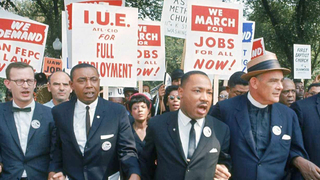
On August 28, 1963, a crowd of more than 250,000 people gathered in Washington, D.C., and marched to the Capitol Building to support the passing of laws that guaranteed every American equal civil rights. We speak with Martin Luther King III, who is leading a mass rally at the foot of the Lincoln Memorial to mark the 40th anniversary of the historic march.
Related Story
 StoryAug 29, 2013Historian Taylor Branch on the March on Washington and the Kennedys’ Aversion to Dr. King’s Struggle
Transcript
AMY GOODMAN: It was August 28, 1963. A crowd of more than a quarter of a million people gathered in Washington, D.C., marched to the Capitol Building to support the passing of laws that guaranteed every American equal rights. Dr. Martin Luther King Jr. was at the front of the March on Washington. On the steps of the Lincoln Memorial that day, Dr. King delivered a speech that was later entitled “I Have a Dream.” The march was one of the largest gatherings of white people and people of color the nation’s capital had ever seen. No violence occurred.
On August 27, 1963, on the eve of the march, civil rights leader W.E.B. Du Bois died in Ghana. He was the author of more than 20 books, two novels, a play, numerous articles and essays, a leading supporter of socialism and pan-Africanism.
The 1963 march was put together to draw attention to black unemployment and discrimination and a civil rights bill that, when it was passed in 1964, outlawed segregation in businesses and public places, and employment discrimination.
Aside from the crowd and the international attention it garnered, the march was highlighted by King’s speech, in which he, among other things, expressed hope that racial harmony could be accomplished and that children, quote, “will not be judged by the color of their skin but by the content of their character.”
On April 4, 1968, Dr. Martin Luther King was assassinated.
To mark the 40th anniversary of the march, Dr. King’s son, Martin Luther King III, will lead a coalition of over a hundred labor, peace, justice and human rights groups to a mass rally at the foot of the Lincoln Memorial this Saturday to kick off a 15-month political action movement against increased U.S. militarism, class warfare and the so-called “war on terror.”
We’re joined right now by Martin Luther King III, president of the Southern Christian Leadership Conference.
It’s good to have you with us.
MARTIN LUTHER KING III: Thank you for the opportunity. It’s certainly good to be here today.
AMY GOODMAN: Can you talk about what your plans are for this weekend?
MARTIN LUTHER KING III: Well, today at 2—excuse me, 4:00 p.m. this afternoon, right on the steps right behind where I’m standing today, the spot where my father delivered the “I Have a Dream” speech will be dedicated. The park service has etched out a specific spot where the actual presentation took place in 1963. That will be at 4:00. And then, at 6:30 or so on these same grounds, there will be a prayer vigil that will last until around 8:45. And then, at 9:00, we have something for young people, the spoken word, which will come in the form of poetry that will be read by a number of different persons.
And then, on tomorrow, we start at 10:00 in the morning right here on these grounds. We have several tents where teach-ins will take place, teach-ins on issues like HIV/AIDS, issues like the criminal justice system, issues like voter education, and—just to name a few. And then, of course, in the afternoon at about 2:30, we will begin the rally and march, where the traditional civil and human rights leaders will be speaking, like Reverend Sharpton, Reverend Jackson, my mother, Coretta Scott King, as well Julian Bond, as well as Kim Gandy from the National Organization for Women, just to name a few. And then there will be a number of young persons on the program, which we’re very excited about—the sit-in generation meeting with the hip-hop generation, so that we can continue [inaudible] process of change. It’s so important that these young people—over half the program tomorrow afternoon will be young people between the ages of 20 and 30. What I say is that the teach-ins give you information. The march and rally gives you inspiration.
AMY GOODMAN: We’re talking to Martin Luther King III about the march on Washington this weekend commemorating 40 years ago. You’re working on the issue of disenfranchisement. You’re working on that issue that brought the—that brought George Bush to the White House. Can you talk about what you’re doing with investigative reporter Greg Palast?
MARTIN LUTHER KING III: Well, number one, we are basically—have stated a position that we are against the form and method of unified voting machines, because if people can use technology in the way that was used—or has been used here recently, they can almost control an election. And so, until we have a better way of actually ensuring that a machine is foolproof and that—the results that you actually designate, you’re going to get. And it’s going to take some time. I think, ultimately, no one is against technology, but we’re against the way that the system is being used now. And so we started a petition drive all over this country to encourage people to get informed and understand that you could in fact be disenfranchised, go and vote and cast your vote for one candidate, and it ends up in the category of another candidate. So we want as many people to this issue as possible, because in the elections, not—in 2000, of course, we know what happened. We know that the election was just stolen, and that we know how that was done using the company ChoicePoint. But two years later, the election, using machinery, also as people were disenfranchised just [inaudible] a year ago, because the machinery is just not quite yet accurate. And so, what we ultimately hope to accomplish is that we do—one day, we will probably have a system of unified voting, or in terms of three—community having a machine that works, but there should be a check-and-balance situation in place. For example, one thing hypothetical, when you cast your ballot, you get some kind of receipt that designates your ballot count, and you can actually the system and find out at the registration office of the county [inaudible] ballot counted, and did it go in the column that I wanted—those kind of things. There just has to be checks and balances. And at this point [inaudible] exist—
AMY GOODMAN: We—
MARTIN LUTHER KING III: —because we have [inaudible] machines can also program what they want.
AMY GOODMAN: We just did a special on the Diebold computer machines, run—that company run by the same people who started Database Technologies, the ones who did scrub the Florida voter rolls of many African Americans. These electronic voting machines, Johns Hopkins University just did a study on the possibilities of fraud and corruption, whether a person can go in and vote a hundred times, or the system can be hacked, or you can hit a button for one person, it will register as another.
MARTIN LUTHER KING III: That’s correct. That is absolutely—those are the things that we are fighting adamantly against. And I think if the public knows, then the people demand that a system be put in place that works. But, unfortunately, most of the public does not know. And so, we are raising that issue through as many mediums as we can. As I travel around the country, I’m raising that issue. And certainly, it’s been a great privilege and honor to work with Greg Palast. So, we’re going to be continuing to forge this cause.
AMY GOODMAN: Finally, you’re breaking up a bit, but that’s because you’re on your cellphone. Are you at the Lincoln Memorial?
MARTIN LUTHER KING III: I am currently, yes, standing actually right in front of the Lincoln Memorial. And it’s a beautiful day here in Washington. Actually, it appears that it’s going to be very, very hot. But that’s a good thing, so we’re looking forward to activities this afternoon, and then, of course, on tomorrow. Oh, and you stated earlier, which is very important, this is a rolling mobilization. This is a 15-month—the one thing that’s different about this demonstration this year is, number one, there’s a teach-in component; number two, there are young persons involved, a lot of young persons; number three is that these two activities will be, the 22nd and 23rd, to [inaudible] anniversary of the March on Washington, and then on the 28th we’ll be in Cincinnati for another activity, which is the actual date. Then, in October, we’re going to have another event around the country with this coalition of conscience, that we will have events in January as the president is delivering his State of the Union address. We will have events in April, and then we’ll have events at the Democratic and Republican conventions. And it will culminate on November of 2004, with the goal being to get people registered—I should say, first, educated and registered, so that they will cast—
AMY GOODMAN: Martin Luther King III, let me ask—with the invasion of Iraq and now the occupation and the very serious violence in Iraq, your father died—a year before he died, he gave his major address on why he opposed the war in Vietnam. Your thoughts today about the U.S. invasion of Iraq and occupation?
MARTIN LUTHER KING III: Yeah, well, number one, I was against the war in—when we went to Afghanistan, while—but I think in the world there was more empathy at that time for America because of the situation of September 11th, 2001. But I still say that I’m morally against war. My father was. And when we—by the time we got to Iraq, the whole world was telling us not to go. And thus far, there has not been—there’s not been any proof of weapons of mass destruction. It’s very sad that we went and destroyed a country, destroyed people. Regardless of how bad of a tyrant Saddam Hussein was, it’s just wrong to go and remove another head of state. We’re not—we cannot police the world. And the other thing is, we’ve created a climate of terror—of more terror. We have not created safety and security for Americans. You don’t stop terrorism by terrorizing others, in my own personal view, because at some point the things that you do are going to come back and haunt you. It’s called you reap what you sow. And so, it’s not something that I hope for, but this is just a universal law. And so, I just hope and pray that somehow, when we see our troops are being killed every week, and others—the U.N. bombing this week, very sad, many people lost, lives lost, over 20 lives were lost—and when we get—we don’t know how many will be lost. There are body bags coming home, and yet no one is covering that, the news, the mainstream media. There are a lot of things that make this war very, very bad.
AMY GOODMAN: Martin Luther King III, I want to thank you for being with us. Website—
MARTIN LUTHER KING III: Thank you for the opportunity.
AMY GOODMAN: Website, if people want to find out about this weekend and the future events?
MARTIN LUTHER KING III: Website is www.marchonwashington.
AMY GOODMAN: Thank you very much.
MARTIN LUTHER KING III: Thank you so much.
AMY GOODMAN: Martin Luther King III, speaking to us from the Lincoln Memorial. There will be a march commemorating the 40th anniversary of the March on Washington, 1963. Before we go to our break, we’ll listen to Dr. Martin Luther King 40 years ago.
REV. DR. MARTIN LUTHER KING JR.: I have a dream that one day this nation will rise up, live out the true meaning of its creed: “We hold these truths to be self-evident, that all men are created equal.”
AMY GOODMAN: And you are listening to Democracy Now! Back in a minute.



 Top
Top
Media Options