






 Watch Full Show

Topics
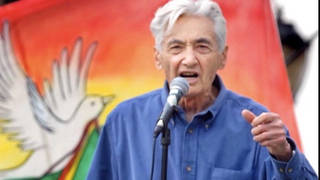
Howard Zinn, author of “A People’s History of the United States,” reviews the history of the abolitionists and the Vietnam War to encourage a new generation of resistance against the Iraq occupation and the war at home.
Labor Day was established more than a century ago. It was a time of tremendous unrest in America. Grover Cleveland was president. Railroad workers, organized by Eugene V. Debs, were leading a nationwide strike against George Pullman. Pressured by the railroad executive, President Grover Cleveland declared the strike a federal crime and called out 12,000 troops. U.S. deputy marshals fired on protesters near Chicago. The strike was over. Cleveland tried to win the labor vote in his reelection by signing off on a congressional bill establishing Labor Day. He was not reelected.
In 1898, Samuel Gompers, head of the American Federation of Labor, called it “the day for which the toilers in past centuries looked forward, when their rights and their wrongs would be discussed … that the workers of our day may not only lay down their tools of labor for a holiday, but upon which they may touch shoulders in marching phalanx and feel the stronger for it.”
But according to the “Encyclopedia of the American Left,” Gompers and the AFL elevated Labor Day as the preferred holiday of the American House of Labor over May Day. He criticized May Day for its ties to anarchists and socialist politics.
Today we’re going to turn first to Howard Zinn. He wrote “A People’s History of the United States.” He spoke in August in Provincetown on Cape Cod. He talks about Iraq, about labor and the people’s history of the United States.
Related Story
 StorySep 02, 2024Labor Day Special Featuring Howard Zinn & Voices of a People’s History of the United States
Transcript
AMY GOODMAN: Labor Day was established more than a century ago. It was a time of tremendous unrest in America. Grover Cleveland was president. Railroad workers organized by Eugene V. Debs were leading a nationwide strike against George Pullman. Pressured by railroad executives, President Grover Cleveland declared the strike a federal crime and called out 12,000 troops. U.S. deputy marshals fired on protesters near Chicago. The strike was over. Debs went to prison. And Cleveland tried to win the labor vote in his reelection by signing off on a congressional bill establishing Labor Day. He was not reelected.
In 1898, Samuel Gompers, head of the American Federation of Labor, called it, quote, “the day for which the toilers in past centuries looked forward, when their rights and their wrongs would be discussed … that the workers of our day may not only lay down their tools of labor for a holiday, but upon which they may touch shoulders in marching phalanx and feel the stronger for it.”
But according to the Encyclopedia of the American Left, Gompers and the AFL elevated Labor Day as the preferred holiday of the American House of Labor over May Day. Gompers criticized May Day for its ties to anarchists and socialist politics.
Well, today we’re going to turn first to Howard Zinn. He wrote A People’s History of the United States. He was speaking this summer in Provincetown on Cape Cod. He talks about Iraq, about labor and the people’s history of the United States. Historian Howard Zinn.
HOWARD ZINN: I have great confidence that the truth is beginning to come through to more and more people. This is how change takes place. And this is how it’s a tribute. It’s a tribute to the common sense and common decency of the American people that the establishment has to work so hard to keep the truth from us, you see. And I really believe that when people learn what is going on, they respond. And we’ve seen this historically. We’ve seen this again and again.
Now, when the abolitionists, the first abolitionists, the first people in the North who spoke out against slavery in the 1830s, began to talk about slavery, they were mobbed, and they were attacked — not in the South, all over the North. But the truth that they spoke began to seep through to the American public, the truth about slavery. A man named Theodore Weld wrote a book, Slavery as It Is. And the book, although ignored by the powers that be, was read and read and read, you see, and by the
time of the early 1960s [sic], the anti-slavery movement had gone from a tiny handful of people to an enormous national movement. That’s why we had an Emancipation Proclamation. That’s why we had the 13th, 14th and 15th Amendments, not because Abraham Lincoln was elected president, although it wasn’t bad, you see, but the key was that when Abraham Lincoln was elected president, this great anti-slavery movement was rising in the country.
And we’ve seen this again and again. We’ve seen it in recent years, when people learn the truth. Racial segregation in the South was really not in the consciousness of the American people. And remember Ralph Ellison’s book, Invisible Man, that was true. Black people were invisible, and the condition of Black people was invisible — of course, not to Black people, but certainly to the white population of the country. What happened in the 1960s is that Black people, seeing that the American government was not going to help them, knowing that the American government — oh, not just the South, but the national government, the government of the United States — had collaborated with the South to maintain racial segregation all through history, Black people in the South knew that they had to do it themselves. They had to bring democracy alive themselves. They had to bring the truth to the American people. And so they went out into the streets, and they sat in, and they went on Freedom Rides, and they demonstrated, and they created a commotion in the country which could not be ignored. And people began to learn the truth about what was happening in the South, the truth about what was happening to Black people in the South. And then you finally had a national movement, that whether you had a Republican or a Democrat in the House or in Congress or in the presidency, it didn’t matter. You had a national movement where finally the government had to respond. And you began to see a remarkable change in the South and in the consciousness of the country about racial equality.
That’s what social movements do. They bring the truth to people, and people, when they learn what is going on, respond. This is what happened during the War in Vietnam. People did not know what was going on in Vietnam. All they knew what was being told to them by the secretary of state and the secretary of defense, and, “Oh, they fired on our ships in the Gulf of Tonkin.” I mean, who knew where the Gulf of Tonkin was? Maybe it was off the coast of San Francisco, you see. Nobody knew, really. Did the president know? Well, he was briefed. Presidents get briefed. That’s how they know about things. But really, people didn’t know what was going on.
And how did they learn? They didn’t learn through the major media. They learned through the 1960s equivalents of Democracy Now! They learned through Noam. They learned through books. They learned through independent media, like Dispatch News Service, a little group of left journalists who went into Asia. And they were the first ones to break the story of the My Lai massacre to the American public.
And when American people began to see what was happening in Vietnam, when finally the pictures began to appear, when finally they saw the huts being burned and the peasants cowering before American power, they began to react to this. And soon we had a national movement against the war. And the War in Vietnam did not end because Henry Kissinger went to Paris. The war did not end because of anything Congress or the president or the Supreme Court did. The War in Vietnam ended because of the people in Vietnam, who resisted, and because of the people in the United States, who finally began to resist the government, and because of the GIs — you know, you heard David sing about the San Patricio Battalion of the American GIs, who looked around in the Mexican War and saw what was going on and went over to the other side. And in the Vietnam War, it was American GIs who played a very critical role in bringing the war to an end, when they refused to go out on patrol and when they turned against the war. And when they came back, when the GIs came back from Vietnam and they formed an organization, the Vietnam Veterans Against the War, we’ve never seen anything like it in the history of this country. And they gathered — and some of you may remember that scene where they gathered in Washington, these GIs who had come back from the war, and some in wheelchairs or with arms missing, and hurled the medals over a fence into a heap to demonstrate their opposition to the war. The truth began to come out, and the truth had an effect.
And I believe that is what is going on today, just the beginning of the truth coming out to the American public of what is going on in Iraq and in the world, beginning to learn the truth that we are not liberating Iraq, we are occupying Iraq. And during World War II, that expression became well known: “Nazi-occupied Europe,” “Nazi-occupied France.” And then, after World War II, we talked about the Soviets occupying Hungary and the Soviets occupying Czechoslovakia, you see. And now it’s the United States occupying Iraq. And the news is beginning to filter through. I mean, the major media tried their best to bury the news in, you know, back pages and to cover it up with all sorts of things. But the news is beginning to come through: This is a very ruthless occupation which is taking place in Iraq.
They saw — I mean, the other day, you may have seen this news story about how the U.S. general, General Sanchez, in Baghdad, was worried about Iraqi reaction to the occupation. The Iraqi leaders, the ones who are pro-America, were giving him a message, as he put it, quote, “When you take a father in front of his family and put a bag over his head and put him on the ground, you have had a significant adverse effect on his dignity and respect in the eyes of his family.” I thought that was very sensitive and perceptive. Yeah.
Amnesty International has been looking into the cases of torture in Iraq and beginning to report — you know, the case of Khraisan al-Aballi. His house is invaded by American soldiers. They come in shooting, and they arrest him and his 80-year-old father. His brother is wounded. The three men are taken away. And Khraisan tells Amnesty International later that his American interrogators stripped him naked, kept him awake for more than a week, either standing or on his knees, bound hand and foot with a bag over his head. He said he told his captors, “I don’t know what you want. I don’t know what you want. I have nothing. I asked them to kill me,” says Khraisan. After eight days, they let him and his father go. U.S. officials did not respond to repeated requests to discuss the case. Paul Bremer, the U.S. administrator of Iraq, said, “We are, in fact, carrying out our international obligations.” Well, yes, international obligations, except to the U.N., except to the world. Who is this — to whom? You know.
And the soldiers who have to do that, the soldiers are set down in a country which is hostile to them. They become afraid. They become panicky. They become trigger happy. They react with the brutality that fearful, fearful soldiers or fearful policemen show when they themselves are afraid. And they’re beginning to recognize, and we’re hearing stories about the soldiers who are asking, “Why are we here? What are we doing here?” And an ABC News reporter in Iraq tells me of a soldier who tells him, “I’ve got my own most wanted list.” He was referring to the deck of cards, remember, reading the deck of cards the U.S. government published in which they featured Saddam Hussein, his sons and other wanted members of the former Iraqi regime. And the soldier said, “I have my own deck of cards. The aces in my deck are Paul Bremer, Donald Rumsfeld, George Bush and Paul Wolfowitz.”
I think there’s something more ominous than the occupation of Iraq, and that is the occupation of the United States. I don’t know if you have the same feeling I do. You wake up in the morning, you read the paper, and you feel that you are in an occupied country, you see, that you feel some alien group has taken over our country. You know, I mean, those Mexican workers who cross the border to get into California — that is, to get into the territory that was taken from Mexico in the Mexican War, you see — those Mexican workers who come over, and many of them die, are killed in the process, you see — those people are not alien to me, you see. Those 20 million Americans who are not citizens but who now, because of the PATRIOT Act, are subject to indefinite detention without any constitutional rights, those people are not alien to me. But those men in the White House who are making these decisions to send young people to kill or be killed, those people are alien to me, you see.
AMY GOODMAN: Howard Zinn, speaking this summer in Provincetown on Cape Cod in Massachusetts. We’re going to come back to that address. If you’d like to get a copy, you can call 1-800-881-2359. That’s 1-800-881-2359. Back with historian Howard Zinn in a minute.
[break]
AMY GOODMAN: Paul Robeson singing “Joe Hill,” here on Democracy Now! I’m Amy Goodman, as we return to historian Howard Zinn, author of A People’s History of the United States.
HOWARD ZINN: I mean, the country’s in the hands of men who care nothing about human life, care nothing about human freedom, care nothing about the Earth, the water, the sun, care nothing about the kind of world that our children and grandchildren are going to inherit. And I believe that Americans are more and more, you know, beginning to sense this. The lies are being exposed. And, you know, those — the weapons of mass destruction, you know, it’s become absurd, right? You know, the — what were called the drones of death turn out to be model airplanes. The decontamination trucks turn out to be fire trucks, you know. The mobile germ labs turn out to be trailers making balloons, you see. And lies, lies, lies. Lies about self-determination — talk about self-determination, and we fly these wealthy Iraqi exiles into Baghdad to take over, just as we flew Diem into Vietnam back then. And we were for self-determination of the Vietnamese. We’ve flown them in from New Jersey.
And then there is a larger lie, you know, that everything that the United States government does here and in the world needs to be done because we are engaged in a war on terrorism — ignoring the fact that war is terrorism, and ignoring the fact that barging into people’s homes, taking away family members, subjecting them to torture, you know, that is terrorism. Invading and bombing other countries does not give us more security against terrorism. It makes us less secure. It makes us more vulnerable.
And you can get a clue to what the government means by the war on terrorism if you examine what secretary defense — if you have the stomach for examining anything said by the secretary of defense, but you examine what Secretary of Defense Rumsfeld, one of those faces on that sergeant’s most wanted list — Rumsfeld said about a year ago. He was addressing the NATO summit in Brussels, and he was explaining the threats to the West. Imagine we’re still talking of the West, as if it were a whole entity, as if the United States has not alienated most of the Western world and is now wooing Eastern countries and trying to persuade non-Western countries that we want only to liberate them. So, Rumsfeld is explaining the threats to the West and why they are invisible and unidentifiable. And he says — I’m quoting him now, because I could not make this up — “There are things that we know. And there are known unknowns. That is to say, there are things we now know that we don’t know. But there are also unknown unknowns. These are things we do not know we do not know.” He goes on to say, “Simply because you do not have evidence that something exists doesn’t mean that you have evidence that it doesn’t exist.”
Well, Rumsfeld has clarified things for us. No, really. He’s explained why the government, not really knowing where to find the criminals of September 11th, will just go ahead and invade and bomb Afghanistan, killing thousands of people and driving hundreds of thousands of people from their homes — and still not know where the criminals are, you see; and explains why the government, not really knowing what weapons Saddam Hussein is hiding, or if he’s hiding any weapons, will invade and bomb Iraq, to the horror of the world, killing thousands of civilians and thousands of soldiers and terrorizing the population; and explains why the government, not knowing who are terrorists and who are not, will put hundreds of people in confinement in Guantánamo and subject them to torture and indefinite detention, to the point where suicides have been attempted again and again by the prisoners in Guantánamo; and explains why the government, not knowing who the terrorists are, will put these 20 million people who are not citizens under the jurisdiction of the PATRIOT Act, depriving them of all their constitutional rights, making them subject momentarily to any kind of invasion of their homes, picking them up. taking them away, and nobody knowing where they are.
So, the war on terrorism is not just a war on innocent people in other countries; it’s a war on the people of the United States. It’s a war on our liberties. It’s a war on our standard of living. The wealth of the country is being stolen from the people. Remember what Eisenhower said in that strangely good moment that Eisenhower had, when he said that, you know, every weapon that is made is a theft from the needs of the American people. The wealth of the American people — the wealth of the people is being stolen, stolen from the citizens of the United States, from the people in this country, and handed over to the super rich, and the lives of the young are being stolen.
And I believe this is becoming more and more clear to more people in this country. Even the polls, distorted as they are — and they are — even they show declining support for Bush. And I don’t know if any of you noticed this, but it’s my job to notice these things. It’s my job, painful as it is, to read Thomas Friedman, you see. And there was this column that he wrote just after the war began, in which he said — I’m quoting Thomas Friedman — “Don’t believe the polls. I’ve been to nearly 20 states recently, and I’ve found that 95% of the country wants to see Iraq dealt with without a war.” This is Friedman, who’s for the war, totally, then, now. He also said in his column that his wife opposed the war. She was one of the 95%, you see.
It’s been interesting to me and important to me, because sort of in — just from reading American history and from living in the South and being involved in in the movement there, to me, I’ve always thought that you just could learn so much about the country by looking at the history of Black people and looking at the attitudes of Black people. And all through this period, while the polls were showing majorities in support for Bush, the polls were showing that 60% of Black people were opposed to the war all the way through. And I had this — I had this experience doing a phone interview with a radio station in Washington, D.C., a Black radio station, called — it’s called “GW on the Hill.” “GW” stands for George Wilson, the guy who was the interviewer on the station. And actually, it was hard for me to say much, because he — all of his questions were rhetorical questions, like “Don’t you think that we are in the grip of madness?” Not much to say, you see.
But after I — after he sort of did this interview with me, there were call-ins. And I took notes, because nobody could see me. I’m home on the telephone. I can secretly take notes on these call-ins. There were eight call-ins, and all of them clearly African Americans. And I’m reading from my notes: John — this was right after Colin Powell had given his speech to the U.N. about weapons of mass destruction. John: “What Powell said was political garbage.” Another caller: “Powell was just playing a game. That’s what happens when people get into high office.” Robert: “If we go to war, innocent people will die for no good reason.” Karine: “What Powell said was hogwash. War will not be good for this country.” Susan: “What is so good about being a powerful country?” Terry: “It’s all about oil.” Another caller, the last of the eight callers: “The U.S. is in search of an empire. And it will fall, as the Romans did. Remember when Ali fought Foreman? He seemed asleep. But when he woke up, he was ferocious. So will the people wake up.”
I believe it will become more and more clear that the casualties of war are not just abroad, you know, but here at home. And very often it is said that, you know, that it will be hard to build a movement against the war because we don’t have the huge casualties that we had in Vietnam. On the other hand, we have a communications system which, despite the monopolization of the media, has moved faster and more efficiently than any communications system during the Vietnam War, through Democracy Now!, through the community radio, through the internet. And that’s why we had those enormous demonstrations against the war, even before the war had started.
But I want to say something about casualties, battle casualties. In the Spanish-American War — I always like to go back a hundred years, 200 years. In the Spanish-American War, the United States — it was one of those short wars, which we have now become accustomed to. It was called a “splendid little war” by a member of the cabinet. There were only a few hundred American battle casualties. There were 5,000 soldiers who were in Cuba who died, not battle casualties. They died of poisoned beef sold to the Army by the meatpackers of Swift and Armour in Chicago. Every war has its battle casualties, and it has its other casualties. What happens to the soldiers who don’t die in battle but who die for other reasons? What happened not to the soldiers of Vietnam who who died on the battlefield, but what happened to the soldiers afterward? What did they suffer as a result of Agent Orange? How many of their kids were born deformed because of the chemicals that the United States dropped in Vietnam? How many of them began to have psychological problems? How many Vietnam veterans committed suicide in the years — thousands and thousands of Vietnam veterans committed suicide after the war in Vietnam.
And the Gulf War, you know, here, too, oh, we’ve only had a couple hundred American casualties. The VA, 10 years after the Gulf War, reported that 8,000 veterans of the Gulf War were dead for various reasons, that of the 600,000 soldiers who fought in the Gulf War, 200,000 of them, after the Gulf War, filed claims with the Veterans Administration for disabilities that they had suffered during the war as a result of the weaponry that the United States was using in the war. The weapons that we use against other people are also used against us. A government that is ruthless about what it does to other people is often ruthless in what it does to our own people.
So, what is our job? You know, as Noam said, there’s nothing magical, no secrets. I have the same experience he does of people wanting to know: What is the secret? There’s no — secret is people. The secret is people getting together. Secret is telling the truth. The truth is powerful. And it can only be suppressed for so long. And the truth gets out. And when the truth gets out, a power is created that is greater than the power of the guns and money that a government possesses, you see. I mean, why is it that people all over the world knew things, knew the truth about the American impending war in Iraq, and 10 million of them protested on one day, February 15th? Why is it that they knew the truth when the American people still did not? I mean, to me, there’s a simple answer. The people in those other countries did not watch Fox News, you see.
So, our job, yes, is to tell the truth. And we all can do that. You don’t have to be a speaker with a microphone. You don’t have to sell hundreds of thousands of books. All of us — all of us speak to other people. All of us have neighbors. All of us have people we work with. We have children. We are maybe teachers, or we may be librarians, or whatever we do that there are people that we reach. There are ways in which we can communicate information to people and steer them toward sources of information which are different, you know, than the major media. We are all in the position — all of us in the position to do this.
And we start with great support: We start with the support of the people of the world. That’s great support. And we start with the support of the artists. I’ve always been struck by that. The musicians, the actors, the writers, the poets, these are the people who almost always come forward, and through a special sensibility that they have, they see what is right, and they see what is wrong.
And so, our job simply is, in every possible way, in the smallest ways and in the largest ways, in the most apparently innocuous ways or in the most bold ways, from writing a letter to the editor of your local paper to doing what those three nuns in Colorado did, civil disobedience, and bringing them years in jail, but that all along the spectrum, we all do, you know, what we can do, in some way, to spread the truth, no action too small, too large for us to engage in, and to defy what the government is trying to get us to do, to keep silent. There are already librarians — you’ve maybe read about it — librarians who are shredding their records, because they know that the PATRIOT — you know. And the truth is, I don’t blame the FBI for wanting to see those records. They want to know who is reading Noam Chomsky, you see. But defying them is what more and more people do. I go around the country, and I see high school students defying the principal, defying even their classmates, high school students, you see. So, that’s what social change is about: telling the truth, organizing, acting in every way we can. You know, we live in a beautiful country. It’s been taken over, and our job is to take it back. Thank you.
AMY GOODMAN: Historian Howard Zinn, speaking this summer in Provincetown, Cape Cod, Massachusetts. If you’d like to get a copy of today’s program, you can call 1-800-881-2359. That’s 1-800-881-2359. When we come back from our break, a special appearance by Mother Jones on the March of the Mill Children. Stay with us.



 Top
Top
Media Options