











 Watch Full Show

The Justice Department is reviewing a request for a criminal investigation into recent disclosures about a highly classified satellite surveillance program. We speak with a stealth satellite expert from the National Security Archive. [includes rush transcript]
The Justice Department and the FBI are reviewing a request for a criminal investigation into recent disclosures about a highly classified satellite surveillance program.
The request from the National Reconnaissance Office comes after reports in the Washington Post and other publications about a stealth satellite program under debate in Congress, which has reportedly risen in cost from $5 billion to $9.5 billion over the past few years.
The project was debated in closed hearings on Capitol Hill, but some lawmakers took the unusual step of voicing their concerns publicly while trying to abide by classification constraints. Senator Jay Rockefeller of West Virginia said the program was “totally unjustified and very, very wasteful and dangerous to the national security.”
Rockefeller added “Because of the highly classified nature of the programs contained in the national intelligence budget, I cannot talk about them on the floor.” He said the Intelligence Committee had voted to terminate the program for the past two years only to be overruled by the appropriations committees.
Rockefeller and three other Senate Democrats refused to sign “conference sheets” related to the 2005 intelligence authorization bill, reportedly to protest the program.
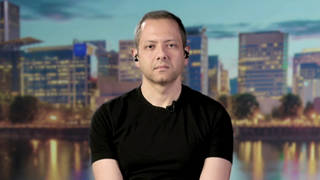
- Jeffrey Richelson, senior fellow at the National Security Archive. The stealth satellite program at issue was first described publicly in his book, “The Wizards of Langley: Inside the CIA’s Directorate of Science and Technology.”
Related Story
 StoryApr 28, 2025Three U.S. Citizen Children, Including 4-Year-Old Battling 4th Stage Cancer, Deported to Honduras
Transcript
AMY GOODMAN: We are joined by Jeffrey Richelson, who is a senior fellow at the National Security Archives. He has written the book, The Wizards of Langley: Inside the C.I.A.’s Directorate of Science and Technology. Welcome to Democracy Now!
JEFFREY RICHELSON: Thank you.
AMY GOODMAN: Can you explain what we’re not supposed to know?
JEFFREY RICHELSON: Well, this program had its most immediate origins during the Reagan administration when there was great concern about soviet anti-satellite capabilities, as well as Soviet denial and deception measures. In other words, the things they did to hide secret aircraft or other military activities from U.S. reconnaissance satellites as they passed overhead. And these were satellites that were certainly track-able by the Soviet Union, so they know when they would be over a particular target. This particular system started at that period of time and it was originally named Misty. The idea was to put it in an orbit that the Soviets would not expect it to be in, so that when it wouldn’t necessarily be looking there and to give it some stealth capabilities so that it would be much harder to detect, so that rather than if it showed up on radar, appearing to be a full-sized satellite, it might appear to be some sort of a debris. So, they weren’t — they would — therefore not take protective measures when the satellite was in range of a particular target, say, an airbase outside Moscow where we might want to photograph something going on. It resulted in the first launch of the satellite in 1990 called Misty, and then a follow-on launch in 1999, and what’s under debate is whether to approve funding for a follow-on program, for which the cost has grown from $5 billion, the projected cost from $5 billion to almost $10 billion.
AMY GOODMAN: In the New York Times today Douglas Joel writes that an alternative to the new highly classified $9.5 billion stealth satellite program is the subject of a Congressional dispute, which relies much more heavily on high-flying unmanned aircraft to take pictures of critical targets around the world. That alternative is part of a classified proposal endorsed by the Senate Intelligence Committee, which has tried since September, 2003, to kill the new satellite program. Can you comment on that?
JEFFREY RICHELSON: Sure. Well, there’s always trade-offs. You can collect intelligence in a lot of different ways, and aircraft versus satellites is always a trade-off that has to be considered. And with higher performance, unmanned aerial vehicles like global hawk or follow-on systems there’s the possibility of buying a lot of those and replacing some of your satellite capability and still saving money. And there are certain advantages to satellites in that they are continuously operating, and that they are not subject to air defense. So, the question would then come up whether you can fly the U.A.V.s over targets that would not be defended, and therefore get your imagery. That’s something that certainly requires an analysis, and you can prejudge one way or the other.
AMY GOODMAN: We’re talking to Jeffrey Richelson, who has written a book, The Wizards of Langley: Inside the C.I.A.’s Directorate of Science and Technology. I was watching when the senator of West Virginia, Jay Rockefeller went to the floor and said he was going to do something very unusual, that everything he said had already been approved by, I don’t know, intelligence, even what he was going to refer to saying that he was objecting to the satellite program, though he didn’t say specifically the satellite program. How significant is it that this is coming to light?
JEFFREY RICHELSON: Well, there have been other cases where a senator has objected to a particular acquisition program. Senator DeConcini years ago made some objections to a satellite program without going any details, but it’s something that doesn’t happen on a regular basis. And senator Rockefeller’s description was very vague in the sense that — in the sense of saying a major acquisition program without specifying it that it was a satellite, although that was probably fairly deducible, but not also saying what particular type of satellite.
AMY GOODMAN: And, shouldn’t this be a public discussion? I mean, we’re talking about $9.5 billion?
JEFFREY RICHELSON: Yes. I mean, that’s one of the problems with the whole — with the secrecy and concerning the intelligence budget and both — both for the community as a whole and specifically agencies, is that you can have enormous expenditures of public funds without any real public oversight, and you can see in this case the difficulty even of a major oversight committee in getting a proposal killed if there — if there are significant forces supporting it who can do so sort of under a veil or behind a veil of secrecy.
AMY GOODMAN: Finally, any comment, Jeffrey Richelson on this test that failed yesterday of the U.S. fledgling missile defense system. An interceptor rocket failed to launch on queue from the Marshall Islands.
JEFFREY RICHELSON: Well, I think the only thing that comes to mind is that in developing new technology systems, you run into a whole lot of failures up front. The question is whether the country considers a system like this something worth persevering in developing. I certainly can’t say that I know that the technology that they’re working on will work, but I can also say that you have had cases in the past with the satellite systems and other high-technology systems where you have had a run of failures at the beginning, and ultimately you do have success if you persevere. Whether that will happen in this case or not is something, you know, I don’t know and I don’t know that anybody knows.
AMY GOODMAN: Jeffrey Richelson, I want to thank you for being with us, senior fellow at the National Security Archive, The Wizards of Langley: Inside the C.I.A.’s Directorate of Science and Technology is his book.





 Top
Top
Media Options