







 Watch Full Show

Related
Topics
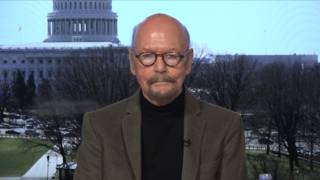
In the first large-scale attack in Saudi Arabia in six months, gunmen stormed the US consulate in Jeddah leaving at least nine people dead. We speak with political science professor and author As’ad Abukhalil. [includes rush transcript]
At least nine people were killed yesterday when gunmen stormed the US consulate in the Saudi Arabian city in Jeddah and fought a three-hour battle with security forces.
Four of the attackers and five non-U.S. staff were killed. In a phone call, the attackers called themselves the “Fallujah Brigades.” The Iraqi city of Fallujah is the scene of a large-scale assault by US forces in which as many as 1,800 people have been killed. A group calling itself “al-Qaida in the Arabian Peninsula” later claimed responsibility.
President Bush said “They want us to leave Saudi Arabia, they want us to leave Iraq, they want us to grow timid and weary in the face of their willingness to kill randomly, kill innocent people,”
It was the first attack against a Western diplomatic mission in Saudi Arabia and first big strike in six months. Officials say the assailants followed an official consulate car into the complex, firing guns and hurling grenades to force entry. After coordinating with U.S. Marines providing security to the consulate, Saudi forces stormed the compound.
Saudi Arabia has been battling a wave of violence since May 2003. Around 170 people, including foreigners, security forces and militants have been killed.
- As’ad AbuKhalil, professor of political science at California State University, Stanislaus and visiting professor at UC, Berkeley. He is the author of several books, his latest is “The Battle for Saudi Arabia: Royalty, Fundamentalism, and Global Power.” He runs a new blog called “The Angry Arab News Service.”
Related Story
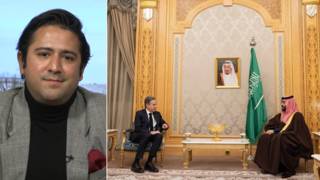
 StoryFeb 06, 2024Dissent Grows Inside Biden Administration over Gaza Policy as Blinken Holds Talks in Middle East
Transcript
AMY GOODMAN: We turn now to As’ad AbuKhalil. He’s professor of political science at California State University, Stanislaus, currently a visiting professor at U.C. Berkeley, and the author of several books, including The Battle for Saudi Arabia: Royalty, Fundamentalism and Global Power. He runs a new blog called the Angry Arab News Service. Democracy now! welcomes you, As’ad AbuKhalil.
AS’AD ABUKHALIL: Thank you.
AMY GOODMAN: Your response to this latest attack on Monday.
AS’AD ABUKHALIL: Well, I think this is a sign of increasing signs that the country may be slipping out of the control of the House of Saud. I think that there are increasing indications that the dissent in Saudi Arabia and the ability of people on the fanatical side of the al Qaeda types are able to strike inside the kingdom with such dare and ability to infiltrate sometimes extremely secure areas. The Arabic press is reporting that it was extremely impenetrable, the area where this time they struck. And every time they strike, it seems that there are signs of cooperation between them and various branches of the security forces. This comes only a few days after a dissident website reported that the House of Saud invited thousands of Jordanian troops into the kingdom, which hasn’t been reported in the western press, in order to help them quell dissent and riot control within the kingdom. So I think that based on what al Qaeda types websites have been reporting lately, that there is a rising movement against the House of Saud and even dissent within the House of Saud, especially as many of them have become vocal against the ability of the highly unpopular Minister of Interior, Prince Nayef, to control the street in Saudi Arabia.
AMY GOODMAN: We’re about to look at Bernard Kerik, the new nominee for Homeland Security chief. He also was head of security for the Saudi royal family. He is the former New York police commissioner. Do you know anything about that?
AS’AD ABUKHALIL: Well, he was, based on what I read in the Arabic press, he had a very limited role within the kingdom as part of many roles by many American consultants, advisers, who helped the various military intelligence branches of the kingdom. He was technically in charge of security of the hospitals within the kingdom, not for the royal family itself. I think for that, they went for somebody more senior than him, somebody who is more qualified than he is. But it seems the president found that he is qualified to be in charge of Homeland Security.
AMY GOODMAN: Professor As’ad AbuKhalil has written a new book on Saudi Arabia, The Battle for Saudi Arabia: Royalty, Fundamentalism and Global Power. What have been other sites? In the past, we know about U.S. military contractor compounds being attacked in Saudi Arabia. Do you expect more violence or less right now?
AS’AD ABUKHALIL: Well, every time I hear reports by the royal family about their ability to quell the dissent and the violence movements within the kingdom, they seem to strike with such dare and I’m also surprised that al Qaeda type websites, those that are very sympathetic to the movement, linked to it, are covering Saudi Arabia with incredible excruciating detail and they seem to have tremendous links within the kingdom. Also, what is noticeable is that the dissident movements operating outside, especially in Europe, seem to be converging toward the bin Laden-type movement, which tells me that there is something going on. It is hard to predict about these things, especially as the royal family is willing to go extremely far in using violence, just as this dissident fanatical movement is able to be very violent in order to protect itself and seems to me that the United States will spare no effort to keep these unpopular royals inside the kingdom in power.
AMY GOODMAN: As’ad AbuKhalil, I want to thank you very much for being with us. Professor of political science, currently visiting at U.C. Berkeley. His blog is at angryarab.blogspot.com. This is Democracy Now!



 Top
Top
Media Options