






 Watch Full Show

Illinois state senator and Democratic nominee for U.S. Senate, Barack Obama, was chosen to deliver the keynote address at this year’s Democratic National Convention in Boston. Obama currently faces no known opponent in the November election and if elected he would become only the fifth black senator in U.S. history. We take an in-depth look at Obama with longtime Chicago columnist Salim Muwakkil. [includes rush transcript]
The Kerry campaign announced yesterday that Illinois state senator and Democratic nominee for U.S. Senate, Barack Obama, will deliver the keynote address at this year’s Democratic National Convention in Boston.
In its press release, the Kerry campaign said: “More African-Americans, Asian-Americans, Native-Americans, and Hispanics will attend the Convention than ever before.”
The announcement came on the same day that the Democrat launched $2 million worth of ads for television, radio and newspapers targeting black voters.
Barack Obama’s father was from Kenya. He met Obama’s mother, who was white, when both were students at the University of Hawaii. When Obama was 2 years old, his father left the family and returned to Kenya, where he eventually became a senior economist in the Ministry of Finance.
Obama was raised mostly in Kansas, by his mother and grandparents. He graduated from Columbia University and received his law degree from Harvard Law School. He became the first black president of the prestigious Harvard Law Review and later worked as a civil rights lawyer and as a community organizer in New York and Chicago. He currently teaches law at the University of Chicago and has served in the state Senate since 1997.
Obama currently faces no known opponent in the November election. Republican Jack Ryan dropped out last month over embarrassing allegations in his divorce papers that he took his wife to sex clubs before they split up. Nearly three weeks later, GOP leaders are still searching for a replacement. The possibility that former Chicago Bears coach Mike Ditka would join the race faded last night when he decided not to seek the party’s nomination.
If elected Obama could become only the fifth black senator in U.S. history.
- Salim Muwakkil, senior editor of In These Times, where he has worked since 1983, and a weekly op-ed columnist for the Chicago Tribune.
Related Story
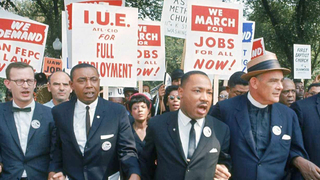
 StoryAug 29, 2013Historian Taylor Branch on the March on Washington and the Kennedys’ Aversion to Dr. King’s Struggle
Transcript
AMY GOODMAN: We go now to Salim Muwakkil the senior editor “In These Times” he also does a weekly op-ed column for the “Chicago Tribune.” We welcome you back to Democracy Now!
SALIM MUWAKKIL: Amy, good to talk to you.
AMY GOODMAN: Good to talk to you. So, tell us more about Barak Obama.
SALIM MUWAKKIL: Well, he’s an extremely attractive candidate. You gave the biological details and aside from those, he’s also, you know, unflinchingly progressive in a state that, you know, looks at progressives in a kind of I guess you could say schizophrenic way. You have people like Paul Simon, the late Paul Simon, one of state’s most respected politicians, who was also liberal, but he was from a downstate district where most of the voters are generally more conservative and Obama has managed to appeal to this wide range of voters in much the same way that Simon did. He also has very strong support in the African American community, which was really long and coming. A lot of people had doubts about him. They thought he was one of these new mode black politicians who downplay racial issues and civil rights modalities and interest. But he doesn’t do that. He speaks forthrightly about racial issues and, you know, has a great deal of history and experience in a civil rights oriented kind of struggles. So, he in many ways, he breaks that mold of the black politician who really softens his message to the point of, you know, homogeneity in other words to appeal to a wide range. He holds on to his message and still appeals to this wide range of constituents. Much of it is his natural charisma. He is very charismatic speaker. He comes across as being at ease and non-threatening to people who may differ from his political position. He speaks before a wide variety of constituents. He to be willing to talk to people in ways that don’t necessarily flatter them. I mean, he speaks truth for example, he will speak before a Jewish audience and talk about his problems with Israeli policy in a way that inspires trust, rather than the kind of disagreement that you often find when that happens. So he is one of these rare figures, political figures who has a kind of fire in their belly that he doesn’t really have to manifest in any histrionic way. He is a very calm person and yet you can see he is deeply committed to certain issues of social justice and civil rights.
AMY GOODMAN: So, you were there on March 16 at the hotel in Chicago when it was announced he won the primary?
SALIM MUWAKKIL: Yes, I was there. I made the point in a piece that that particular rally that night reminded me s much of 1983 when Harold Washington won the primary for mayor of Chicago. The same kind of racially diverse crowd, you know, and each element of that diversity was equally enthusiastic about him. He inspires trust. He’s really a rare political figure and I’ve known him for quite a while, been following his career, even before he went into the state senate and, you know, you kind of know when you encounter him that he’s that he’s meant for some serious positions. He’s just a unique figure. He really is.
AMY GOODMAN: Can you talk about the political landscape of Illinois and see the seat that he would be taking over the fading prospect that the famed football coach Ditka would be the republican candidate, what the republicans will do now?
SALIM MUWAKKIL: It’s really hard to say. They’ve been, you know, their hopes have been dashed so frequently in the last few months. Ditka, of course, was fascinating. As one of the columnists said, he was fascinating because, you know, just as a floating object, is fascinating to a drowning person. They’re looking for someone to give them at least the hint of a chance in November because Barak beat seven candidates in the primary and he won with 53% of the vote, which was extraordinary, completely confounding, all of the pundits predictions. Although they thought he was, you know, he would win, but not by such an overwhelming margin. And his appeal was quite catholic across all segments of the population. And the first opponent who they thought would win, a guy named Blair Hall, who is a billionaire, they say, in the Chicago area, he also had problems with his divorce records, Blair Hall, after his divorce records came out, it revealed there was some allegation he had actually physically assaulted his wife. So, his star dropped immediately and just ironically that same problem afflicted the one who eventually won the republican primary, Jack Ryan, who, in many ways, is a very appealing candidate. Jack Ryan was someone who, you know, deserted corporate life to teach in the inner city high school. A very well-regarded inner city high school and he had a lot of black supporters. So, he was an unusual republican candidate who posed a serious I mean, he could have been a very powerful opponent because of his own personal story and when he dropped out of the race, the republicans were left without anything at all. And, so they began grasping for straws and now they’re still grasping after Ditka decided to bow out.
AMY GOODMAN: And Obama’s family, his wife and his children?
SALIM MUWAKKIL: Obama’s wife is Michelle, who herself is quite a powerhouse. she’s in many ways, his campaign manager and he has two children, who are, you know, obviously two young kids of a cute additions to any campaign, as we’re finding out with Edwards’ kids in the presidential campaign. He has a very appealing family. He lives in Hyde Park, a few doors down from me, as a matter of fact. And, he’s a family man. He’s the committed civil rights activist, he’s the intellectual. He graduated from Harvard. He was the first African American to be the president of the Harvard Law Review, and he has an intellectual aura about him as well as a kind of down-to-earth aura.
AMY GOODMAN: What has his stance been on the invasion of Iraq?
SALIM MUWAKKIL: He’s been very, very forthright in his opposition to the war. He spoke in an anti-war rally in October 2002. Very well attended, very large rally, and he said some powerful words that were strongly against the war. I think he gained a lot of supporters from that particular speech. He was so clear in his opposition and yet not in any way negative or he didn’t — he didn’t use, you know, the traditional kind of code words that people who oppose the war were using. He did it in a way that attracted people who normally would be, you know, gung ho for military action . He said he wasn’t against all wars and he kind of went against much of what was being said on the podium, but he did it in such a considerate and intelligent way that even those who wanted more raw meat were satisfied with his speech. In fact, were captivated by the way he presented himself.
AMY GOODMAN: Finally, what are the major positions he has taken outside invasion of Iraq and his being critical of what’s going on now in the occupied territories in the West Bank and Gaza?
SALIM MUWAKKIL: In my mind, his most significant contribution has been his legislative battles against the death penalty, against in the criminal justice system, you know, in Illinois, it’s been a series of shocking exonerations. You know, of innocent people who are on death row. He was involved very intimately in drafting and passing legislation that requires the video taping of police interrogations and confessions in all capital cases. And he also was one of the co-sponsors of this very comprehensive reform or the death penalty system in Illinois, which many people say may kind of, you know, trigger the retreat on the death penalty in many other states.
AMY GOODMAN: We have 30 seconds.
SALIM MUWAKKIL: Jobs, he passed legislation that provided tax breaks for investment in depressed areas. Education, early childhood education, he was a very strong advocate for that. He supports charter schools, but he’s also a very strong advocate for public education. He is not in favor of vouchers. And, his opposition is considered, and once you hear it, you say, well, why didn’t I think of that? You know? This man is putting it in such clear terms. It’s hard to disagree. A star in the political affirming.
AMY GOODMAN: I thank you for joining us. Salim Muwakkil talking about Barak Obama, who has been chosen as the keynote speaker at the Democratic National Convention in Boston. This is Democracy Now!



 Top
Top
Media Options