







 Watch Full Show

When President Bush was questioned about tribal sovereignty in the 21st century at a gathering of minority journalists he responded: “Tribal sovereignty means that. It’s sovereign. You’re a … you’re a … you’ve been given sovereignty and you’re viewed as a sovereign entity.” Jesse Jackson makes light of Bush’s remarks at the conference and we speak with Mark Trahant, the reporter who asked Bush the question. [includes rush transcript]
The Unity conference wrapped up this weekend in Washington DC. It was the largest conference of journalists in US history. The event was organized by the four journalists of color organizations: the National Association of Black Journalists, the National Association of Hispanic Journalists, the Asian-American Journalists Association and the Native American Journalists Association. More than 7,500 journalists participated in the convention. On Friday, President Bush was questioned about Native American sovereignty and tribal issues.
- (Tape)
- President Bush being questioned by journalist Mark Trahant at the UNITY conference in Washington DC, August 6, 2004.
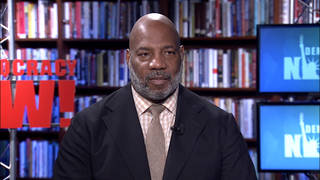
- Rev. Jesse Jackson makes light of President Bush’s comments on tribal sovereignty.
Democratic presidential nominee John Kerry addressed the conference on Thursday a day earlier. After his appearance, Kerry focused in on courting the votes of Latino and Native American voters. In a swing through Arizona and New Mexico, Kerry announced the formation of Native Americans for Kerry. On Sunday in Gallup, New Mexico, Kerry spoke at the closing powwow for the 83rd annual Intertribal Indian Ceremonial, with more than 30 tribes participating. Kerry pledged to promote tribal sovereignty and partner with tribes to improve access to health care, provide more educational opportunities, and strengthen economic development efforts. He announced he would increase funding for the Indian Health Service and elevate the Director of the IHS to a senior position in the administration, saying he would appoint at least one Native American as a Senior member of his administration who would have an office in the White House. During his swing through New Mexico and Arizona, Kerry picked up the endorsements of more than a dozen Native American leaders.
- Mark Trahant, Editorial Page Editor for the Seattle Post-Intelligencer. He is a member of Idaho’s Shoshone-Bannock Tribe and former president of the Native American Journalists Association.
Related Story
 StoryDec 08, 2025“Domestic Terrorism”: Leaked DOJ Memo Targets “Anti-Americanism, Anti-Capitalism, Anti-Christianity”
Transcript
AMY GOODMAN: Here we play the questioning by Mark Trahant. He is the editorial page editor of The Seattle Post Intelligencer, former president of the Native American Journalists Association, questioning President Bush.
MARK TRAHANT: Most school kids learn about government in the context of city, county, state and federal, and of course, tribal governments are not part of that at all. Mr. President, you have been a governor and a president, so you have unique experience looking at it from two directions. What do you think tribal sovereignty means in the 21st century and how do we resolve conflicts between tribes and the federal and state governments?
GEORGE BUSH: Tribal sovereignty means that, it’s sovereign. You’re a — you’re a — you have been given sovereignty and you’re viewed as a sovereign entity.
MARK TRAHANT: Okay.
GEORGE BUSH: And therefore, the relationship between the federal government and tribes is one between sovereign entities. Now, the federal government has got a responsibility on matters like education and security to help. And health care. And it’s a solemn duty. From this perspective, we must continue to uphold that duty. I think that one of the most promising areas of all is to help with economic development, and that means helping people understand what it means to start a business. That’s why the Small Business Administration has increased loans. It means, obviously, encouraging capital flows, but none of that will happen unless the education systems flourish and are strong. That’s why I told you, we spent $1.1 billion in reconstruction of Native American schools.
AMY GOODMAN: President Bush speaking at the UNITY Conference this past Friday. Afterwards, the Reverend Jesse Jackson held a news conference and he was questioned by Brent Merrill of the publication, Smoke Signals.
BRENT MERRILL: As you saw today at the president’s conference, the leader of the free world does not understand tribal sovereignty. What would you do in your estimation, Reverend, what would you do and how would you advise tribes to educate our folks, just exactly what tribal sovereignty is?
JESSE JACKSON: The President explained. You just didn’t understand. Sovereignty is sovereignty. You understand? It’s like in sovereignity. If you are on a reservation, you have been soverized. Your Ph.D. is in soverbication. You understand? I don’t think you understand.
BRENT MERRILL: You’re right. I didn’t understand that.
JESSE JACKSON: Well, needless to say — needless to say that the sovereignty of American — Native American tribes are federally protected rights. As long as Native Americans were perishing on those reservations it didn’t matter to states. But now that you have gaming on the reservations and economic development on the reservations, and indeed in some states voting on the reservations, the state now wants to impose itself on the federally protected sovereignty of the states. It has nothing to do with education, per se. It has to do with a legal relationship between federally constructed contracts or treaties, and states would not have the right to interfere with those federal territories. That is the real answer to that.
AMY GOODMAN: That is Reverend Jesse Jackson responding to President Bush’s comments after he was questioned by Mark Trahant, the former president of the Native American Journalists Association, editorial page editor of The Seattle Post Intelligencer. Mark Trahant joins us on the line right now. Welcome to Democracy Now!
MARK TRAHANT: Thank you.
AMY GOODMAN: It’s good to have you with us. Can you respond to President Bush’s response to your question on Friday?
MARK TRAHANT: Well, unfortunately, it fits into a much longer pattern of presidents not being particularly well informed on this subject. When President Reagan went to Moscow, he talked about how it was too bad that America’s Indians were put on preservations, and it was the biggest mistake the United States made. So, presidents have a history of saying things like this, unfortunately.
AMY GOODMAN: Well, the issue of Native America has gotten more attention this weekend as John Kerry, after leaving the UNITY Conference, has been focusing on courting the Latino and Native American vote and swings through Arizona and New Mexico. Kerry announced the formation of Native Americans for Kerry on Sunday in Gallup, New Mexico. Kerry spoke at the closing pow-wow for the 83rd Annual Intertribal Indian Ceremonial with more than 30 tribes participating. Kerry pledged to promote tribal sovereignty, partner with tribes to improve access to health care. He announced that he would increase funding to the Indian Health Service and elevate the director to the I.H.S. to a senior position in the administration, also saying that he would appoint at least one Native American who would have an office in the White House. Can you talk about this?
MARK TRAHANT: Well, the Native vote — in fact, it’s interesting, Reverend Jackson was the first presidential candidate that I know of when he ran for president who actually campaigned in Indian country. He went to at least two reservations in his campaign. He spent a great deal of time on the Navajo Nation, actually going to more than one place. So, what we have seen in the last few years is states like Washington, South Dakota, Arizona, New Mexico, where the Native American vote has made a significant difference. There wouldn’t be a democrat governor in Oklahoma right now, Arizona, perhaps even New Mexico not to mention the senate race in South Dakota. What’s significant is in Indian communities, it’s not just that the vote turns out like it hasn’t for many year, but it’s 8, 9, 10 to 1 in one direction. That’s something that any politician likes to see.
AMY GOODMAN: We’re talking to Mark Trahant who is the editorial page editor of The Seattle Post Intelligencer. A member of Idaho’s Shoshone Bannock tribe. How many Native American journalists are there in this country?
MARK TRAHANT: Probably active about 300, which is a huge increase from just, say, 20 years ago when there may have been 10 or 15.
AMY GOODMAN: You can talk more about the significance of the Native American vote, and if you see President Bush doing the same thing that Senator Kerry is doing now, really courting the vote, paying a great deal of attention, at least the last few days?
MARK TRAHANT: It’s going to be hard for him to court too much. He just doesn’t have policies that reflect life in tribal nations. I mean, we didn’t talk — some of the things we didn’t talk about in his — the content of what he had to say. There’s a major trust fund scandal that the administration hasn’t been able to get their arms around, and to be fair it goes back many administrations, but this administration has been as inept as previous administrations in trying to figure out solutions. The Indian Health Service, which is by treaty a promise to provide health care, has been under-funded for generations. In the last at least — except for the Clinton Administration, Congress has been so upset with the way the administration budgets come in, that they completely ignore them and start over. So, this administration would have to go a long way just to rally people. I think one of the reasons why Arizona and New Mexico have become so much more important to republicans is Senator John McCain has really versed himself well in American Indian issues, and particularly Southwest issues and earned a great deal of respect, and that started to create an in-road for republicans. They were hoping that it would translate into a broader picture. But I think the Bush Administration has pretty much reversed that.
AMY GOODMAN: When we had on the presidents of all of the major journalists of color organizations sponsoring UNITY, Patty Talahongva, your successor as president of the Native American Journalists Association talked about the Indian Trust Scandal saying it’s far larger than Enron and yet has gotten very little attention.
MARK TRAHANT: That’s right. It — basically, the federal judge in that case has said, unless the federal government figures this out, he’s going to put the federal government’s management of these trust funds, which is both land and money, into receivership. That’s a pretty strong statement when a federal judge says it’s so bad that he’s going to have to put it under court receivership.
AMY GOODMAN: Well, Mark Trahant, I want to thank you very much for being with us, The Seattle Post Intelligencer, also member of Idaho Shoshone Bannock tribe, former president of the Native American Journalists Association, questioned President Bush on Friday at the UNITY Conference. This is Democracy Now!



 Top
Top
Media Options