





 Watch Full Show

The Citizens for Responsibility and Ethics filed a complaint with the State Bar of Texas requesting an investigation into misrepresentations Attorney General nominee Alberto Gonzales made in a written response to the Senate Judiciary Committee about his role in protecting President Bush’s DUI arrest. We speak with the executive director of the Citizens for Responsibility and Ethics. [includes rush transcript]
President Bush’s picks for his second-term cabinet are proving to be very divisive on Capitol Hill. The Senate approved the nomination of Condoleezza Rice as Secretary of State this week by a vote of 85-13. It marked the most negative votes cast against a nominee for that post in 180 years. Next week’s vote on Attorney General nominee Alberto Gonzales is expected to be much closer.
On Wednesday, Gonzales was narrowly approved by the Senate Judiciary Committee by 10-8 vote along party lines. At the hearing, Democratic Senator Patrick Leahy of Vermont said Gonzales, “championed policies that are in fundamental conflict with decades of our laws, sound military practice, international law and human rights.”
As White House counsel, Gonzales helped lay the legal groundwork that led to the torture of detainees at Guantanamo and Abu Ghraib.
Democrats say they will require several hours of debate on the Senate floor next week before allowing a confirmation vote. At a news conference Wednesday, President Bush was asked about Gonzales” role in the abuse of detainees.
- President Bush, news conference, January 26, 2005.
President Bush speaking to reporters this week. In addition to questions about his role in laying the legal groundwork for the mistreatment of detainees, Gonzales is also coming under scrutiny for his time as gubernatorial counsel to then-Texas governor Bush.
Earlier this week, Citizens for Responsibility and Ethics filed a complaint with the State Bar of Texas requesting an investigation into misrepresentations Gonzales made in a written response to the Senate Judiciary Committee.
- Melanie Sloan, executive director of Citizens for Responsibility and Ethics in Washington.
Related Story
 StoryNov 12, 2025Epstein & Israel: Drop Site News Investigates Jeffrey Epstein’s Ties to Israeli Intelligence
Transcript
AMY GOODMAN: At a news conference Wednesday, President Bush was asked about Gonzales’ role in the abuse of detainees.
REPORTER: That there are some responses that Judge Gonzales gave to his Senate testimony that has troubled some people, specifically his allusion to the fact that cruel, inhumane and degrading treatment of some prisoners is not specifically forbidden, so long as it’s conducted by the C.I.A. and conducted overseas. Is that a loophole you approve?
GEORGE W. BUSH: Al Gonzales reflects our policy, and that is we don’t sanction torture. He will be a great Attorney General. And I call upon the Senate to confirm him.
JUAN GONZALEZ: That was President Bush speaking to reporters this week. In addition to questions about his role in laying the legal groundwork of mistreatment of detainees, Gonzales is also coming under scrutiny for his time as Gubernatorial Counsel to then Texas Governor Bush. Earlier this week, Citizens for Responsibility and Ethics filed a complaint with the State Bar of Texas requesting an investigation into misrepresentations Gonzales made in a written response to the Senate Judiciary Committee.
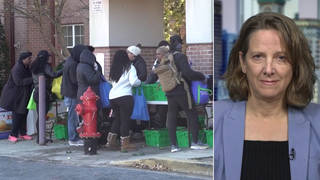
AMY GOODMAN: We’re joined by Melanie Sloan. She is Executive Director of Citizens for Responsibility and Ethics in Washington. Welcome to Democracy Now!
MELANIE SLOAN: Thank you for having me.
AMY GOODMAN: Can you explain what is at issue here, why did you file a complaint?
MELANIE SLOAN: Sure. Back in 1996 or '97, when Mr. Gonzales was the counsel to the governor, currently President Bush, then Governor Bush, Governor Bush was summoned for jury duty and the case involved a dancer at a strip club who was charged with drunk driving and obviously Mr. Bush, who has a drunk driving conviction, that would have had to have come out in the jury selection and he wouldn't have been able to serve. Mr. Gonzales accompanied Mr. Bush to court and, in the court, they asked for an off the record conversation and the judge, prosecutor, and defense lawyer are now all giving the same version of the story and they’re saying that what happened was Mr. Gonzales came in and asked that Mr. Bush be excused from jury duty because, as the governor, he might one day be asked to pardon the defendant in the case. Now the judge said, Judge David Crain, said that he thought that was incredibility unlikely, the concept of a stripper basically getting a pardon by the Governor for a drunk driving charge. But he, out of deference to the governor, he agreed that, ok, they would excuse him. The defense lawyer then made a motion to strike Governor Bush from the jury panel and Mr. Bush was excused. In his answers to some questions, written questions offered by senator Leahy, Mr. Gonzales was asked about the incident and he said that he accompanied the Governor to jury duty and then the defense lawyer made a motion to strike the Governor and Mr. Gonzales was asked if he had any objections to that and he said no. So, he left out the entire conversation about the pardon issue and asking that the Governor be excused from jury duty. Now the reason I filed a bar complaint over this discrepancy is because Mr. Gonzales clearly was evasive and gave untrue answers to the Senate Judiciary Committee. He misrepresented the truth and the rules of professional conduct for lawyers state unequivocally that a lawyer can’t engage in conduct that involves dishonesty, misrepresentation, or fraud, and I believe that Mr. Gonzales’ conduct does include those things.
JUAN GONZALEZ: Now in the actual case, didn’t then Governor Bush say that publicly that he was a perfectly willing to serve on the jury, but that there was some question as to whether one of the questions that he was going to be asked was whether he had ever been convicted or arrested for drunk driving?
MELANIE SLOAN: Yes. That in fact was one of the questions he would have had to face and he did not answer that question when answering the jury questions. He just left that blank and, in fact, they were making a big public to-do that he was willing to serve, but in the Judge’s chambers, they were trying to get out of it and the defense lawyer now says that it was very clear that they wanted to make a big show of Bush being willing to serve like any other citizen, but really they didn’t want that to happen.
AMY GOODMAN: How unusual is it for a complaint that’s filed to be made public like yours? Aren’t these usually kept private?
MELANIE SLOAN: Well, the investigation is kept private. This is not the first bar complaint we’ve filed and when we filed them, you know, we do make it public because we think the public has a right to know that lawyers have violated their professional conduct. People have a low opinion of lawyers overall and people need to understand that there is a code of conduct of what’s acceptable for lawyers and what isn’t and when a public figure, such as Alberto Gonzales, violates the rules, that is even more serious than when a regular everyday lawyer violates the rules and it’s important that people know.
AMY GOODMAN: Melanie Sloan, I want to thank you for being with us. Executive Director for Citizens for Responsibility and Ethics in Washington.



 Top
Top
Media Options