










 Watch Full Show

Guests
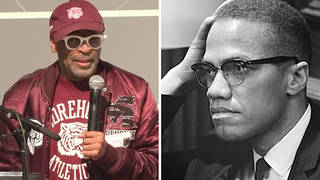
- Ossie Davisdelivered an eulogy for Malcolm X at the Faith Temple Church Of God, February 27, 1965.
We air a recording of Ossie Davis delivering the eulogy for Malcolm X at the Faith Temple Church Of God on February 27, 1965. Davis said: “[Malcolm] talked to all of us: Get up off your knees. Come out of your hiding place. If your hiding place is gold, come out from behind it. If your hiding place is prestige, come out from behind it. If your hiding place is poverty, if you live in the slum, if you live in the gutters, stand up, look at the sun, you too are a man.” Courtesy of the Pacifica Radio Archives. [includes rush transcript]
Related Story
 StoryMay 26, 2023Spike Lee on “Malcolm X” & How Hollywood Almost Prevented Landmark Film from Being Made
Transcript
AMY GOODMAN: We’re going to turn now to Ossie Davis delivering the eulogy for Malcolm X. This is from the Pacifica Radio Archives. It was at the Faith Temple Church of God, just a few days after Malcolm X was assassinated. February 27, 1965.
OSSIE DAVIS: My appreciation of Malcolm, in addition to all of the other things he meant as a leader, as a teacher, as a man, a philosopher, as a man who knew the facts of life, as an Africanist, as an economist, as a political scholar, as an agitator, the thing that struck me most about him was that Malcolm was a man. I mean man in a particular sense. Malcolm had created a new style for those of us who would be men to follow. Not only black men, but also white men. Malcolm left us the heritage of manhood, which in our country has long been going out of style.
And if you don’t believe it, if you’ll remember last February—last March, when 38 people sat by the telephone and refused to pick it up when a young lady was calling for help, and she called three times, and these 38 citizens, who represent us, let the lady die without picking up the phone to call the police. That is the state of our manhood in this country today. And those were not Negro people who did that. They were whites. We have ceased to care. We have ceased to be concerned. We have ceased to remember our humanity. We are things. We are cogs. We are close to being dehumanized in this great country of ours.
Malcolm came along and said, “Stop. Stop. You are men. Stop. You do care. Stop. There is life in you. Stop. There is still the possibility that manhood, that courage, that strength, that imagination, will make the difference.” It was he who rallied our flagging efforts, who taught us to stand up off of our knees—especially the black men, but also the whites—to stand up off of our knees, to address ourselves to the truth, even if we were killed for it. And it’s been a long time since that kind of courage and bravery was abroad in our land.
We’ve had men, men who were martyrs, men who were mighty, men who set us great and good examples. But they had one advantage that Malcolm did not have. They were men of education. They were men of college. They had had training. Malcolm came from the lowest depth. And therefore, in measuring the man, we have to measure the place from whence he came. All of us sitting here tonight, men and women, black and white, can stand a little taller because a man like Malcolm X walked on our Earth, lived in our midst, smiled his smile on the face of Harlem.
I am happy to have known him. And if there is a possibility of redemption for me, for you, for Harlem, for our country, Malcolm is the man who said that such a redemption was possible, and when he died, he was pointing the way to this redemption. We sat tonight. We were uplifted by the singing, by the dancing, by the presence of great leaders among us, and you must have noticed that our greatest leaders turned out to be women. Now, this—there is a reason why this is so. And it’s the same reason why a man would hesitate to keep a picture of Malcolm X on his wall. And that reason is that as black men we have been the most systematically emasculated people on the face of the Earth. And we have learned, unfortunately, to accept and live with our emasculation as if this is the definition of what we are. Malcolm said, “No, you are a man. I will make you see that you are a man.” He insisted on ripping the lies from our face, our middle-class smugness. He talked to all of us.
Get up off your knees. Come out of your hiding place. If your hiding place is gold, come out from behind it. If your hiding place is prestige, come out from behind it. If your hiding place is poverty, if you live in the slums, if you live in the gutters, stand up, look at the sun. You, too, are a man. And when Malcolm said it, when he looked at you, when he gave you the stuff of your own manhood, how could we resist or deny or do less than the little we did to honor him when he died and here tonight? Great things sometimes show up very small. The cloud no bigger than a man’s hand betokened the flood that destroyed the Earth. Many looking on the reception, what has happened since Malcolm has been dead, seeing the kind of reception that we have gotten and that we have not gotten, might make the mistake of thinking that we have measured the man, we have put him in his place, and therefore we can safely turn around and forget him forever. But that is not so. I say this to you, as I say to myself: If Malcolm and his message, so strong, so bright and so pure, was too good for those of us who have already reached manhood, there is a generation who is not yet spoiled, not yet degutted, not yet de-bold, not yet emasculated, who when they come into the light of this truth will rise up and redeem him and us and all the rest of the world. That is the meaning of Malcolm X.
AMY GOODMAN: Ossie Davis, delivering the eulogy for Malcolm X at the Faith Temple Church of God, February 27, 1965. We got this from the Pacifica Radio Archive.




 Top
Top
Media Options