









 Watch Full Show

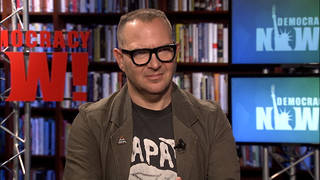
“If the reconstruction industry is stunningly inept at rebuilding, that may be because rebuilding is not its primary purpose,” writes Naomi Klein in the cover story of this week’s Nation. “If anything, the stories of corruption and incompetence serve to mask this deeper scandal: the rise of a predatory form of disaster capitalism that uses the desperation and fear created by catastrophe to engage in radical social and economic engineering.” [includes rush transcript]
- Naomi Klein, award-winning journalist and author of Fences and Windows: Dispatches From the Front Lines of the Globalization Debate and No Logo: Taking Aim at the Brand Bullies. She has the cover story in this week”s Nation magazine called, “The Rise of Disaster Capitalism.”
Related Story
 StoryOct 22, 2025“Nobody’s Girl”: Virginia Giuffre’s Memoir Details Sex Abuse by Epstein, Maxwell, Prince Andrew
Transcript
AMY GOODMAN: Looking at latest cover of The Nation magazine, “The Rise of Disaster Capitalism.” It starts, “Last summer, in the lull of the August media doze, the Bush administration’s doctrine of preventive war took a major leap forward. On August 5, 2004, the White House created the Office of the Coordinator for Reconstruction and Stabilization, headed by former U.S. Ambassador to Ukraine, Carlos Pascual. Its mandate is to draw up elaborate post-conflict plans for up to 25 countries that are not as of yet in conflict. According to Pascual, it will also be able to coordinate three full-scale reconstruction operations in different countries at the same time, each lasting five to seven years.” That’s the first paragraph of the piece. Naomi Klein wrote it. Welcome to Democracy Now!
NAOMI KLEIN: Thanks, Amy.
AMY GOODMAN: Can you talk about these plans that — well, this is the first time that they’re really coming out?
NAOMI KLEIN: Yeah, this happened in August, but it wasn’t reported anywhere in the US press. And really, this is the flipside of an administration totally committed to preemptive deconstruction and destruction, which means that they now have a standing office of preemptive reconstruction, where they have these fast-action, civilian teams, who are private companies like Bechtel and Halliburton; think tanks, obviously right-wing think tanks committed to free market ideology; large NGOs ready to swoop in on pre-signed contracts and rebuild countries that don’t even realize they’re in conflict yet. They don’t even realize they’re on these watch lists. And the real issue here is that there is a growing consensus and understanding that countries that have just experienced a seismic event, like a war or a natural disaster, are, in the language of torture, “softened up” for what Pascual describes as a reconstruction that is more about tearing down the old than rebuilding it. It’s really a kind of social engineering or economic engineering project. And they’re very, very open about this, that they’re not talking about rebuilding states. They’re talking about using the language of reconstruction to privatize state-owned industries, to impose basically what they tried to do in Iraq, a neo-liberal state, but using the dislocation of disaster, which is why I call it disaster capitalism, where people are struggling with the daily concerns of survival, because they’ve just lost everything and their country lies in rubble, to push through these very, very unpopular policies.
AMY GOODMAN: And who is behind them?
NAOMI KLEIN: Well, certainly we see the Defense Department behind it. But the World Bank is extremely involved, which is why Wolfowitz’s appointment — sorry, yeah, Wolfowitz, I get the Wolf’s mixed up, not Wolfensohn. Wolfowitz’s appointment is sort of a lateral move within this — you know, first he was in the destruction department and now he’s in the reconstruction department. Because the World Bank has been shifting its focus to reconstruction very steadily in recent years. They’ve increased — now it’s 25% of their spending is in so-called post-conflict countries. And the World Bank is an extremely ideological institution. When they talk about reconstruction, it’s structural adjustment programs, it’s, “We’ll give you aid money to reconstruct, but…” To be specific, in Afghanistan, for instance, immediately after the war, they bring in an emergency aid package. It’s all used in the language of aid and help. But there is a technical — it’s an aid package to rebuild the infrastructure: water, sewage, things like that. But they attach what’s called a technical annex to it, and in the technical annex it says, we also think that you should privatize the water system, privatize the electricity system, privatize the oil system.
AMY GOODMAN: And is there a list of countries?
NAOMI KLEIN: There’s — they keep a standing list of 25 countries on a watch list, drawing up these plans. And Pascual in this speech that he gave, bragged that they would be able to shave, I think he said five to seven months off of their response time by having reconstruction contracts pre-signed before a conflict even begins. So, you know, as quickly as we saw Halliburton and Bechtel moving in in Iraq, they’d be able to move in even quicker because the paperwork would already be done. And Iraq really is the prototype. I mean, this is what they did in Iraq. And even though the reconstruction itself, we know, is tremendously ineffective, very, very little has been rebuilt. In many ways, things seeming to going backwards. And we’re going to be talking about this more in the debate. We hear the same thing out of Aceh, out of Sri Lanka, post-tsunami, the same sorts of complaints about private contractors getting $1,000 a day. People are getting — what’s happened is that reconstruction has become a tremendously lucrative, for-profit industry. What used to be the domain of aid agencies run by the United Nations is now the domain of private contractors, consultants, and they’re making a killing, even if they are not doing what they say they’re doing, which is, rebuilding a country.
AMY GOODMAN: And the names of the countries?
NAOMI KLEIN: The names of the countries. Well, we don’t know everyone who is on that list. But for instance, a country like Nepal we’ve heard is definitely on the list. But we don’t — it’s not public. It’s intelligence information. But they are saying there’s a 25-country list.





 Top
Top
Media Options