











 Watch Full Show

Related
The agents are accused of seizing the cleric–without permission from Italian officials–and then sending him to Egypt where he was reportedly tortured. This marks the first time a foreign government has filed criminal charges against US citizens involved in counter-terrorism work abroad. [includes rush transcript]
An Italian judge has ordered the arrest of 13 CIA agents for kidnapping a Muslim cleric off the streets of Milan in 2003 and then transferring him to Egypt where he was reportedly tortured.
According to the Italian judge, the U.S. agents seized the man–Hassan Osama Nasr–as he walked from his home to a local mosque. He was then taken away in a white van to a joint U.S.-Italian base, then flown to a U.S. base in Germany and then onto Cairo.
The cleric–who is also known as Abu Omar — was never charged with a crime and has never appeared in a court of law.
Once in Egypt, the cleric said he was beaten and given electrical shocks on his genitals. The kidnapping in Milan was reportedly done without the knowledge of the Italian government who had also been tracking Abu Omar with U.S. assistance.
This marks the first time a foreign government has filed criminal charges against US citizens involved in counter-terrorism work abroad.
The U.S. describes the practice of extrajudicially seizing wanted individuals and then transferring them to third countries as extraordinary rendition.
- Don Van Natta, reporter with The New York Times based out of London. He wrote an article about the kidnapping in The Sunday New York Times.
Related Story
 StoryJan 22, 2020A Torturer Meets His Victims: CIA Psychologist Defends Brutal Methods at Guantánamo Military Hearing
Transcript
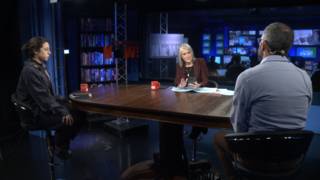
AMY GOODMAN: We’re joined on the phone right now by New York Times reporter Don Van Natta. He is based out of London and wrote a piece about the kidnapping in Sunday’s New York Times. Welcome to Democracy Now!
DON VAN NATTA: Hi, Amy. Great to be with you.
AMY GOODMAN: It’s good to have you with us. Can you talk about exactly what happened and the judge’s response?
DON VAN NATTA: Well, in February of 2003, the Italian secret police were working with the United States intelligence agents based in Milan, who were monitoring the activities of a cleric named Hassan Nasr, also known as Abu Omar. And quite surprisingly to the Italians on February 17, 2003, the cleric disappeared off a Milan street. The Italians really didn’t know why that had occurred. They began a missing persons investigation, and the investigation led them to the very same men and women that they were working with in their investigation of the cleric, these are the American intelligence agents based in Milan. They went before a judge in March of this year, and asked the judge to order the arrest of 19 officers and operatives of the Central Intelligence Agency. It took a few months for that to happen, but just this past week, as you say, it was the unprecedented action where the judge ordered 13 — the arrest of 13 officers and operatives basically to come to court in Milan and face charges of kidnapping.
AMY GOODMAN: In a piece in today’s New York Times, that says, headline, “Experts Doubt Accused C.I.A. Operatives Will Stand Trial in Italy,” it says, “if they are indeed Americans and C.I.A. officers and operatives as described in the arrest warrants.” Is there a question?
DON VAN NATTA: I’m not sure there is much of a question. If you read the investigative report attached to the arrest warrants, which I have read, the Italian investigators have done quite an extraordinary job of investigative work. They have 13 names, two of them are real names, as far as we have been able to determine, and both are people that we believe are in the C.I.A. The other 11 are, we believe, fictional names, but they are all linked to northern Virginia. I have no reason to doubt that these folks do not have links to the C.I.A.
AMY GOODMAN: Well, what will the U.S. do?
DON VAN NATTA: It’s a good question. The United States has been very quiet. The C.I.A. declined to comment when we first found out about this on Friday and throughout the weekend. Also, the embassy, American embassy in Rome, as well as the U.S. consulate in Milan, have been very quiet. I’m assuming, and it’s one of the things we’re trying to find out, that there’s a lot of behind the scenes negotiating going on between Italy and the United States. Berlusconi, the prime minister of Italy, has been also silent on this question, and there hasn’t been much talk on the side of the United States either. So, I think the piece in today’s paper is quite right about it being unlikely that the United States would extradite these people back to Italy to face charges. Another interesting question is these warrants goes to Interpol. Interpol is led by an American named Ron Noble. He is going to have to put out these warrants all over the world for the arrest of these 13 individuals, and the question is whether that’s going to happen today.
AMY GOODMAN: And what’s Ron Noble’s background?
DON VAN NATTA: He is a — he’s got a terrific law enforcement background from the United States and, I mean, I’m sure he’ll play it by the book and it will go out, but the question — I mean, really now, it becomes a sort of a political story of how Italy and the United States are going to deal with this. You know, we had a rendition earlier this year that we reported on first in Germany of a man named Khalid el-Masri. I don’t know if you remember that story. This was a German man who was in Macedonia and was kidnapped and then flown to Afghanistan, we believe by the United States. And he claims that he was tortured in a prison in Afghanistan. And he finally got out and told his story to us first. Again, in that country, in Germany, prosecutors are conducting a very active criminal investigation into his kidnapping. In Stockholm in Sweden, a parliamentary investigator has concluded that C.I.A. agents violated Swedish law by subjecting two Egyptian nationals to what they call “degrading and inhumane treatment” during a rendition in 2001. So I think what you’re seeing is in Europe, which is still been trying to fight terrorism through a criminal justice system, there’s been a backlash to this rendition system that the United States has employed since 9/11.
AMY GOODMAN: Well, Don Van Natta, I want it thank you very much for joining us, from London, New York Times reporter.
DON VAN NATTA: My pleasure.
AMY GOODMAN: Thanks so much.




 Top
Top
Media Options