






 Watch Full Show

A vigil is being held today in New York to commemorate the anniversary of the death of Palestinian human rights activist Farouk Abdel-Muhti. He was jailed for two years without charge. He died last summer just three months after being released. We play an excerpt of the documentary, “Farouk Abdel-Muhti: Political Prisoner. [includes rush transcript]
A vigil is being held today in New York to commemorate the anniversary of the death of Palestinian human rights activist Farouk Abdel Muhti.
In March 2002, Farouk began working regularly at Pacifica Radio station WBAI. He used his contacts to arrange interviews with Palestinians in the Occupied Territories on the morning radio program “Wake-Up Call.”
Farouk was detained one month later. He was jailed in various facilities around the country and was never charged with a crime. Two years after his detention, a federal judge ordered Farouk to be deported, charged or released. He walked out of prison on April 12, 2004.
Two months after his release, Farouk was giving a speech at the Ethical Culture Society in Philadelphia. When he finished his address, Farouk’s head fell to the table. He collapsed and died shortly afterwards. He was 57 years old.
To commemorate the anniversary of his passing we bring you this is an excerpt of a documentary about Farouk that was produced when he was still in prison.
- Farouk Abdel Muhti: Political Prisoner, documentary by Konrad Aderer.
To commemorate the anniversary of his passing, a vigil is being held at noon tomorrow in front of the Federal Building in New York–the same time and place of the vigils that were held every week during Farouk’s confinement. Farouk’s fiancee Sharin Chiorazzo and his son, Tarek, his will be there as will longtime New York civil rights attorney Lynne Stewart.
Related Story
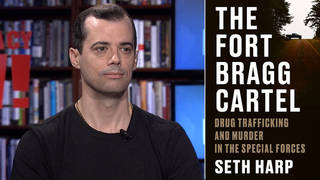
 StoryAug 14, 2025“The Fort Bragg Cartel”: Book Exposes U.S. Special Forces’ Involvement in Drug Trafficking & Murder
Transcript
AMY GOODMAN: We bring you this excerpt now. Farouk was 57 years old. An excerpt of a documentary made about Farouk Abdel-Muhti that was produced when he was still in prison. It begins with his son, Tarek, describing Farouk’s detention.
TAREK ABDEL: During the time that he was arrested and taken to 26 Federal Plaza in Manhattan, this F.B.I. agent, who was not supposed to be asking him any sorts of questions about crime or terrorism because that’s not his charge, interrogated him severely and beat him, kicked him in the groin, slapped his face, and hit his head. If it were solely for I.N.S. reasons, then that would have never happened to him.
FAROUK ABDEL-MUHTI: My name is Farouk Abdel-Muhti. I am Palestinian. I come to this country from 1976, and include I have a son, children who is an American, born here. He’s named Tarek. I’ve been detained on 26 of April, after my voice was on WBAI Radio Pacifica to bring the voice of the Palestinian people in the West Bank and the Gaza Strip and the Palestinian refugee camps.
TAREK ABDEL: Hundreds of thousands of people across the country heard the broadcasts, you know, broadcast from Jenin, broadcast from Nablus, all these different places where all these humanitarian disasters were taking place. People were getting like first-hand information of what was actually happening.
FAROUK ABDEL-MUHTI: You know, I was with all these groups when we make a big rally after 9/11. With the interfaith, I bring the Muslim speaker, I bring the Christian Arab speakers to be part of this big rally. I believe in peace. Peace and justice, and equal society in historical land of Palestine.
TAREK ABDEL: He always makes a distinction between legitimate national liberation struggle and terrorism. He doesn’t believe in exporting the Palestinian struggle outside of its borders.
FAROUK ABDEL-MUHTI: You understand about my community, the Palestinian Arab community here beginning to be afraid, afraid even to talk, afraid to go to the streets, afraid even to deal, to talk by telephones. The I.N.S. detainees, many of them, especially the 9/11 people, have families, have lawyers, have cases, and be deported. One day — night, day — deported. Never you know what time you can get moving from here. They remove you, and after, you disappear. Strange policies working very secretly. You don’t know what’s going to happen to you. This kind of psychological war against the Arabs and the Muslims today is the same time repeated the history of the 1943 against the Japanese Americans. We have to stop these things, you know. We have to go to talk about the balance and criterion of right and true.
AMY GOODMAN: Farouk Abdel-Muhti, speaking while he was in detention for two years. Yesterday was the first anniversary of his death. There will be a vigil outside the Federal Building in New York today to remember the vigils that were held every week during his detention.




 Top
Top
Media Options