





 Watch Full Show

Related
Topics
American peace activist Rachel Corrie was crushed to death by an Israeli bulldozer three years ago today. To celebrate her life, people around the world are staging readings of her words. We hear some of the organizers from New York, Bethlehem, London, Amman and more. [includes rush transcript]
Today is the third anniversary of the death of Rachel Corrie. On March 16, 2003 an Israeli military bulldozer crushed her to death as she was attempting to stop the demolition of the home of a Palestinian doctor in the Gaza town of Rafah.
Eyewitnesses said at the time of her death Rachel was sitting directly in the path of the bulldozer holding a megaphone and wearing a fluorescent jacket. She was 23 years old.
Three years after her death, Rachel Corrie is at the center of a new controversy. Two weeks ago a New York theater company backed out of an agreement to stage the new play “My Name is Rachel Corrie”, based on Rachel”s writings.
It premiered in London in April 2005 and was supposed to open soon at The New York Theater Workshop. But now the theater says it has been “postponed indefinitely.”
The play’s producers are accusing the theater of censorship but James Nicola, artistic director of the New York Theatre Workshop has defended the decision saying it was made following Ariel Sharon’s recent stoke and the election of Hamas. Nicola said, “We had a very edgy situation. We found that our plan to present a work of art would be seen as us taking a stand in a political conflict, that we didn’t want to take.”
Today, to commemorate the third anniversary of Rachel’s death, people around the world are remembering her life by staging readings of Rachel’s words. We reached some of the organizers yesterday and asked them to describe the events.
- New York, NY: Jen Marlowe, founder of Rachelswords.org
- West Jerusalem: Angela Godfrey-Goldstein, member of the Israeli Committee Against House Demolitions.
- Amman, Jordan: Marcy Newman, University of Jordan researcher.
- London, England: Mike Cushman, London School of Economics researcher.
- Bethlehem, West Bank: Abdel Fattah Abu Srour, director of the Al-Rowwad Culture and Theatre Center.
- Olympia, WA: Rachel Corrie’s former teacher at Evergreen State College.
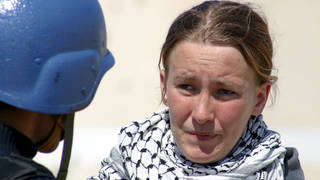
We turn now to Rachel in her own words. This is an excerpt of the documentary “Rachel Corrie: “An American Conscience” directed by Yahya Barakat. It includes excerpts of Rachel speaking in Gaza about the plight of the Palestinian people.
- Rachel Corrie, speaking Gaza before her death. From an excerpt of the documentary “Rachel Corrie: “An American Conscience.”
Related Story
 StoryMar 18, 2024Rachel Corrie: Parents & Friend Remember U.S. Activist Crushed by Israeli Bulldozer in Rafah in 2003
Transcript
AMY GOODMAN: Today, to commemorate the third anniversary of Rachel’s death, people around the world are remembering her life by staging readings of Rachel’s words. We reached some of the organizers and asked them to describe the events.
JEN MARLOWE: My name is Jen Marlowe. I’m one of the co-founders of “Rachel’s Words.” “Rachel’s Words” started as a response to the play not opening in New York. There has been a tremendous grassroots response to this initiative. Rachel’s emails and her writings are going to be read today in Iraq, in Israel, Palestine, Kosovo, Nigeria, India, England. There’s going to be 70 readings — more than 70 readings so far planned going on in cities and countries all over the world.
ANGELA GODFREY-GOLDSTEIN: My name is Angela Godfrey-Goldstein. I’m an Israeli peace activist. And I’m Action Advocacy Officer with the Israeli Committee Against House Demolitions based in Jerusalem. And tomorrow I will be reading emails that Rachel Corrie wrote while she was alive, which I was reading at the time when she was writing them.
MARCY NEWMAN: My name is Marcy Newman. I live in Amman, Jordan. And we are organized a staged reading of My Name is Rachel Corrie at Books@Cafe in Jabal, Amman, a neighborhood of Amman. We’ll be reading Rachel’s writings and commemorating her death.
MIKE CUSHMAN: My name is Mike Cushman. I’m a researcher at the London School of Economics in London, U.K. Tomorrow, on March 16, the third anniversary of the killing of Rachel Corrie by an Israeli Defense Force Caterpillar bulldozer, we’ll be reading from Rachel’s emails home, which describe her experiences on the West Bank.
ABDEL FATTAH ABU SROUR: My name is Abdel Fattah Abu Srour. I am the director of Al-Rowwad Children’s Theatre in Aida camp in Bethlehem, Palestine. Tomorrow, we will be doing a reading with children of the camp about Rachel Corrie’s emails. Rachel was the most beautiful face of the American country, and she was here because, as she said in her poem, “I’m here for other children. I’m here because I care.”
LIN NELSON: My name is Lin Nelson. I’m a teacher here at Evergreen State College, where Rachel went to school. Faculty, staff and students and community members are going to gather at a small remembrance site we have here for Rachel. And we’re going to be reading from the play and from other writings Rachel has done since she was a little girl.
AMY GOODMAN: Some of the events around the world commemorating the third anniversary of Rachel Corrie’s death. We turn now to Rachel Corrie in her own words. This is an excerpt of the documentary, Rachel Corrie: An American Conscience. It was directed by Yahya Barakat. It includes excerpts of Rachel speaking in Gaza about the plight of the Palestinian people.
RACHEL CORRIE: I’ve been here for about a month and a half now, and this is definitely the most difficult situation that I’ve ever seen. In the time that I’ve been here, children have been shot and killed. On the 30th of January the Israeli military bulldozed the two largest water wells, destroying over half of Rafah’s water supply. Every few days, if not every day, houses are demolished here. People are economically devastated, because of the closure of the borders into Egypt and the extreme control of the Gazan economy by Israel. I saw it. I came to look at the aftermath of a place where 25 greenhouses had been demolished on the other side of Rafah, destroying the livelihoods of about 300 people. And that had taken place while they rounded up about 150 men, held them under a sniper tower and shot around them to contain the men, the farmers in the area. So I feel like what I’m witnessing here is a very systematic destruction of people’s ability to survive, and that is incredibly horrifying.
Sometimes it takes a while for it to set in, what is happening here, because I think many of the people here, they try to maintain what they can of their lives. And I think — I don’t know, maybe it has to do with protecting their children that they try to be happy, joke with their children. So sometimes it takes time to — it’s hard to hold in your mind, you know, the complete reality of what’s happening here. Sometimes I’m sitting down to dinner with people, and I just realize that there is a massive military machine surrounding them and trying to kill these people that I’m having dinner with, these families that I’m sitting down to eat with and who are being very generous and kind to me, and their children here, who are incredibly threatened, living lives that no child ever should have to live. And so, I feel a lot of horror, really. I feel a lot of horror about the situation.
AMY GOODMAN: Rachel Corrie, from the documentary, Rachel Corrie: An American Conscience, directed by Yahya Barakat. This is the third anniversary of Rachel’s death.



 Top
Top
Media Options