











 Watch Full Show

Related
Topics
The vital concept of net neutrality–universal and non-discriminatory to the Internet–is at risk. Phone and cable companies are lobbying Congress for legislation that would permit them to operate Internet and other digital communications services as private networks, free of policy safeguards or governmental oversight. We speak with Jeff Chester of the Center for Digital Democracy. [includes rush transcript]
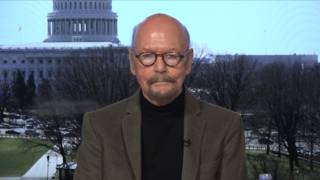
- Jeffrey Chester, executive director of the Center for Digital Democracy. He wrote an article in the Nation Magazine titled “The End of the Internet?”
Related Story
 Web ExclusiveMay 23, 2018Malkia Cyril on Facebook’s Civil Rights Audit & How Amazon Sells Facial Recognition Tools to Police
Transcript
AMY GOODMAN: We’re joined in Washington by Jeff Chester, who’s Executive Director of Center for Digital Democracy, wrote a piece in The Nation magazine called “The End of the Internet,” and we want to talk about that. But before we do, Jeff, you’ve just heard a portion of a discussion we’ve been having about what’s happening to the Village Voice and Jim Ridgeway, who was in the studio seat right before you were. Can you comment on this?
JEFF CHESTER: Well, you know, the question that I’m going to discuss soon, about so-called network neutrality, the future of the internet, is directly related. I’m not so sure, frankly, that the changes underway being pushed by the nation’s largest cable and telephone companies to change the way that the internet operates, I’m not so sure journalism, whether it’s alternative journalism or new forms of so-called mainstream journalism or even dissent, I’m not so sure how viable those forms will be in the emerging online world. That’s why we have to make sure that as these decisions are being made now, you know, in state capitals and in Washington, we keep today’s open internet at the core of these dramatic changes in our media system.
Let’s say Jim Ridgeway and his colleagues wanted to create an alternative, and let’s say the phone and cable companies were able to do what they intend to do. Well, Ridgeway’s video or Democracy Now!'s video could be slowed down while the FOX programming goes into computers and into television sets and into mobile devices super fast. Let's say, if the phone and cable companies have their way, they hand Jim Ridgeway or they hand Democracy Now! a rate card. You want to have mainstream quality? Here’s what you have to pay! And if you can’t afford it, well, you’re just going to have to go on the old dirt road. So, the future of journalism, and in many ways the future of our democracy, I think, is tied up in this issue of: What is going to happen to the internet if the phone and cable lobby gets their way here in Washington, D.C.?
JUAN GONZALEZ: Well, Jeff, one of the things that’s happening obviously is that this kind of debate is going on right now in the House of Representatives — I saw a little bit of the subcommittee hearings about a week or so ago — but all the national attention, obviously, is on the immigration issue while this is quietly going on under the radar, the huge debate going on in the House of Representatives in the subcommittees now. Could you tell us what is net neutrality precisely and that particular portion of the legislative battle going on right now?
JEFF CHESTER: Well, it’s important for your listeners and viewers to realize that the phone and cable lobbies have deliberately gone to the F.C.C. to remove the fundamental regulations, which were the foundation of the internet. The internet was required to operate as a nondiscriminatory medium. The internet, as we knew it, grew up over telephone lines. Those lines were regulated by the F.C.C. Phone companies had to treat all content equitably. That’s why you could have start-ups like Google or Amazon. Anybody could create a website, create a service, put their content out there. The fact that you would have to treat all content equitably was a serious threat to the plans of cable and telephone companies, because their business is based on a monopoly. I control the wire and I control the content, whether it’s television content for cable or voice content for the phone company. So they went to the Bush F.C.C., first under Michael Powell, now under current chair Kevin Martin, and they eliminated the prohibition against nondiscrimination so they can discriminate.
Now, what advocates, such as Free Press and Common Cause, Consumers’ Union, and even giants like Microsoft, Google, and Yahoo! are saying is that: Whoa, we need to put some of that nondiscrimination back into the statutes that govern the internet. And it’s being called network neutrality. And it simply means that the people that bring you the internet aren’t allowed to discriminate against competing and alternative content. They could not, if network neutrality legislation goes through, slow down a transmission from Democracy Now! They could not speed up their content or the content that, for example, FOX pays them and not offer similar services elsewhere. So network neutrality would in part maintain this kind of open network.
Now the phone and cable lobby are spending literally tens of millions of dollars trying to buy and, likely have bought, Washington, D.C. They are working together, and they’re opposed to any national policy that would ensure the internet remain an open space. And if we don’t have it, if we don’t have it, we’re going to see slowly over time fundamental changes occur in our digital media culture. Everyone recognizes — and this is why this is all going on — is that our media system is changing.
JUAN GONZALEZ: But, Jeff, I’d just like to — just to clarify on this issue of net neutrality. You already have a certain segmentation of the audience between those who are still on old phone lines versus broadband. Are you saying that even within broadband service that they would then create tiers of operation? And how would it work? Would it be for the user or would it be for companies?
JEFF CHESTER: Right now, you know, there are millions of Americans who don’t have access to the internet at all, and clearly that has to be part of this legislation. And it’s not. But, ultimately, everyone is going to be on some form of high-speed access. What we call broadband will be the dominant medium in the United States. And for a certain class of young people, you see it most clearly, where they’re instant-messaging, they’re on their mobile phone, they’re downloading high-speed videos onto their computers. So, eventually it will all be broadband, and what the phone and cable companies want to do is create a pay-as-you-go toll road for those broadband networks.
AMY GOODMAN: Jeff, we have to leave it there. But we’re going to bring our listeners and viewers part two of this discussion tomorrow. I want to thank you for being with us right now. Again, tune in for part two tomorrow. Jeffrey Chester is Executive Director of the Center for Digital Democracy.




 Top
Top
Media Options