









 Watch Full Show

Related
Topics
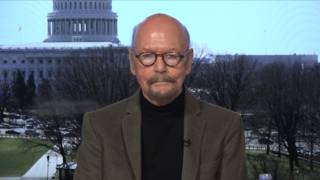
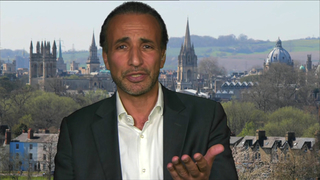
Village Voice columnist Nat Hentoff discusses the government’s attempt to clamp down on the ability of the public to transmit or receive information the government deems secret. Hentoff says the prosecution of two former officials of the American Israel Public Affairs Committee is the “first in which the federal government is charging violations of the Espionage Act by American citizens who are not government officials for being involved in ,until now, what have been regarded as first amendment protected activities.” [includes rush transcript]
Today we look at the U.S government’s attempt to clamp down on the ability of the public to transmit or receive information that the government deems secret. In recent weeks, various government agencies have sought to punish people who they believed leaked classified information. Government agents have also sought personal files from those who they claimed possessed classified information and some intelligence agencies have tried to limit what information the public has access to.
Last week, the CIA fired analyst Mary McCarthy who the agency says had undisclosed contacts with journalists, including Washington Post reporter Dana Priest. Priest won a Pulitzer Prize earlier this month for a series of articles about how the CIA is running secret prisons overseas. McCarthy has denied disclosing this information to Priest or leaking any other classified information.
Congress is also considering legislation which would potentially revoke the pensions of intelligence agency employees who make unauthorized disclosures. The legislation would also greatly expand intelligence agency powers by permitting security forces at the National Security Agency and the CIA to make warrantless arrests outside the grounds of those agencies. And it was also recently disclosed that the CIA and the National Archives signed a secret agreement, which would permit the CIA and other intelligence agencies to withdraw from public access records it considered improperly declassified.
Also, earlier this month it was revealed that the FBI is seeking to go through the files of legendary muckracking journalist Jack Anderson in order to remove anything it regarded as classified or secret. Anderson died last December and his family is refusing to allow government agents access to 200 boxes of his documents which are housed at George Washington University. We will talk more about this later in the program. But first we turn to longtime First Amendment advocate and Village Voice columnist Nat Hentoff. On Tuesday, he spoke at an all-day conference on Presidential Powers sponsored by NYU’s Center on Law and Security.
- Nat Hentoff, speaking on April 25, 2006.
Related Story
 StoryJul 06, 2016U.S. Policies Have Not Changed: Banned Under Bush, Tariq Ramadan Speaks Out Against Obama & Clinton
Transcript
AMY GOODMAN: We turn to longtime First Amendment advocate and Village Voice columnist, Nat Hentoff. On Tuesday, he spoke at an all-day conference on presidential powers, sponsored by New York University’s Center on Law and Security.
NAT HENTOFF: I’m going to focus on the further expansion of the President’s powers in the increasing investigations, and some may be criminal investigations, of the press for, in the President’s terms, “aiding the enemy” in publishing leaks of classified information. Now, having been advised by a covey of lawyers in the Justice and Defense Departments 2002 and 2003, headed by John Yoo, that since 9/11, as Commander-in-Chief, he has the power, when it’s necessary for national security, to bypass Congress, bypass the courts. The White House is now insistent that the press is also getting in the way of the unitary executive.
Now, testifying before the Senate Intelligence Committee in February, C.I.A. Director Porter Goss — Porter Goss was about to resign from Congress. He had been in the C.I.A. previously, but he was persuaded by the President and Dick Cheney to become the director of the C.I.A. Vice President Cheney, shortly after 9/11, mentioned the necessity to cultivate the dark arts, and he wanted to make sure, with all the leaks going on, that those arts would become even darker, and he’s testified, Porter Goss did, saying, “We will witness a Grand Jury investigation with reporters present” — presumably “and testifying” — “being asked to reveal who is leaking information about the C.I.A.’s classified material.”
The charge against Mary O. McCarthy — and she has denied not only the charge, that she even had access to that information that Dana Priest was printing — that she was a source of Dana Priest’s Washington Post report on the C.I.A.'s secret prisons in Eastern Europe. Now, Dana Priest — I'm so pleased she won the Pulitzer this year — has been writing about the C.I.A.'s black sites since late 2002, the Bagram Air Base in Afghanistan. And Pat Roberts, Chairman of the Senate Intelligence Committee, who continually refuses to authorize an investigation of the C.I.A.'s violations of American and international laws in its prisons, wholly hidden, obviously deliberately from our rule of law, is now congratulating the firing of Mary McCarthy.
Dana Priest is already subject to a Justice Department investigation, as are New York Times reporters Lichtblau and James Risen, for their disclosure of the President’s secret approval of the National Security Agency’s warrantless surveillance of Americans, and those reporters have also received Pulitzers this year, despite the President’s characterization of their reporting as “shameful.”
The administration’s position has been clearly stated by F.B.I. spokesman William Carter. “Under the law, no private person, including journalists, may possess classified documents that were illegally provided to them. These documents remain the property of the government,” unquote, and that’s what they’re telling the late Jack Anderson’s family now.
The law cited by Mr. Carter is this administration’s expansion of the Espionage Act of 1917, which is now before the courts. By the way, Woodrow Wilson has been mentioned earlier, and he was very disappointed in what finally became of the Espionage Act. He was insistent that there be a provision that would punish the press, and that, after a very spirited debate, was extracted from the Espionage Act of 1917. It is now expanded by this administration, and there is a case now in the courts that can greatly diminish the First Amendment rights of the press and the rights of Americans to receive information about such lawless practices as the C.I.A.'s secret interrogation centers, the President's violation of the Foreign Intelligence Surveillance Act, etc.
This espionage case, which has been not reported sufficiently in the media, United States of America v. Franklin, Rosen and Weissman, is the first in which the federal government is charging violations of the Espionage Act by American citizens who are not government officials for being involved in what until now have been regarded as First Amendment protected activities engaged in by hundreds of journalists, not everyday, but quite often. Stephen Rosen and Keith Weissman, former officials of AIPAC, the American Israel Public Affairs Committee — they have since been fired — are accused of receiving classified information from a Defense Department analyst, Lawrence Franklin, about American Middle East and terrorism strategy. Rosen and Weissman are charged with providing that classification information to an Israeli diplomat and a journalist.
Lawrence Franklin has pleaded guilty, is sentenced to prison, but defense attorneys for Rosen and Weissman declared — and by the way, in the defense brief, there are several now before the Federal District Court, I was very pleased to see that signing the defense brief against this use of the Espionage Act was a previous speaker this morning, when he was in the Justice Department and a primary architect of the PATRIOT Act, but he is also, as he indicated today, concerned with what is happening now, Viet Dinh, signed the defense brief in this Espionage Act case. Anyway, the defense of the two say, “Never until now has a lobbyist, reporter or any other non-government employee been charged for receiving oral information the government alleges to be national defense material, as part of that accused person’s normal First Amendment protected activities.”
In an amicus brief to the U.S. District Court for the Eastern District of Virginia, the Reporters Committee for the Freedom of the Press, with which I’m affiliated, I’m on the steering committee but — and never being asked to steer, but anyway, they say, “These charges potentially eviscerate the primary function of journalism: to gather and publicize information of public concern, particularly where the most valuable information to the public is information that the government wants to conceal, so that the public cannot participate in and serve as a check on the government.” After all, that’s why the First Amendment, one of the reasons anyway, was added to the Constitution in 1791.
But the judge now hearing this case, this espionage case, T.S. Ellis, III, said in March — he’s backtracking a little now, but he said in March —that “persons who come into unauthorized possession of classified information must abide by the law. That applies to academics, lawyers, journalists, professors, whatever,” unquote. “Whatever” being a rather broad and vague term.
Now, recently, as I said, Judge Ellis is beginning to realize, it seems, that this is a more difficult case than he first thought. However it goes, and it will eventually, I expect, be before the Supreme Court, as Steven Aftergood, head of the Project on Government Secrecy at the Federation of American Scientists, says, “To make a crime of that kind,” of this kind of conversations that Rosen and Weissman had with Franklin over lunch, “would not be surprising in the People’s Republic of China, but it’s utterly foreign” — the question is, is it? — “it’s utterly foreign to the American political system.”
This censorship of the press was cut out, as I said, of the Espionage Act of 1917. Now, if the Supreme Court agrees with the Bush administration and Judge Ellis in March, maybe not now, we will, as Steven Aftergood says, “We will have to build many more jails and disarm the First Amendment.”
AMY GOODMAN: Nat Hentoff, writer for the Village Voice, well known for his writings on the First Amendment.




 Top
Top
Media Options