







 Watch Full Show

Related
Topics
Four weeks. Thirty-two countries. Sixty-four matches. One billion viewers. The FIFA World Cup underway in Germany right now is the most-watched sporting event on the planet. We take a look at the global significance of the World Cup with sports writer Dave Zirin. [includes rush transcript]
Four weeks. Thirty-two countries. Sixty-four matches. One billion viewers. The World Cup. It’s the most-watched sporting event on the planet. Once every four years, the world comes to a standstill to watch countries compete in what is known as “The Beautiful Game”–football, or soccer as it is called it in the United States.
Nearly every nation in the world competes to play in the World Cup. Only thirty-two qualify. Just the honor of making it to the tournament is tremendous. It can even help to stop war. That’s right, in the Ivory Coast this year, warring sides called a temporary truce to a bloody four-year civil conflict when the national team qualified for their first ever World Cup.
In Argentina, with so many kids staying home to watch the tournament, teachers showed the games at school and made the World Cup part of the curriculum tackling geography and other issues.
This year’s World Cup is being held in Germany. And the competition is well underway. Only twelve countries remain in the running. The United States is not one of them. They were eliminated in the first round by Ghana, who are competing in their first ever World Cup.
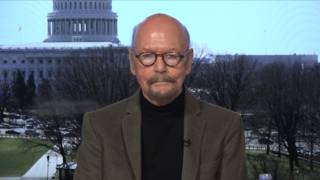
- David Zirin, is joining us now in the studio. He writes the weekly column “Edge of Sports.” He is a regular contributor to the Nation and author of the book, “What’s My Name, Fool?: Sports and Resistance in the United States.”
Related Story
 StoryApr 16, 2024Yanis Varoufakis Banned from Germany as Berlin Police Raid & Shut Down Palestinian Conference
Transcript
AMY GOODMAN: Dave Zirin joins us now. He writes the weekly column, “Edge of Sports,” a regular contributor to The Nation, author of the book, What’s My Name, Fool?: Sports and Resistance in the United States. Welcome to Democracy Now!, Dave.
DAVID ZIRIN: Great to be here, Amy.
AMY GOODMAN: Talk about the significance of these games?
DAVID ZIRIN: Incredibly significant. And it’s been particularly significant here in the United States, because normally to be a soccer fan in the United States is to be in the witness protection program of sports. I mean, you are watching these games in the dark of night, under cover, communicating over email lists about your favorite players. But this is really the time for soccer to take center stage.
And even though one may not see it take center stage on ESPN, anybody who goes to any of the neighborhood bars in your local city know that this has the pulse of the neighborhood. I mean, in Washington, D.C., where I’m from, you go down to U Street where they have the Eritrean or Ethiopian bars, I mean, they are just buzzing. You go to the Irish pubs on Connecticut Avenue, you can hear the cheers in the streets. And especially in Adams Morgan, where there’s a wonderful place called the Ghana Café, I mean, when Ghana beat the United States, you would have thought you were in Accra, because people were pouring out into the streets, singing songs, waving flags. And that’s the aspect of the World Cup that I think people find so appealing.
AMY GOODMAN: What about the significance of that, Ghana beating the United States?
DAVID ZIRIN: Oh, it’s tremendously significant, I mean, first and foremost, because the United States was very favored going into this tournament. They made the quarterfinals four years ago. And Ghana, as you mentioned, this was their first ever World Cup. And very few people predicted that Ghana would make it to this point. And what’s so exciting about the Ghanaian team is that they seem to be fulfilling the prophesy of the great Pele, who predicted almost 30 years ago that by the year 2000, an African team would win the World Cup. That hasn’t happened yet, but to see Ghana playing with such flare and beauty and excitement really has people excited about the future of soccer in Africa.
AMY GOODMAN: In one of your pieces, you described the commentators and the people from Ghana who were watching in the Ghana Café, their response to them.
DAVID ZIRIN: Yes. Oh, they were furious about the commentators, I mean, first and foremost, because to watch the game, you would think that it was the United States versus some team. And there was just very little mention of the Ghanaian players, of what the Ghanaian players were doing. Everything was in relation to the United States. And that just brought them no end of frustration.
The other thing that was very frustrating for the people at the Ghana Cafe was just very little mention of the fact that the Ghanaian players largely don’t get to play in Europe at the top leagues, so they don’t get to play in the off-years against the best players and really hone their abilities. Most of them play in leagues in Africa or in the Middle East. And that frustrated them to no end, because when Ghana was beating the U.S., one of the commentators said, “Well, that’s because so many of these Ghanaian players are now playing in Europe. They’ve really been able to hone their skills,” when you’re talking about literally one Ghanaian player who plays in the top leagues in western Europe.
So the Ghanaian fans who are just incredibly savvy and have forgotten more about soccer than the commentators they have on the air just throw up their hands and just, like, “Are you kidding me? What is this person talking about?” Because there is that kind of pride in what Ghana is being able to accomplish. And it’s worth saying that it’s a continent-wide pride. It wasn’t all Ghanaians in the Ghana Café; it was people from Ethiopia, Eritrea, South Africa, Namibia. I mean, it really was this sense of a continent unity that, I think, speaks to the best angels of our nature with regards to sports.
AMY GOODMAN: Dave Zirin, talk about Iran.
DAVID ZIRIN: Absolutely. Well, Iran was part of the World Cup. They were the Middle Eastern champions this year. And there was a push to keep them from playing in the World Cup, because of the nuclear controversy that’s been going on there, because of the desire for a nuclear enrichment program led by President Ahmadinejad. And the European Union, they passed a resolution to try to keep Iran out of the World Cup. One of the leaders of the E.U. suggested that they get Bahrain, who came in second, to play in the World Cup, because they said if we get Bahrain here, then people won’t think it’s an attack against the Muslim world. It will show how generous we are that we actually want Bahrain to play, which is just an idiotic, head-scratching concept.
In the United States, this happened, as well, when Senator John McCain, the maverick of Bob Jones University, attempted to get a bill passed through the Senate that would call for FIFA — that’s the governing soccer body — from keeping Iran from playing in the World Cup. I mean, it was a transparent effort to try to use the current geopolitical situation as a club to keep Iran out of the World Cup, and it’s something that failed, which is a very good thing.
AMY GOODMAN: Racism at the games?
DAVID ZIRIN: Oh, my goodness. Well, in the lead-up to the Cup, there was a continent-wide controversy throughout Europe about racism at the top levels of soccer. And this is accompanied in Europe, issues around immigration, asylum, anti-Muslim sentiment. And with that, you see a resurgence of just some absolutely awful spectacles, like star African players who play in the European leagues, every time their foot would touch the ball, fans would make ape noises or monkey noises. Fans would be throwing — I actually don’t even like calling them “fans” — but people in the stands would be throwing banana peels at them, peanuts at them. And it got so bad that a star player named Samuel Eto’o, who’s from Cameroon and plays for Barcelona, he literally started to walk off the field and said, “I’m not going play anymore.” And it took players from both teams to get together to quiet the fans down, to eject fans.
Another player named Marc Zoro, who plays for a top Italian club, who’s from Africa, he picked up the ball and started to just walk off the field holding the ball. Not allowed to touch the ball with your hands. He was pretty mad. He was ready to walk away. I mean, it’s an absolutely horrible thing. One of the African players was quoted anonymously, saying that “in Europe, we’re treated as worse than dogs.” And it got some play here in the U.S. when a U.S. player of African descent named DaMarcus Beasley, he described the situation. He said, “Every time my foot touches the ball, I fell like I’m in just some horrible racist, anachronistic film, you know, of some kind.” And this is the sort of thing that soccer is facing right now.
AMY GOODMAN: But it hasn’t happened as much at the World Cup.
DAVID ZIRIN: No, and it hasn’t happened — we should be very clear about this, that the reason why it’s happened less at the World Cup, despite some little outbursts by little Neo-Nazi fringe groups trying to organize rallies or what not, is because of the organization of players and fans themselves. There’s a group called FARE — that’s Footballers Against Racism — that have been organizing to keep the racists out.
There’s a star player from France of African descent named Thierry Henry, who started a campaign called “Stand Up, Speak Up,” which is an amazing campaign. He actually pressured his sponsor, Nike. You don’t usually think of Nike when you think of the anti-racist vanguard in the world, but he pressured Nike to actually produce these black-and-white arm bands to sell, that fans could wear in solidarity with anti-racism. They’ve sold over five million.
AMY GOODMAN: We only have 30 seconds. But American soccer player Eddie Johnson, just a few days, went before the games to Ramstein Air Base in Germany and said, “We’re here for a war.”
DAVID ZIRIN: Yes. I mean, there’s something about the sporting DNA of the United States that seems to import war into these games, and Eddie Johnson, he’s a very young man. He apologized for saying it. You know, give him the benefit of the doubt as a 21-year-old. But I got to tell you, people in the Ivory Coast, who know what war is really like, know we shouldn’t be playing these games by conflating sports and war.
AMY GOODMAN: Dave Zirin, I want to thank you very much for being with us. He’s author of the book, What’s My Name, Fool?: Sports and Resistance in the United States.




 Top
Top
Media Options