






 Watch Full Show

Related
Topics
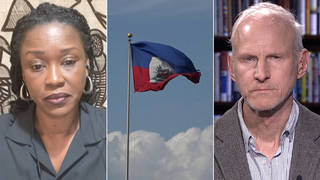
United Nations troops in Haiti opened fire last week on a poor neighborhood outside of Cite Soleil. We show footage of the raid, speak with a writer and activist who witnessed the raid and hear from the mother of a nineteen year-old who was killed in the raid. [includes rush transcript]
Is life in Haiti improving under the new presidency of Rene Preval? Well just last week, UN forces opened fire on a poor neighborhood outside of Cite Soleil. An international delegation of activists was in the area and witnessed what happened. They also caught much of the raid on tape. In a moment we are going to play some of that tape. But first we are joined in our firehouse studio by one of the witnesses. Ben Terrall is a writer and activist. He just returned from Haiti this week.
- Ben Terrall, writer and activist who just returned from Haiti. His writings have appeared in CounterPunch, In These Times, the San Francisco Chronicle and else where.
We go back to the day of the UN raid in Simon Pele. These are members of the international delegation describing the scene:
- Witnesses describe the UN raid as it is caught on tape.
Nineteen year-old Wildert Sanedy was shot and killed by UN troops in the raid. The delegation caught up with his mother, Adacia Sanedy, four days after the shooting. She spoke about her son.
- Adacia Sanedy, son killed by UN troops in Haiti.
Related Story
 StoryApr 03, 2024Haitians Resist Foreign Intervention as U.S. Pushes for Unelected “Transition Council” to Rule Island
Transcript
AMY GOODMAN: I want to stay on this issue of UN forces. Is life improving under the new presidency of Rene Preval? Just last week UN forces opened fire on a poor neighborhood outside Cite Soleil. An international delegation was in the area and witnessed what happened. They also caught some of the raid on tape. In a moment, we’ll play a clip of that tape, but first we’re joined in our Firehouse studio by one of the witnesses, Ben Terrall, who is a writer and activist, just returned from this delegation in Haiti. Ben, would you set the scene for us about what we’re going to see?
BEN TERRALL: Well, I was with other members of this delegation on a road in Simon Pele, which is adjacent to Cite Soleil. It joins it on one side. And we saw two armored personnel carriers come in as we were there and go down one street, and on a perpendicular street there were two other APCs. And I personally saw five or six Brazilian UN troops run out of one of the APCs into the neighborhood. And we went towards the APC, and we got footage.
AMY GOODMAN: This footage is quite something. Let’s go to the day of the UN raid in Simon Pele. These are members of the international delegation describing the scene.
SASHA KRAMER: We’re in Pele in Cite Soleil, and we just heard several rounds of gunfire. We saw soldiers jump out of the tank and run into the houses nearby. Sounds like they were shooting from inside the houses.
HAITIAN CIVILIAN: [translated] Last week, there were several groups in Cite Soleil who said they would turn over their weapons. But since, MINUSTAH has continued to shoot on the population. They have not done that. As you can see right here, they are continuing to shoot on the population.
DELEGATION WITNESS: There’s the MINUSTAH soldiers firing from their tank into a residential neighborhood. And the blue helmets signify that it’s UN soldiers. They’re wearing the Brazilian uniforms. They’re getting instructions over the radio right now. They don’t seem to be at all deterred by our presence. More troops have moved into position here, and it looks like a military operation underway. The foot troops are going into the area — the infantry troops are going into the area. They’re positioning themselves for some kind of an attack in this civilian neighborhood.
HAITIAN CIVILIAN: [translated] This is the same formula they used when they killed Dred Wilme on the 6th of July last year. So they are cutting off a street here using bulldozers, so people can’t get in and out. They say they are looking for bandits. But we do not know exactly who they are looking for.
AMY GOODMAN: 19-year-old Wildert Sanedy was shot and killed by the UN troops in the raid. The delegation caught up with his mother, Adacia Sanedy, four days after the shooting. She talked about her son.
ADACIA SANEDY: [translated] After I lost my son, I didn’t even know what to do. I couldn’t even stand up. I felt like I lost him in a very bad situation. My message to the UN is to thank them for the son that they killed. They are always looking for bandits. Apparently they didn’t get them. At this time, any innocent civilians just passing can get shot for nothing.
AMY GOODMAN: Ben Terrall, there is a grieving mother. Explain what she’s saying, because maybe it misses something in translation, as she says I thank the UN troops.
BEN TERRALL: Well, I was going to ask her if she had a message to the outside world, but we just sort of let her talk about the experience. And she described how her son was fixing the radio on the roof as the snipers came in. And she said, 'This is my message to the UN: I want to thank you for killing my son. You come in here. I don't know why you’re here. Civilians are killed all the time.’ So this is part of a pattern. This operation —
AMY GOODMAN: She’s being sarcastic.
BEN TERRALL: Completely sarcastic. Yeah, she’s very obviously very bitter about this. And her son did nothing to deserve this. He wasn’t connected to an armed group. He was just fixing a radio on the roof. And this has been true throughout these operations. I talked to an older man who was leaving the neighborhood, who said there had been many people killed. We have him on tape, as we were interviewing him. He said many people had been killed, and they weren’t connected to armed groups.
So the UN, they’re — basically the UN is operating without oversight. They’re operating with impunity. They’re going in, and they’re just, quote/unquote, “securing” these neighborhoods at the behest of the ultra-rightwing small elite in Haiti that want to kill as many people as possible in these areas. They’re not going after death squads. They’re not disarming the rightist-backed forces and the holdover forces from the coup, which unfortunately are still controlling the judiciary. They’re controlling much of the Haitian government.
And though there have been a small number of high-profile political prisoners released, as well they’ve been targeting people. So this week I spoke with an incredible Lavalas organizer who’s very close to Aristide. He had been with Lavalas from their early years. They come back from exile. His name is Rene Civil. He had come back from exile, and he was picked up for what looks to be a completely bogus charge. His lawyers denounced the charges on the radio. And I spoke to him, and it just looked completely ridiculous. He left his car in Haiti. He went to the D.R. They’re charging him with crimes committed by the police, when they had his car when he was in exile.
So this guy spoke to us earlier in the week about a program he was running, which was getting scholarships to poor kids. He’s working with the poorest of the poor, as the Lavalas movement is all about. I mean, their motto was “From misery to poverty with dignity.” And apparently, the U.S. continues to just feel — clearly the U.S., France, and Canada continues to not be willing to accept that. And their friends who are still in power there just want to target these people as much as possible and kill people and do all the things that we heard of in the Lancet reports.
JUAN GONZALEZ: I’d like to ask you about some of these incidents and the atrocities of the UN peacekeepers. What kind of coverage in the media — first of all, in Haiti, because the rest of the world has already, like, forgotten Haiti, ever since Preval came back, was re-elected as president. But in terms of — what’s happened now in terms of the Haitian media?
BEN TERRALL: Well, the largely rightwing elite-controlled Haitian media is driven by these ultra-rich, ultra-right forces that want the UN to crack down further. They want them to kill more people. There’s been a campaign of complete dehumanization of the poorest neighborhoods in Haiti. And so, you’re not getting accurate information in most of the Haitian press and a small number of radio stations.
But certainly internationally, we don’t hear the broader — we never hear the broader context of what the UN has been doing, since the beginning of the coup, which is backing up the Haitian police, aiding and abetting slaughters. And this went on in the first two years. A key factor of this is this went on in the first two years. And they were provoking the population by engaging in vast numbers of killings, the police. And it’s been thoroughly documented before the Lancet study by the University of Miami Law School, by filmmaker Kevin Pina, by the Institute for Justice and Democracy in Haiti.
So they kill off, they imprison, they torture the nonviolent leadership. And then a small number of people, after two years of these attacks, take up arms. But they’re very limited in number. And it’s something that I think people in Houston would do if their neighborhoods were under siege by armed forces for two years. And you have to remember, in the '91 coup, there were like 5,000 people killed, so people have this memory of that. And it's always — in the media reporting, it’s always taken out of that context.
And also, you never hear about the people that are running free, you know, the rightwing people like Guy Philippe, who was a key player in the coup forces that came in from the north, who was trained by the U.S., you know; and Jodel Chamblain is out now, too. And these people are running around. They’re old Duvalier people running around, who were backing all these death squads, and nobody’s disarming them.



 Top
Top
Media Options