







 Watch Full Show

The strike has been felt across the entertainment industry, putting daily talk shows, sitcoms and dramas on hiatus due to a lack of scripts. The Writers Guild of America has called the strike over paying writers for online reruns and original work written for the internet. We speak with WGA-East President Michael Winship. [includes rush transcript]
Related Story
 Web ExclusiveMar 01, 2019Big Tech Stole Our Data While Democracy Slept: Shoshana Zuboff on the Age of Surveillance Capitalism
Transcript
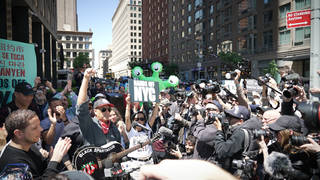
AMY GOODMAN: Striking writers staged a last rally in central Hollywood Tuesday before contract talks resume next week between studios and major producers. Some 4,000 people marched down Hollywood Boulevard. The writers were joined by TV and film actors and other union members. The rally comes sixteen days into the strike that’s been felt across the industry, with daily talk shows canceled and shooting on top-rated dramas postponed due to a lack of scripts.
On Monday, about 500 television and radio writers working for CBS News also voted to strike following their own contract dispute with the network. Here in New York, writers have walked a daily picket line in various locations across the city. Democracy Now! went to Sony Plaza yesterday and spoke to some of the writers on strike.
STRIKER 1: We are striking because of the situation with digital rights, digital platforming. We make no money on any of the downloads. My daughter live-streams television shows on her computer at school, which they sell advertising for, which we get none of the revenue for.
STRIKER 2: My main concern is that the Writers Guild has 12,000 members, and you need to make $30,000 a year in Writers Guild earnings to get healthcare. Thirty thousand dollars. And last year, over half our membership did not make that. So half our membership doesn’t have healthcare.
STRIKE SUPPORTER: What the writers are asking for is completely fair and is their right. This is their livelihood. And what they accomplish with this strike benefits the entire entertainment working community, I believe.
STRIKER 3: Right now, writers aren’t getting anything for internet and new media, and my feeling is that in like the next twenty or so years, the entire entertainment industry is going to be dominated by, you know, new media and the internet. So it’s not just us that we’re — I feel like, that we’re fighting for, but writers to come.
AMY GOODMAN: The Writers Guild of America will meet next Monday with the Alliance of Motion Picture and Television Producers for the first time since they went on strike. The two sides have clashed over paying writers for reruns of their work online and for original work written for the internet.
Michael Winship is the president of the Writers Guild of America, East, joining us now in our firehouse studio.
Welcome to Democracy Now!
MICHAEL WINSHIP: Hi. I’ve actually worked in this studio in the past, so it’s nice to be back.
AMY GOODMAN: Well, it’s great to have you back. Talk about what you’re striking for.
MICHAEL WINSHIP: Well, as one of the people just said in the roll-in that you did, the crux of the strike is really about our work being used on the internet and new media and getting a fair shake, a fair part of the deal, us establishing a revenue model that allows us to share in the great amounts of money that the studios and networks are going to be making off of this. In certain areas like streaming video, when you go on to the network websites and so forth and download an episode of The Office, for example, we don’t see a dime. We don’t get anything on that, because they say it’s totally promotional. You look at that program on the air — on the internet, rather, and you see that it’s filled with commercials, and yet we don’t get a dime of that revenue because they claim it’s promotional.
AMY GOODMAN: What do they get?
MICHAEL WINSHIP: They get at least — I believe it’s a 70-30 split, with the network receiving the 70 percent, depends on who actually gets the advertising that is used on the site, but they get a big chunk of it.
AMY GOODMAN: I want to go for a minute to another clip. Striking writers are taking their cause directly to the internet, channeling their creativity into numerous short videos. On YouTube, the most popular of these videos is produced by a writer of Comedy Central’s popular satirical program The Daily Show with Jon Stewart. It’s called “Not the Daily Show with Some Writer.”
JASON ROSS: Hello, and welcome to what is obviously not The Daily Show. I am obviously not Jon Stewart. I’m Jason Ross, one of the show’s fourteen writers. Our top story — really our only story — the ongoing writers’ strike, which began last Monday after talks broke down between writers, seen here working slavishly for your entertainment, and media company CEOs, captured here in their natural habitat. It’s about whether writers should get paid when media companies make money using their work online. Writers think they should get paid. Corporations think the writers should go [bleep]. And I’ve got to say they have a point. I mean, this is the internet. It’s not about money. Online, you know, intrinsic worth is measured in things like number of tears shed over Britney Spears by a heartbreakingly gay teenager.
TEENAGER: Leave Britney alone!
JASON ROSS: And while we’re sad over this state of affairs, we’re clearly not that sad. Besides, media conglomerates say it’s too soon to put a dollar value on internet content. They say it — what’s that? Viacom is suing YouTube for a billion dollars for using its content online? I can’t even believe it! Unless there’s some sort of Daily Show-style montage.
MONTAGE: Viacom, the parent company of Comedy Central, has sued YouTube for over $1 billion. A billion dollar lawsuit. A billion dollars for copyright infringement. A whopping one billion. A billion-dollar clash of the titans. More than a billion dollars. Saying, “Hey, you can’t put our stuff out there for free!”
JASON ROSS: But is there anyone much older and more personally identified with Viacom, who could help us make our case?
SUMNER REDSTONE: Say, hypothetically, someone files such a lawsuit, what would they expect? Money? They would expect the protection of their rights for the future. And they might expect a deal that reflected the value of their content.
JASON ROSS: I know. It may seem Redstone’s YouTube stance contradicts his stance with the writers, but it’s really quite simple: when you’re not paying him, you owe him a billion dollars. When he’s not paying you, he’s not paying you.
AMY GOODMAN: Produced by a writer of Jon Stewart’s Daily Show, called “Not the Daily Show with Some Writer.” That was Sumner Redstone they quoted, head of Viacom.
MICHAEL WINSHIP: Yes, and that was actually a bunch of the guys of The Daily Show did that. They shot it down at our picket last week down on Wall Street. It was terrific. One of the great things about this whole strike has been the issue has been about internet and the new media, and we have shown the power of internet and new media by viral videos like the ones that the guys at The Daily Show have done.
AMY GOODMAN: Why did you decide, Michael Winship, to strike now?
MICHAEL WINSHIP: Well, what we decided — well, our contract ran out on October 31st. And the original thought was that we would continue negotiating until the end of June next year, when the contracts expire for the Screen Actors Guild and the Directors Guild. But working in conjunction with those other unions, working together, we determined that it would make more sense for us, that our power would be more effective, if negotiations failed, to go out when we went out, which was right at the beginning of November. And that was partly because we recognized that this would have an enormous effect on the television season, and also because we realized that the motion picture studios were stockpiling scripts, were planning to go into major heavy production at the beginning of the year. Normally they produce about forty or fifty movies at the beginning of any given year. We discovered that they had about 150 planned. So that it was better for us to go out now, when we did, when negotiations failed, than to wait.
AMY GOODMAN: And CBS News writers are now talking about going on strike.
MICHAEL WINSHIP: Yes.
AMY GOODMAN: How does that link to you?
MICHAEL WINSHIP: Well, that’s a separate contract. We also cover the CBS News writers and graphic artists and other folks who work at CBS News. That’s about 500 of our members, both here and in Los Angeles — in New York, Washington, Los Angeles and Chicago. They have been without a contract for two-and-a-half years. We have been trying everything we possibly can to get management back to the table. We finally reached a point where we took a strike authorization vote. We announced the results of that vote on Monday. It was an 81 percent vote. About 70, 75 percent of the membership voted. And now we hope that this will send a strong enough message to management to get them back to the bargaining table. But if we don’t get a fair and respectful contract, if we don’t make some progress, we’re prepared to walk.
AMY GOODMAN: And CNN? Non-union?
MICHAEL WINSHIP: CNN is non-union, yeah.
AMY GOODMAN: What about —
MICHAEL WINSHIP: We also cover ABC News, and NBC is covered by a separate union.
AMY GOODMAN: And what’s happening with NBC?
MICHAEL WINSHIP: NBC is covered by NABET.
AMY GOODMAN: And ABC?
MICHAEL WINSHIP: ABC, they are also without a contract. We’re also working on that front, as well.
AMY GOODMAN: And Broadway shows in New York that have gone dark, what’s their connection?
MICHAEL WINSHIP: That’s Local One. That’s Local One with IATSE, a totally separate union, but we have been in quite vocal support of their strike against the Broadway theaters.
AMY GOODMAN: What has most surprised you in this strike?
MICHAEL WINSHIP: Well, I was around for the 1988 strike, which was a five-month strike, a very long, very difficult, very bitter and acrimonious strike. This time, the support and solidarity of the membership is much, much stronger than any of us thought it would happen. I mean, it’s been extraordinary. And part of that has been the strength of people who are called the show runners. These are people who are both writers and producers, who have their writing and editorial duties on a program, but also have production duties. Technically speaking, those people did not necessarily have to walk, in terms of their production duties. They couldn’t write, but they didn’t necessarily have to. But they felt that, in good conscience, they could not continue working on their programs. And as a result of that, we stopped production on television programs much sooner than we anticipated.
AMY GOODMAN: So, you meet on Monday?
MICHAEL WINSHIP: We meet on Monday.
AMY GOODMAN: What do you expect?
MICHAEL WINSHIP: Don’t know yet. Don’t know yet.
AMY GOODMAN: Well, we’ll certainly continue to cover it. I want to thank you, Michael —
MICHAEL WINSHIP: We’re hopeful.
AMY GOODMAN: — Winship, for joining us, president of the Writers Guild of America, East.



 Top
Top
Media Options