





 Watch Full Show

Topics
Guests
- Jim Shultzexecutive director of the Democracy Center in Cochabamba, Bolivia. He writes a blog on Bolivia that can be found at Democracyctr.org. He joins us on the line from Cochabamba.
Links
Bolivian President Evo Morales formally received a copy of the country’s new draft constitution on Saturday, as tens of thousands of supporters marched through the capital of La Paz. But four of Bolivia’s wealthiest regions have declared autonomy in protest of the plans. We speak with Jim Shultz of the Democracy Center in Cochabamba, Bolivia.
Related Story
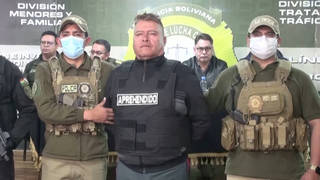
 Web ExclusiveJun 27, 2024Failed Coup in Bolivia: Army Chief Arrested After Leading Troops in Attack on Government Palace
Transcript
AMY GOODMAN: The Bolivian President Evo Morales formally received a copy of the country’s new draft constitution Saturday, as tens of thousands of supporters marched through the capital La Paz.
The new constitution would increase the power of Bolivia’s indigenous majority. But four of Bolivia’s wealthiest regions have declared autonomy in protest of the plans. The four lowland provinces contain much of Bolivia’s natural resource wealth and most of its large natural gas deposits. In Santa Cruz, tens of thousands of people marched to celebrate their self-declared “autonomy.” They object to the new constitution, which would redistribute wealth to the poorer highland areas of Bolivia.
Opposition leader and president of Santa Cruz Civic Committee Branco Marincovic spoke at a rally on Saturday.
BRANCO MARINCOVIC: [translated] Mr. President, Evo Morales, stop discrediting this autonomy. I propose you read our statute. I propose you read our statute, so that you can realize that this is an autonomy of unity and not a separation.
AMY GOODMAN: Meanwhile, President Evo Morales opposed the autonomy move and has vowed to defend Bolivia’s unity, saying, “We’re not going to let anyone divide Bolivia.” All the legislation has to be submitted to referendums that are expected to take place early next year.
Jim Shultz joins us now, executive director of the Democracy Center in Cochabamba, Bolivia. He writes a blog on Bolivia that can be found at democracyctr.org. He joins us on the phone from Cochabamba. Welcome to Democracy Now!, Jim.
JIM SHULTZ: Good morning, Amy. Thanks for having me on.
AMY GOODMAN: It’s good to have you on. Can you tell us what’s happening?
JIM SHULTZ: Well, I think as your listeners and viewers know, Bolivia has been going through a huge political transformation for the last year and a half with the election of Evo Morales, the country’s first indigenous president. One of the big initiatives that that movement has been pushing has been to rewrite the constitution through a constituent assembly elected by the people just over a year ago, to rewrite the nation’s Magna Carta.
And that’s all come to a head in the last few weeks, and the opposition to Morales and MAS has worked for over a year to try to sidetrack that process. They don’t want most of the things that Morales has been pushing for and that MAS and the indigenous groups have been pushing for in that constitution. The meetings that were held in Sucre were disrupted to the point where for two months, the constituent assembly wasn’t able to meet. Finally the backers of Morales and MAS actually met in a military facility behind police guards to initially approve a constitution in a session that the opposition boycotted. All of this has just snowballed into what we have this last weekend, which you described, which is the highland areas, where the support for the new constitution is very strong, delivered the constitution symbolically to Evo Morales in La Paz, and the lowlands, where opposition to Morales is equally strong, on the other side, have declared autonomy.
It’s about a lot of issues all at once. It’s about race. There’s certainly a racial divide between the highlands and the lowlands. It’s about oil and gas. By the luck of geology, the oil and gas wealth in the country is in the eastern lowlands, and the people in the highlands, where there isn’t oil and gas, want that to be a national resource, and the people in the lowlands, in the same way that you see in Chad or Cameroon or all over the world, are looking for the oil and gas to be within their control. So it’s about race, it’s about power, it’s about oil and gas, it’s about regional divisions. And it’s all come to a head in this endgame over the new constitution.
AMY GOODMAN: Well, with these four areas declaring autonomy, do you see the breakup, a possible breakup of Bolivia?
JIM SHULTZ: I think that there’s certainly a fear of that here. I think that’s unlikely. I think that there is a lot of tension. I think that there’s some very hard negotiations to happen in this country. But remember, Bolivian politics always plays out in two forms at the same time. It always plays out simultaneously in political institutions and negotiations and on the streets, as people flex their street muscle.
I think there are two big issues that autonomy relates to. One is land, and one is oil and gas. On land, I think that the autonomy movement is potentially very strong. I mean, the national government is not going to send in troops to enforce land reform. So I think the autonomists there have a strong hand to play. On the other hand, the oil and gas contracts the Bolivia has are largely with the governments of Brazil and Argentina. You know, the governments of Brazil and Argentina are not going to suddenly cut side deals with these conservative governments in Santa Cruz to deliver the gas and oil revenue. So that revenue is still going to go through the national government.
AMY GOODMAN: Jim Shultz, are any foreign governments or corporations backing these four states declaring autonomy?
JIM SHULTZ: Well, certainly, overtly they’re not. There is always suspicions here that there are some foreign oil companies with their hands in the movement to try to get more autonomy for these eastern regions. But again, the players are the governments of Argentina and Brazil. I think it’s highly unlikely that Lula is running around behind the scenes to try to topple the Morales government or weaken it. There’s certainly always, you know, conspiracy theories here about whether the US government and the US embassy has a hand in this, and Morales has certainly made that accusation. My experience with the US embassy here is that they’re a lot more incompetent than they are conspiratorial.
AMY GOODMAN: And the draft constitution, what does it give to the indigenous people of Bolivia?
JIM SHULTZ: Well, it’s very important for the indigenous people here in a lot of ways. And it’s important to remember, Amy, that this dream of a new constitution and of a constituent assembly did not get born with Evo Morales and it did not get born in 2005. This goes back two decades with this vision of, you know, really trying to write a constitution that rises above the history of colonization here. So, for the first time, this constitution recognizes the thirty-six indigenous peoples that are a part of Bolivia. It includes things like the recognition of community justice, in which indigenous pueblos in the highlands, for example, instead of bringing cases of theft and that kind of thing to a court system far away, communities can have systems of justice where people have to make amends through helping build a school or that kind of thing. It also grants other kinds of autonomy to indigenous communities so that people, for example, can elect their leadership through traditional means, as opposed to just adopting a quote/unquote “Western model.”
AMY GOODMAN: And so, what happens now with the draft constitution?
JIM SHULTZ: Well, we’re going to have a lot of elections in 2008, that’s for sure. The draft constitution has to go to a vote of the people. It has to be approved by a majority of 50% plus one. There will be a separate article of the constitution that did not receive the approval of the full assembly needed, that’s on land reform, that will be voted on. As part of the standoff between the regions, President Morales has called for a referendum, in which there would be an up-or-down vote on whether he and the governors would continue in office past 2008. So I think we’re headed for an awful lot of elections. I frankly think that the MAS government is in a politically weak position to win approval of this constitution.
AMY GOODMAN: Jim Shultz, we’re going to leave it there. I want to thank you very much for being with us, executive director of the Democracy Center in Cochabamba, Bolivia, writing a blog on Bolivia that can be found at democracyctr.org.



 Top
Top
Media Options