







 Watch Full Show

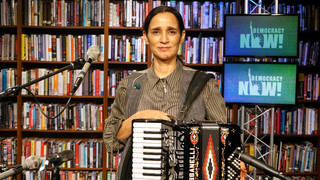
Poet and activist Sonia Sanchez, a leading figure in the Black Arts movement, paid tribute to Max Roach at his funeral in Riverside Church on Friday. [includes rush transcript]
- Sonia Sanchez, poet and activist speaking at the funeral of jazz pioneer, Max Roach.
Related Story
 StoryJun 03, 2026“Fraud on the Court”: Even as DOJ Drops $1.8B Settlement Fund, Judge Reopens Case over Collusion
Transcript
AMY GOODMAN: Sonia Sanchez said the same thing. She also spoke at the funeral, the leading figure in the Black Arts Movement paying tribute to Max Roach on Friday.
SONIA SANCHEZ: I have seen this Maxwell man, this Maxwell Roach man. From the middle of the twentieth century to the beginning of the twenty-first century, I have seen him at work moving in the bloodstream of his people. I have seen him look up when someone inferred that this long voyage of artistry had been futile and had lacked dignity. I have seen his tongue track down these disbelievers. I have seen his mouth silence these diplomats of the dead and anoint our hands with eyes.
He has known for a long time that we stand on an earth collapsing in a pallet of pain, that we stand in the tracks of conquistadores and imperialists, homophobes and racists, terrorists and pornographers, sexists and voyeurs, countries and people who want to own everything that exists, who try to extract our rhythms and put them in the pillbox to be taken once a day, earth studiers, doomsayers, invasive actors, offense to their own blood.
And this Maxwell Roach continued to hold up the air. No mysteries surrounded him. The cities knew him, felt his touch, saw his solitary eye demanding dignity and change, saw his sparkling hand scoop thunder from his pores. And his drums ask, “Who will hold them when they are weary?” And his drums ask, “Who will carry them and remember that they have hearts?”
And you came towards us, Max, hands outstretched, suffering our ignorance and indecision. You came warrior-clear, your intellect kissing our spines, and you brought us life. You came feet, hands, head, heart, strumming sweet life-life-life-life-life-ooooh-life-life-life-life-life, and we were reborn in your spreading sails of flesh.
Brother Max, baba-baba-baba-baba-baba, Brother Max, baba-baba-baba man, whenever I hear a drum exploding in a room, I remember the first time I saw you on stage, your drum crashing against the stars. You let me ride on your riff. You held me tight against this hard earth, and I knew you, man. I knew you would hold us all tight against this hard earth, make our living and dying matter. And you pulled our bodies homeward until we shouted, “Amen! Awomen! Amen-men-men-men! Awomen! Awomen! Awomen! Awomen! Awomen!”
And you played, and your hands kept reaching for God. And you played. And your hands kept reaching for God. And you played, “I want to go home, gots to get home, gots to walk on the water, gots to ride the air, gots to ride the lightning across the sky, gots to cross myself one day and wake up home.” And you did, my dear brother. We heard the prayer in your hands. And you crossed yourself last Thursday morning and woke up home. Indicia. Indicia-a-a. Indi-indicia-a-a, you men phon., close with the ancestor.
AMY GOODMAN: Poet Sonia Sanchez at the funeral of Max Roach.





 Top
Top
Media Options