







 Watch Full Show

Topics
Guests
- Htun Aung Gwaypresident of the U.S.-based Civil Society for Burma. He is the former president of the All Burma Students’ Democratic Front that led the protests of 1974 and 1988. He was imprisoned for five years in Burma and came to the United States in 1992 after living in the jungle on the Burmese-Thai border for four years. He now lives in Chicago.
In Burma, the military junta is continuing its violent crackdown on anti-government protesters. Soldiers raided monasteries and fired at demonstrators. At least nine people were killed on Thursday, including a Japanese photojournalist. There are fears the death toll could be several times more. We speak with Burmese activist, Htun Aung Gway, president of the Civil Society for Burma. [includes rush transcript]
Related Story
 StoryApr 01, 2025“The Darkest Hour of Need”: Burmese Junta Continues Bombing in Aftermath of Devastating Earthquake
Transcript
AMY GOODMAN: In Burma, the military junta is continuing its violent crackdown on the most vocal popular uprising against its rule in nearly two decades. Burmese soldiers and police are baton-charging groups of demonstrators gathering in the city of Rangoon. State-run television admitted nine people had been killed Thursday, but Australia’s ambassador in Burma, Bob Davis, told his country’s ABC radio that the real death toll is probably several times higher. One of the people killed on Thursday was Japanese photojournalist, Kenji Nagai. Video footage shows him being shot point-blank when soldiers charged the crowds. Japan said it would make an official protest over his death.
All the main roads into central Rangoon have been blocked. Soldiers have been progressively moving the barricades to seal off central neighborhoods. Security forces have also sealed off the five main monasteries that were focal points of previous mass marches and are trying to prevent further protests. Buddhist monks have been leading the nearly two weeks of popular protests against the ruling junta. But after a series of raids on monasteries and arrests of dozens of monks, there were few, if any, in the crowd on Friday. At least six Buddhist monks have been killed so far.
Most of the news coming out of Burma this week has been from citizen journalists who have sent pictures and video to international media outlets. But the military junta is cracking down on the use of cellphones and cutting Internet access in an attempt to stem the flow of information.
President Bush has condemned the crackdown and has tightened sanctions on Burma’s military leaders. Bush called on China, one of Burma’s closest neighbors and a main trading partner, to put more pressure on Burma. Beijing has urged all parties to “maintain restraint” but has refused to condemn the junta.
Htun Aung Gway is the president of the U.S.-based Civil Society for Burma. He’s the former president of the All Burma Student Democratic Front that led protests in 1974 and ’88. He was in prison for five years in Burma and came to the United States in 1992 after living in the jungle on the Burmese-Thai border for four years. He now lives in Chicago, joining us in our firehouse studio today in New York. We welcome you to Democracy Now!
HTUN AUNG GWAY: Thank you. I’m happy to be here.
AMY GOODMAN: It’s very good to have you with us. You were yesterday at the United Nations?
HTUN AUNG GWAY: Yes. We are —
AMY GOODMAN: What are you calling for?
HTUN AUNG GWAY: We are demonstrating against the junta, and we are showing our solidarity with the monks and the people in the United States.
AMY GOODMAN: And what information are you getting out of Burma right now, the country that the military regime has renamed Myanmar?
HTUN AUNG GWAY: We heard that they are cracking down on the monks, and they are getting in the monasteries at night and beat them and force them to crawl on the floor, and the head monks were beaten with a [inaudible] and kick his head several times, and a lot of blood was spilled out. And the security guard said, “Don’t wash it. Just let them see the people. And they deserve this.” So, like, a lot of monasteries were raided, and a lot of monks were arrested at night, also including the opposition party leaders, U Aung Shwe and the CRPP, like a parliament representative committee, these members were also are arrested.
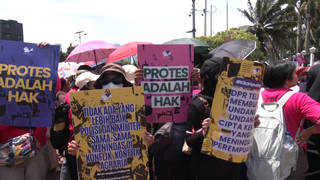
AMY GOODMAN: Protest against the Burmese military junta have been taking place around the world. In New York, scores of Buddhist monks and Burmese exiles marched Thursday from the United Nations to the Burmese mission on 77th Street. Democracy Now! was there to cover the story.
ANJALI KAMAT: Why are you here today?
PROTESTER 1: Today, because the government, the military government, they are killing the monks and the peaceful protesters in my country.
BURMESE MONK 1: [translated] The military government in Burma has been brutalizing people. That’s why I am here to protest.
BURMESE MONK 2: They are the worst in the world. And they don’t have a religion. They don’t believe nothing. They care only power. And for their power, they can kill anybody.
PROTESTER 1: Here, you have your rights, you have your freedom, and then you have like freedom of speech, freedom of everything, you know. But in our country, they didn’t do anything; they just walked on the street peacefully, and they just called for democracy, and then, you know, they have been killed for that.
PROTESTER 2: We need a democracy in Burma, because since 1962 to until now we have had no democracy, no human rights and no — it’s a only one-party system.
BURMESE MONK 2: We don’t have time this in the Security Council, because Russia and China always block. So this time it’s EU or NATO, they have to do something, if they love about human rights, because they kill regular all the people from Burma; they kill all the monks; they break all the Buddha statues in the monastery; and they don’t care even that all the Buddhists, whatever we have inside of Burma, they don’t care no more; they break everything.
BURMESE MONK 1: [translated] I hope that what people want, that democracy will come to Burma.
PROTESTER 1: And I really want to call for the citizens of the United States, you know, to think about that. There are some people who really need help. And I just want them, you know, to call the government and then to stop killing people innocent.
AMY GOODMAN: People protesting outside the United Nations and outside the Burmese mission yesterday in New York. As we return to our guest, I wanted to ask, Htun Aung Gway, about your own experience in Burma. How were you arrested? And what happened in 1988, when 3,000 people were killed by the Burmese regime?
HTUN AUNG GWAY: I was a student leader in 1974 U Thant uprising. And after that, we make another demonstration in March and June. In June 1975, after the demonstration, I was are arrested and sent to prison. It’s called Insein Prison. A lot of people were insane in this prison, because it’s very cruel treatment we had. So I was sentenced to life, but luckily got out from prison in 1980.
And after that, I still continue our struggle in 1988. We led the students and monks and walked with — together we make a nationwide demonstration, and people cry out for democracy. And we were peacefully demonstrating, like right now, in 1988. The whole people demanded for democracy. It’s really inspiring, because only not in the city, in Rangoon, it’s the whole country, like Mandalay, Moulmein, and other towns and small towns and cities, all people walk out and demand for democracy. But after one-and-a-half months demonstrating against the regime, the army stepped in and they opened fire on the crowd, and at least 3,000 unarmed demonstrators were killed, and including in this dead, high school and middle school students, young students, were shot and killed.
AMY GOODMAN: Htun Aung Gway, you said that you were held at the Insein Prison.
HTUN AUNG GWAY: Yes.
AMY GOODMAN: We understand that the Nobel Peace Prize laureate Aung San Suu Kyi, who’s been held under house arrest for years, just seen this weekend for the first time — we got a glimpse of her on video — that she has been moved into that prison. Are you concerned?
HTUN AUNG GWAY: Yeah. I’m very concerned about her health and condition, because Insein town — we call town; is a prison — Insein town is very big, and also inside there’s a different kind of cells. Number one cell, number two, number three, number four, number five and number six cells. They have a different condition. And number six cells is like two-door cells — the air flow is very tight; you can’t breathe sometime. So I was in this cell for at least three weeks, and I understand how hard it is to breathe in. So I was worried that they might put her in the cell or they might make her crazy.
You know, Insein Prison have a very — methodically they torture people. They have to isolate you, or they have to put you in the den — or they have to put you in the dog cell with the dogs, you know, like that. And also there’s not sufficient food. Only rice and watery soup, you have. And a lot of people dying, when they are walking like a zombie. Their bodies were swollen, and they die instantly.
AMY GOODMAN: Htun Aung Gway, we’re going to continue to follow this story and keep our listeners and viewers around the world updated. I want to thank you very much for joining us from New York, after you participated in the protest at the U.N. and the Burmese mission there.



 Top
Top
Media Options