









 Watch Full Show

Topics
Guests
- Harvey Wassermanone of the founders of the grassroots movement against nuclear power. He is senior editor of the Ohio-based freepress.org and the editor of nukefree.org.
The Bush administration has pledged to support Saudi Arabia’s nuclear power program, including supplying enriched uranium for nuclear reactors. The agreement came out of President Bush’s visit to the Saudi kingdom last week, during which Bush also pledged new US assistance in guarding Saudi oil reserves. [includes rush transcript]
Related Story
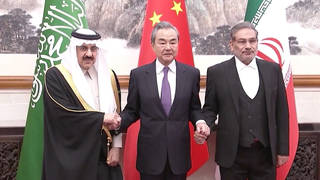
 StoryMar 13, 2023China’s Middle East Deal: Iran & Saudi Arabia Reestablish Relations as U.S. Watches from Sidelines
Transcript
AMY GOODMAN: We turn from cluster bombs to what could be a major development in nuclear proliferation worldwide: the Bush administration pledging to support Saudi Arabia’s nuclear power program, including supplying enriched uranium for nuclear reactors. The agreement came out of President Bush’s visit to the Saudi kingdom last week, during which Bush also pledged new US assistance in guarding Saudi oil reserves.
In a statement, the White House said the deal “will pave the way for Saudi Arabia’s access to safe, reliable fuel sources for energy reactors and demonstrate Saudi leadership as a positive non-proliferation model for the region.” But questions are being raised about the agreement at a time when the Bush administration continues to threaten military action over Iran’s nuclear program.
Harvey Wasserman joins us now, one of the founders of the grassroots movement against nuclear power, senior editor of the Ohio-based freepress.org and editor of nukefree.org, joining us on the phone from Columbus, Ohio.
Harvey Wasserman, what’s going on here?
HARVEY WASSERMAN: You know, I’d like to know the insane asylum in which this policy was concocted. The idea of giving enriched uranium to the Saudis while threatening war with the Iranians for enriching uranium is astonishing. The idea that the Saudis are going to somehow lower the price of oil on the basis of possibly getting nuclear reactors in the future is just almost staggering to think about. It’s something, I guess, we’ve come to expect with the Bush administration.
But the nuclear power industry is trying desperately to spread itself all over the world, and we have proliferation problems. As you may recall, the Clinton administration cut a deal with the North Koreans to build a reactor there, and of course now suddenly, when Bush comes in, they’re a nuclear threat. We have to put this in perspective. We have to remember that when the Shah was in power in Iran so many years ago, he was in the process of buying thirty-six reactors, and had those reactors been completed before he fell to the Ayatollah, Iran would now have thirty-six reactors. So what the Bush administration is telling us is that this current Saudi government is always going to be in power and it’s perfectly fine for them to have nuclear reactors. We know that India and Pakistan built — both built nuclear weapons from their commercial atomic power programs, as perhaps did South Africa. And it’s just almost staggering to think about this prospect.
AMY GOODMAN: How much attention is being paid to this in the anti-nuclear community?
HARVEY WASSERMAN: Well, at this point, there’s not much we can do. We can protest. The idea of sending them enriched uranium is going to raise the price of uranium for atomic reactors here in the United States. Much of this uranium is mined on Native lands, where lung cancer and environmental — general environmental damage is rampant. Water issues, air pollution issues, all of them arise when uranium is mined and milled. There’s only one enrichment facility in the United States, in Paducah, Kentucky, that’s operating now. The impracticalities of this are amazing.
The Saudis do not currently have an operating commercial reactor. If they do build one, it’s not going to come from the United States. It will probably come from France or Japan. And, you know, it’s just hard to fathom. It is such an irrational idea that it almost boggles the mind, in terms of trying to critique it. But suffice to say, it makes no sense whatsoever. Oil is not a major currency when it comes to generating electricity, and nuclear power plants only generate electricity. So this is just some kind of Alice in Wonderland program that is typical of the Bush administration, particularly on nuclear power policies.
AMY GOODMAN: Well, Harvey Wasserman, thank you for joining us. Harvey Wasserman is head of freepress.org, one of the leaders of the grassroots movement against nuclear power, also editor of nukefree.org.



 Top
Top
Media Options