











 Watch Full Show

Guests
- Myrlie Evers-Williamswidow of civil rights leader Medgar Evers. From 1995 to 1998, she served as the chair of the NAACP. Prior to that, she was the first African American woman to be appointed to the Los Angeles Board of Public Works. She has written two books: For Us, the Living with William Peters, and an autobiography, Watch Me Fly: What I Learned on the Way to Becoming the Woman I Was Meant to Be.
Forty-five years ago today, civil rights leader Medgar Evers was assassinated outside his home in Jackson, Mississippi. Evers fought segregation of schools and public places, struggled to increase black voter registration, led business boycotts, and brought attention to the murders and lynchings, like the slaying of black teenager Emmett Till. We speak to Medgar Evers’ widow, the civil rights activist Myrlie Evers-Williams. [includes rush transcript]
Related Story
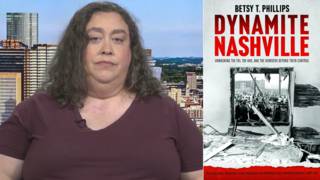
 StorySep 04, 2024“Dynamite Nashville” Book Reveals KKK Behind Unsolved Civil Rights-Era Attacks, Prompts New Probe
Transcript
JUAN GONZALEZ: Forty-five years ago today, June 12, 1963, civil rights leader Medgar Evers was assassinated outside his home in Jackson, Mississippi. He was thirty-seven years old. Evers was killed at the close of an important day in the civil rights movement. Earlier that day, Alabama Segregationist Governor George Wallace stood on the steps of the state’s all-white university and tried to block the admission of two black students. That night, President Kennedy delivered an impassioned speech defending the federal government’s intervention on behalf of the students. He spoke of a “moral crisis” facing the nation.
Evers was killed by a white supremacist named Byron De La Beckwith. He was tried twice for murder in 1964, but both ended in mistrials because the all-white juries could not reach a verdict. He was later convicted of murder thirty years afterwards.
AMY GOODMAN: Medgar Evers became an NAACP leader in 1954 after the all-white University of Mississippi rejected his law school application. Evers fought segregation of schools and public places, struggled to increase black voter registration, led business boycotts, brought attention to the murders and lynchings, like the slaying of black teenager Emmett Till. The day before he died, Medgar Evers was on the coast planning a protest to allow African Americans access to Mississippi’s public beaches.
This is Medgar Evers speaking shortly before he was assassinated.
MEDGAR EVERS: This demonstration will continue. We will have a mass meeting tonight, and after the mass meeting we will be demonstrating even further on tomorrow. So then, this will only give us an impetus to move ahead, rather than to slow down. We intend to completely eradicate Jim Crow here in Jackson, Mississippi.
AMY GOODMAN: Here, Medgar Evers organizes the NAACP boycott of downtown stores in Jackson, Mississippi, for their support of the separatist group, the White Citizens’ Council.
MEDGAR EVERS: Don’t shop for anything on Capitol Street. Let’s let the merchants down on Capitol Street feel the economic pinch. Let me say this to you. I had one merchant to call me, and he said, “I want you to know that I’ve talked to my national office today, and they want me to tell you that we don’t need nigger business.” These are stores that help to support the White Citizens’ Council, the council that is dedicated to keeping you and I second-class citizens. Now, finally, ladies and gentlemen, we’ll be demonstrating here until freedom comes to Negroes here in Jackson, Mississippi.
AMY GOODMAN: That was Medgar Evers. We’re joined now on the phone by civil rights leader Myrlie Evers-Williams. She’s the widow of Medgar Evers, killed forty-five years ago today. From 1995 to 1998, Myrlie Evers-Williams served as the chair of the NAACP. Prior to that, she was the first African-American woman to be appointed to the Los Angeles Board of Public Works. She has written two books: For Us, the Living, with William Peters, and an autobiography, Watch Me Fly: What I Learned on the Way to Becoming the Woman I Was Meant to Be.
Myrlie Evers-Williams, welcome to Democracy Now!
MYRLIE EVERS-WILLIAMS: Good morning, and thank you very much.
AMY GOODMAN: It’s very good to have you with us. Your thoughts today, forty-five years after the assassination of Medgar?
MYRLIE EVERS-WILLIAMS: Well, it is a day that certainly I and members of my family remember very intimately. And for some reason, this forty-fifth anniversary has been a little more difficult than the last few, and perhaps it’s because of what is happening in our country today. But I thank you so much for bringing to the public at least a part of the story of Medgar Evers, because it’s been very difficult to hear people talk about the civil rights movement and the leadership as though it started in 1964, when really indeed it did not. So I owe you a great debt of gratitude.
JUAN GONZALEZ: And the progress that you feel has been made over these forty-five years, especially in places like Mississippi? I recall recently a WLBT TV, which created so many problems for allowing Medgar Evers to be able to even get his message across, was owned by African Americans for quite awhile and then recently changed hands. Has there been continuing progress there in Mississippi, or in some ways have things gone back?
MYRLIE EVERS-WILLIAMS: Oh, no. I would have to say that there has been progress on a continuous basis there. When I look back at the time when Medgar was so prominent and immediately after his death and the changes began to take place very slowly, but they have continued to grow in all aspects of life in Mississippi. That is not to say, however, that prejudice and racism still does not exist. But it certainly doesn’t to the degree that we remember what it was. And I think that goes for America as a whole.
Certainly, things that we see happening today, particularly politically, at my age at this point I knew it would happen, but I wasn’t sure I’d ever see it happen within my lifetime, ’til — but it also —- the things that are happening today also bring up the point that Medgar made, that freedom is not free, and it will be more difficult to hold onto those freedoms once they have been gained than perhaps to even achieve them in the first place.
AMY GOODMAN: Myrlie Evers-Williams, it’s interesting to talk to you after we were just speaking with Souleymane Guenggueng, who was a victim of the Chadian dictator, talking about why justice is so important. Byron De La Beckwith, two trials in ’64, right after Medgar Evers was assassinated, he goes free. How did he end up being convicted thirty years later?
MYRLIE EVERS-WILLIAMS: I’m sorry, the last part I did not hear.
AMY GOODMAN: How was he convicted thirty years later?
MYRLIE EVERS-WILLIAMS: Oh, well, that’s a very long story, because I was told that nothing would ever be done. I had made a promise to Medgar that if something happened to him and I was still alive, that I would dedicate my life to seeing that justice prevailed. It took thirty-plus years to have that happen. As I heard earlier, two years with a hung jury, and then a third trial that took place, of which I wasn’t sure what would happen. But I think the time that had passed helped to make people realize that it was something that citizens should do, those who knew about it, stand up and fight for equality.
Well, the man was convicted, and he was placed in jail. One of the, I guess, things that I enjoyed, if I can call it that, was the fact that his jail cell had the view of the new post office, which was named for Medgar there. But it did something else, too. After that trial, there had been at least eighteen to twenty-one additional civil rights trials that have been held. And I believe out of that number, there have been eighteen convictions. So, in a sense, it’s been a cleansing of the South of America of some of those horrible things that took place. And once again, Medgar was in the forefront of it, with my pushing.
And I just want so badly for historians and particularly for our younger generation to know more about Medgar and the role that he played, because, as I mentioned earlier, it is almost devastating to see and hear mentioned things of the civil rights movement that give the appearance that nothing happened until 1964.
AMY GOODMAN: Well, Myrlie Evers-Williams, we will link on our website to the video and the photographs that we have of the historical record, for those who didn’t get to see it on our broadcast, for our radio listeners. And I thank you for taking the time to spend with us today on Democracy Now!
MYRLIE EVERS-WILLIAMS: You are so welcome. And I do want to add that there is a third book. There’s The Autobiography of Medgar Evers, which is about three years old, that was published by Basic Books, and that gives an in-depth sight into his work and his feelings.
AMY GOODMAN: And we will link to all three books: your two and his. Thank you so much, Myrlie Evers— Williams, on this forty-fifth anniversary of the assassination of the civil rights leader Medgar Evers outside his home in Jackson, Mississippi.




 Top
Top
Media Options