








 Watch Full Show

Topics
Guests
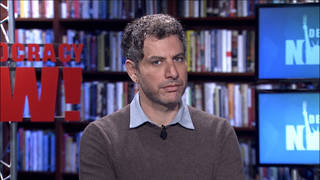
- Matt Daloisiomember of Witness Against Torture. He read the opening statement at the trial. Member of the New York Catholic Worker and is on the board of the War Resisters League.
Links
Thirty-four anti-torture activists have been convicted for protesting the Guantanamo Bay prison outside the Supreme Court. Twelve are now serving jail sentences. During the trial, protesters gave their names and those of Guantanamo prisoners and dressed in orange jumpsuits and black hoods. We speak to Matt Daloisio of Witness Against Torture, who gave the opening statement at the trial. [includes rush transcript]
Related Story
 StoryNov 14, 2024Iraqis Tortured at Abu Ghraib Win $42 Million Judgment Against U.S. Military Contractor CACI
Transcript
JUAN GONZALEZ:
Thirty-four anti-torture activists have been convicted for protesting the Guantanamo Bay prison outside the Supreme Court. Twelve are now serving jail sentences ranging from one to fifteen days. The demonstration took place on January 11th, the sixth anniversary of the opening of Guantanamo. As they did in January, several protesters dressed like Guantanamo prisoners in orange jumpsuits and black hoods during their trial.
AMY GOODMAN:
Matt Daloisio is a member of Witness Against Torture. He read the opening statement at the trial. He’s a member of the New York Catholic Worker, is on the board of the War Resisters League.
Welcome to Democracy Now! Matt. Talk about the trial, what you said in your statement and what’s since happened.
MATT DALOISIO:
As part of the trial, there were fifteen of us who chose to be silent in solidarity with the men who have no chance to speak in court. So at the beginning of the trial, I read a statement into the record, where fifteen of us who were wearing orange jumpsuits in the trial said that we’ve made it further in the criminal justice system in five months than men in Guantanamo have in five years, and we’re going to be in solidarity with them by not defending ourselves, by not taking rights that are not granted to them.
JUAN GONZALEZ:
And so, how did the trial develop then?
MATT DALOISIO:
After that, the government put on its case and tried to prove how we were — we were charged with displaying a banner, flag or other device to draw attention to a political party, organization or movement in the Supreme Court.
AMY GOODMAN:
I’m confused. Explain exactly what you did.
MATT DALOISIO:
So, about forty of us assembled on the Supreme Court steps in orange jumpsuits and holding signs that said “Shut down Guantanamo.” And about forty gathered inside the Supreme Court wearing orange T-shirts and reading accounts of prisoners in Guantanamo.
AMY GOODMAN:
Inside the Supreme Court.
MATT DALOISIO:
Correct.
JUAN GONZALEZ:
And there’s actually a law that prohibits people from having banners outside the Supreme Court?
MATT DALOISIO:
Free speech ends at the Supreme Court’s steps. And in this trial we weren’t actually contesting the law. But we were contesting the fact that law without justice is simply a mechanism of tyranny. Inside the Supreme Court, there’s a display about old Supreme Court cases, and one of them that they look as somberly is the Dred Scott decision in 1857. And we pointed out in court that we would like to think that if people in 1857 gathered on the steps and inside the Supreme Court speaking out against the Dred Scott decision, that justices in our land would be able to see that maybe we shouldn’t be applying the law to this and recognize the value of speaking out against what are really crimes.
AMY GOODMAN:
Matt, you now have been sentenced, but explain what is happening.
MATT DALOISIO:
So twelve of our brothers and sisters are in D.C. jail doing sentences between one and fifteen days. And the rest of the defendants have suspended sentences and one-year stay away from the Supreme Court and one year of probation. And if we violate that, we could be serving our sentences, which range from ten to thirty days.
JUAN GONZALEZ:
How did they differentiate those who were sent to jail versus those that got suspended sentences?
MATT DALOISIO:
Some of the folks refused probation, and others refused to speak in their own defense in solidarity with those, again, in Guantanamo, who have no chance to speak in court. They also tried to single out who the leaders of the group were and tried to give them more time. There was clearly a tone in the court of wanting to discourage this from happening. It came out in the trial that the longest-serving police officer there was twenty-one years, and he had never seen a demonstration inside the Supreme Court. So it was clear that they wanted to make a point that they don’t want these demonstrations in the Supreme Court.
AMY GOODMAN:
In the sentencing phase, each of you spoke the name of the prisoner you represented, and you invited the prosecutor and judge to join you?
MATT DALOISIO:
We had two folks — all of us represented ourselves, and we had two folks give closing statements, after which each one of us stood up individually and gave our name and the name of the prisoner we were there on behalf of. And it was a packed courtroom and a very emotional moment, at the end of which I asked the court to join us in a moment of silence for the prisoners in Guantanamo, over 200 of whom are still there. And everyone in the court stood, including the prosecutor, who stood to object. But to the judge’s credit, he let the moment of silence stand. And it was another point in the trial where those men’s names and their presence was with us.
JUAN GONZALEZ:
And the detainee you were representing?
MATT DALOISIO:
I was representing a man named Yasser al-Zahrani, who was arrested at the age of seventeen, and at the age of twenty-two, on June 10, 2006, he apparently took his own life. So my sentencing statement was simply to read and spell his name into the record and point out that it possibly will be the last time it’s ever entered into a US court.
AMY GOODMAN:
Matt, were you one of the people who went to Cuba to try to call attention to Guantanamo, stopped from getting to the prison?
MATT DALOISIO:
In 2005, Witness Against Torture formed as a trip to go try to visit the prisoners. And there were twenty-five of us who tried to go to the prison in Cuba.
AMY GOODMAN:
I just want to say that on Saturday night at UC Davis in California, I talked to three prisoners by videoconference — we did it on a stage — who were in Sudan, ex-prisoners at Guantanamo. They said they were aware of the protest, and it was very moving to them inside.




 Top
Top
Media Options