







Headlines October 19, 2011 Full Show | First Story >
U.N. Torture Chief: Ban Solitary Confinement for Teens, Mentally Disabled
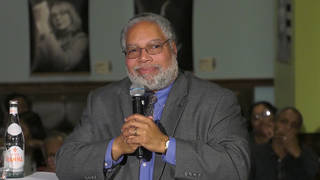
The top United Nations official on torture is calling for an end to almost all forms of solitary confinement. Juan Méndez, the U.N. special rapporteur on torture, said solitary confinement should only be allowed in exceptional cases, and emphasized an absolute ban in the case of juveniles and people with mental disabilities.
Juan Méndez: "I am of the view that juveniles, given their physical and mental immaturity, should never be subjected to solitary confinement. Equally, in order not to exacerbate a previously existing mental condition, individuals with mental disabilities should be provided with proper medical or psychiatric care, and under no circumstances should they ever be subjected to solitary confinement. My recommendations are, first, to see if we can have a complete ban on prolonged or indefinite solitary confinement. And I more or less arbitrarily define that as anything beyond 15 days of solitary confinement, meaning someone being confined to a cell for at least 22 hours a day."
In his remarks, Méndez also commented on U.S. soldier and alleged whistleblower Bradley Manning, who’s being held in a Kansas prison following his arrest for allegedly leaking government material to WikiLeaks. Méndez says although Manning is no longer being held in solitary confinement, he is still monitoring the case.
Juan Méndez: "I want to stress that, on the one hand, he is no longer in solitary confinement, although he spent something like eight months in solitary confinement, but when he was moved to Fort Leavenworth, his regime changed, and he’s not in solitary confinement now. I’m not saying anything about whether his present regime violates other possible standards, but at least he’s—on a daily basis, he does communicate and socialize with other inmates in his same category."
Recent ShowsMore Shows
Stories
Headlines
- Egypt Holds Landmark Presidential Elections
- IAEA, Iran Approach Deal Ahead of Baghdad Talks
- U.S. Drone Strike Kills 4 in Pakistan
- Tens of Thousands Protest Education Cuts in Spain
- Estimated 400,000 Protest on Quebec Student Strike’s 100th Day
- Former U.S.-Backed Guatemalan Dictator Faces 2nd Genocide Trial
- CBO: U.S. Could Face Recession in 2013
- Regulators Confirm Probes of JPMorgan Chase over $3 Billion Loss
- Senate Panel Votes to Extend Gov’t Surveillance Powers
- Court Upholds $3.4 Billion Settlement over Native American Land Trusts
The original content of this program is licensed under a Creative Commons Attribution-Noncommercial-No Derivative Works 3.0 United States License. Please attribute legal copies of this work to democracynow.org
. Some of the work(s) that this program incorporates, however, may be separately licensed. For further information or additional permissions,
contact us.
By Amy Goodman with Denis Moynihan
Gen. John Allen, commander of U.S. Forces Afghanistan, spoke Wednesday at the Pentagon, four stars on each shoulder, his chest bedecked with medals. Unlike Allen, many decorated U.S. military veterans left the streets of Chicago after the NATO summit without their medals.
In an extended interview, David Bronner, president of Dr. Bronner’s Magic Soaps, discusses the history of the company, why they put sustainability and social justice ahead of profits, the organic and GMO labeling movements, the U.S. war on hemp, and why they refuse to sell out. [includes rush transcript]
Human Rights Watch’s Kenneth Roth examines why the U.S. has not pressured Bahrain to release pro-democracy activists. He also discusses Syria and the conditions in Israeli jails and courts that prompted 1,550 Palestinian prisoners to go on a hunger strike. [includes rush transcript]