








 Watch Full Show

Guests
- Jill SteinGreen Party 2012 presidential nominee.
- Rocky Andersonformer mayor of Salt Lake City, Utah. He is a former Democrat who once endorsed Mitt Romney for governor of Massachusetts but is now running against him for president on the Justice Party ticket.
- Virgil GoodeConstitution Party 2012 presidential nominee. He is a former six-term Virginia congressman. He was first elected as a Democrat, later switching to the Republican Party.
President Obama and Republican challenger Mitt Romney sparred last night in their second of three debates. Today, in a two-hour special, we expand the debate by including the voices of three presidential candidates shut out of the official debate. We are joined by Jill Stein of the Green Party, Constitution Party nominee Virgil Goode, and Justice Party candidate Rocky Anderson. We re-air parts of last night’s presidential debate, pausing the videotape to give third-party candidates a chance to respond to the same questions put to the major-party candidates. [includes rush transcript]
Related Story
 StoryOct 04, 2012Expanding the Debate Exclusive: Third-Party Candidates Break the Sound Barrier as Obama-Romney Spar
Transcript
AMY GOODMAN: This is Democracy Now!, democracynow.org, The War and Peace Report. I’m Amy Goodman, as we continue our “Expanding the Debate” series. As President Obama and Mitt Romney debated at Hofstra University on Long Island, we are now going to include the voices of three presidential candidates shut out of last night’s debate: Dr. Jill Stein of the Green Party, Rocky Anderson of the Justice Party and Virgil Goode of the Constitution Party. We begin at Hofstra University with the debate moderator, Candy Crowley of CNN.
CANDY CROWLEY: Governor Romney, as you know, you won the coin toss, so the first question will go to you. And I want to turn to a first-time voter, Jeremy Epstein, who has a question for you.
JEREMY EPSTEIN: Mr. President, Governor Romney, as a 20-year-old college student, all I hear from professors, neighbors and others is that when I graduate, I will have little chance to get employment. What can you say to reassure me—but more importantly, my parents—that I will be able to sufficiently support myself after I graduate?
MITT ROMNEY: Thank you, Jeremy. I appreciate your—your question, and thank you for being here this evening. And to all of those from Nassau County here that have come, thank you for your time. Thank you to Hofstra University and to Candy Crowley for organizing and leading this—this event. Thank you, Mr. President, also, for being part of this—this debate.
Yours question—your question is one that’s being asked by college kids all over this country.
I was in Pennsylvania with someone who had just graduated. This was in Philadelphia, and she said, “I—I got my degree. I can’t find a job. I’ve got three part-time jobs. They’re just barely enough to pay for my food and pay for an apartment. I can’t begin to pay back my student loans.”
So what we have to do is two things: we have to make sure that we make it easier for kids to afford college and also make sure that when they get out of college, there’s a job.
When I was governor of Massachusetts, to get a high school degree, you had to pass an exam. If you graduated in the top quarter of your class, we gave you a John and Abigail Adams Scholarship, four years tuition-free to the college of your choice in Massachusetts. It’s a public institution. I want to make sure we keep our Pell—Pell Grant program growing. We’re also going to have our loan program so that people are able to afford school.
But the key thing is to make sure you can get a job when you get out of school. And what’s happened over the last four years has been very, very hard for America’s young people. I want you to be able to get a job. I know what it takes to get this economy going. With half of college kids graduating this year without a college—or excuse me, without a job and without a college-level job, that’s just unacceptable. And likewise, you got more and more debt on your back. So more debt and less jobs.
I’m going to change that. I know what it takes to create good jobs again. I know what it takes to make sure that you have the kind of opportunity you deserve. And kids across this country are going to recognize we’re bringing back an economy. It’s not going to be like the last four years. The middle class has been crushed over the last four years, and jobs have been too scarce. I know what it takes to bring them back, and I’m going to do that and make sure when you graduate—when do you graduate?
2014. When you come out in 2014—I presume I’m going to be president—I’m going to make sure you get a job. Thanks, Jeremy. Yeah, you bet.
CANDY CROWLEY: Mr. President.
PRESIDENT BARACK OBAMA: Jeremy, first of all, your future is bright, and the fact that you’re making an investment in higher education is critical, not just to you but to the entire nation.
Now, the most important thing we can do is to make sure that we are creating jobs in this country, but not just jobs, good-paying jobs, ones that can support a family. And what I want to do is build on the five million jobs that we’ve created over the last 30 months in the private sector alone. And there are a bunch of things that we can do to make sure your future is bright.
Number one, I want to build manufacturing jobs in this country again. You know, when Governor Romney said we should let Detroit go bankrupt, I said, we’re going to bet on American workers and the American auto industry, and it’s come surging back. I want to do that in industries not just in Detroit but all across the country. And that means we change our tax code so we’re giving incentives to companies that are investing here in the United States and creating jobs here. It also means we’re helping them and small businesses to export all around the world in new markets.
Number two, we’ve got to make sure that we have the best education system in the world. And the fact that you’re going to college is great, but I want everybody to get a great education. And we’ve worked hard to make sure that student loans are available for folks like you, but I also want to make sure that community colleges are offering slots for workers to get retrained for the jobs that are out there right now and the jobs of the future.
Number three, we’ve got to control our own energy, you know, not only oil and natural gas, which we’ve been investing in, but also we’ve got to make sure we’re building the energy sources of the future, not just thinking about next year, but 10 years from now, 20 years from now. That’s why we’ve invested in solar and wind and biofuels, energy-efficient cars.
We’ve got to reduce our deficit, but we’ve got to do it in a balanced way, asking the wealthy to pay a little bit more, along with cuts, so that we can invest in education like yours. And let’s take the money that we’ve been spending on war over the last decade to rebuild America—roads, bridges, schools. We do those things, not only is your future going to be bright, but America’s future is going to be bright, as well.
AMY GOODMAN: Dr. Jill Stein, Green Party presidential candidate, your response?
DR. JILL STEIN: So, first, to ensure that our students have a strong, secure economic future, how about we bail out the students instead of bailing out the banks for the fourth time? The Federal Reserve just announced its latest quantitative easing, where it will be spending $40 billion a month to bail out the banks for what’s effectively the fourth bailout, yet we’ve really gone nowhere with these bailouts. It’s time to bail out the students instead, so that way students can enter into their professional life, their careers, without the deep burden of debt that they currently now have.
While we’re at it, let’s make public higher education free. We owe it to our young people to give them a good, strong start in life, to have the security that a college degree provides. We provided a high school degree throughout the 20th century, but in the 21st, a college degree is essential for that security. And we know this pays for itself from the GI Bill, in which every dollar taxpayers invested in student public higher education, $7 was returned in economic benefits to the economy.
And as for jobs, we’re actually calling for a program that has a track record of actually creating jobs—that is, a Green New Deal for America. We want to directly create jobs, not simply provide tax breaks for corporations or tax breaks for the job creators to move their jobs to China or India. The Green New Deal will create 25 million jobs. We’ll put an end to unemployment, and we’ll jump-start the green economy. And that means putting a halt to climate change as well as making wars for oil obsolete. And the Green New Deal puts national resources, national funding into the hands of communities, so that they can decide what kinds of jobs they need to become sustainable economically, socially and environmentally. So it includes a spectrum of jobs in the green sector, as well as jobs that meet our social needs, and these are public services and public works, like during the New Deal that got us out of the Depression. And these are jobs you can get by going down not to an unemployment office, but to an employment office, and actually getting a job, as well as small businesses and worker-owned co-operatives.
AMY GOODMAN: Virgil Goode of the Constitution Party in Rocky Mount—in Rocky Mount, Virginia.
VIRGIL GOODE JR.: All right, thank—thank you very much, Amy Goodman.
To get jobs in America, neither President Obama nor Governor Romney are focusing on some of the key issues. First issue, we need to eliminate illegal immigration, keep illegals from coming into this country, taking jobs from American citizens. Secondly, we need to have a near-complete moratorium on green card admissions to this country until unemployment is under 5 percent. We give hundreds of thousands of green cards per year to working-age persons that come into the United States, take good-paying jobs from students that had just graduated, like Jeremy. We need to preserve jobs in America for American citizens first, and none of the other presidential candidates are—are addressing this issue. It’s not politically correct, but it is one thing we could do right away to have jobs in America for American citizens first.
I would also end “Obamacare,” which is a real restraint on job creation among small businesses. They are fearful of the fines, the taxes and also the regulations that’s going to be imposed on them under this. We can have more jobs in small businesses if “Obamacare” is eliminated.
I also favor more energy growth in all areas in this country—drilling for oil, drilling for natural gas, utilizing coal. And I like alternatives, too, but we need to be energy independent, produce more energy in this country, be an exporter, like Canada and Russia have become. That has helped the economies and provided thousands upon thousands of more jobs in those nations. These are the things we can do so that the Jeremys will have jobs when they graduate.
AMY GOODMAN: Rocky Anderson, presidential candidate of the Justice Party.
ROCKY ANDERSON: It was amazing to me to see that the number one issue on people’s minds in this country was raised as the first question in this debate last night, and neither of the major-party candidates answered it. The most we got out of Mitt Romney is he said, “I know how to create jobs,” this coming from a man who had no problem—he’s already said he loves to fire people. He had no problem taking over companies, wringing out all the money he could, and firing people. And then President Obama, he has set our nation’s record for the most months in a four-year period of over 8 percent unemployment. He has not ever even suggested renegotiating the trade agreements that are responsible for sending so many millions of jobs overseas. We need leadership in this country, with people who care about those who are struggling, about young people who are so worried about their futures.
And I absolutely agree, we don’t let people out of college with this crushing tuition debt. For the first time in our nation’s history, there is more student debt than there is credit card debt. It’s over a trillion dollars. It takes now students 2,000 hours on average to pay for their tuition. When I was going to college, it took about 200 hours to pay for one’s tuition.
So we need to renegotiate our trade agreements so that we’re no longer sending these millions of jobs overseas and we’re bringing them back. We need to provide the kinds of incentives so that there is an equal playing ground for those employers who will hire United States workers and provide the kinds of good jobs that our young people should be looking forward to.
President Obama talks about his recovery and all the new jobs. The fact is that when we lost all these jobs in 2008 and 2009, 60 percent of them were mid-skill, mid-paying jobs, and only 22 percent of the jobs in the so-called recovery are of that level. Most of them are low-paying, low-skill jobs. We also need a WPA-like project where we’re building up our nation’s infrastructure and employing millions of people. We can do this, but not with these austerity programs that are being proposed by both Republicans and Democrats.
AMY GOODMAN: Let’s return to debate moderator Candy Crowley.
CANDY CROWLEY: Let me ask you for a more immediate answer, beginning with Mr. Romley [sic]. Just quickly, what can you do—we’re looking at a situation where 40 percent of the unemployed have been unemployed for six months or more. They don’t have the two years that Jeremy has. What about those long-term unemployed who need a job right now?
MITT ROMNEY: Well, what you’re seeing in this country is 23 million people struggling to find a job, and a lot of them, as you say, Candy, have been out of work for a long, long, long time. The president’s policies have been exercised over the last four years, and they haven’t put Americans back to work. We have fewer people working today than we had when the president took office. If the—the unemployment rate was 7.8 percent when he took office; it’s 7.8 percent now. But if you calculated that unemployment rate taking back the people who dropped out of the workforce, it would be 10.7 percent. We have not made the progress we need to make to put people back to work.
That’s why I put out a five-point plan that gets America 12 million new jobs in four years and rising take-home pay. It’s going to help Jeremy get a job when he comes out of school. It’s going to help people across the country that are unemployed right now.
And one thing that the—the president said, which I want to make sure that we understand, he said that I said we should take Detroit bankrupt, and—and that’s right. My plan was to have the company go through bankruptcy like 7-Eleven did and Macy’s and—and Continental Airlines and come out stronger. And—and I know he keeps saying, “You wanted to take Detroit bankrupt.” Well, the president took Detroit bankrupt. You took General Motors bankrupt. You took Chrysler bankrupt. So, when you say that I wanted to take the auto industry bankrupt, you actually did. And—and I think it’s important to know that that was a process that was necessary to get those companies back on their feet, so they could start hiring more people. That was precisely what I recommended and ultimately what happened.
CANDY CROWLEY: Let me—let me give the president a chance. Go ahead.
PRESIDENT BARACK OBAMA: Candy, what Governor Romney said just isn’t true. He wanted to take them into bankruptcy without providing them any way to stay open, and we would have lost a million jobs. And that—don’t take my word for it; take the executives at GM and Chrysler, some of whom are Republicans, may even support Governor Romney. But they’ll tell you his prescription wasn’t going to work.
And Governor Romney says he’s got a five-point plan. Governor Romney doesn’t have a five-point plan; he has a one-point plan. And that plan is to make sure that folks at the top play by a different set of rules. That’s been his philosophy in the private sector; that’s been his philosophy as governor; that’s been his philosophy as a presidential candidate. You can make a lot of money and pay lower tax rates than somebody who makes a lot less. You can ship jobs overseas and get tax breaks for it. You can invest in a company, bankrupt it, lay off the workers, strip away their pensions, and you still make money.
That’s exactly the philosophy that we’ve seen in place for the last decade. That’s what’s been squeezing middle-class families. And we have fought back for four years to get out of that mess. The last thing we need to do is to go back to the very same policies that got us there.
AMY GOODMAN: Rocky Anderson of the Justice Party, one minute.
ROCKY ANDERSON: President Obama promised four years ago that he would push for an increase in the minimum wage to nine-and-a-half dollars by 2011. He—that’s one of many of his broken promises to working people in this country. The best job creators are working people who have money in their pockets, who will spend. One of the great advantages of raising the minimum wage would be to provide for more consumer spending to build more jobs and to help small businesses in this country. To get back to 1968 minimum wage levels, it would require a minimum wage of $10.55. It is time that we raise the minimum wage, and there would be a great ripple effect impacting the wages of some 30 million people in this country.
AMY GOODMAN: Virgil Goode of the Constitution Party.
VIRGIL GOODE JR.: Thank you. Mayor Anderson, in his previous response, was right on target about these free trade agreements. When I was in Congress, I voted against, consistently, these agreements that have cost so many American jobs in this—in the United States. They need to be, as he said, renegotiated, with the emphasis on bringing jobs to this country instead of sending them overseas.
What we have are some of the big political donors behind the super PACs, are big on promoting more of these trade agreements which cost us jobs—another reason that we need to end political action committees and have only individual donations with their donations being disclosed completely with names and addresses and other information. That would enhance our economy indirectly, because we would not do so many things that benefit a few and not the majority of people who want jobs in America for U.S. citizens.
AMY GOODMAN: Dr. Jill Stein of the Green Party.
DR. JILL STEIN: So, the question really pointed to this jobs emergency, especially for the unemployed, and there are—for the chronically unemployed. There’s some three to four million people who are in that category. And that’s one of the wonderful things about our Green New Deal plan. You can find out all the details about it at jillstein.org, on our website. But one of the things that it would do would be to put people back to work on an emergency basis and would hire people in public works and public services, which, as we know from the New Deal, can create millions of jobs in a matter of months. So, one of the ways to put people to work very quickly is in an emergency program to weatherize and to insulate our homes, government buildings, schools and businesses. And doing this, we can put people to work, especially low-income and people who do not have more than—may not even have a high school degree. So we can directly create jobs and, at the same time, meet the climate emergency, which also needs really dramatic, prompt solutions.
AMY GOODMAN: We’re going to break, then come back to this “Expanding the Debate” special, with Dr. Jill Stein of the Green Party, Rocky Anderson of the Justice Party, Virgil Goode of the Constitution Party, Mitt Romney of the Republican Party, and President Barack Obama of the Democratic Party. This is Democracy Now! Back in a minute.
[break]
AMY GOODMAN: This is Democracy Now!'s “Expanding the Debate” special. I'm Amy Goodman. We’re joined by three third-party candidates shut out of last night’s presidential debate at Hofstra University on Long Island. Here in New York, we have Green Party presidential nominee Dr. Jill Stein—she was arrested as she attempted to go to the debate last night; Justice Party nominee Rocky Anderson, the former mayor of Salt Lake City. And in Rocky Mount, Virginia, Constitution Party nominee Virgil Goode, he is the former six-term congressman who was first elected as a Democrat and later switched to the Republican Party. We’re re-airing parts of last night’s presidential debate, pausing the videotape to give third-party candidates a chance to respond to the same questions put to Republican Mitt Romney and Democrat President Barack Obama. We return to debate moderator Candy Crowley of CNN.
CANDY CROWLEY: Lorraine Osario has a question for you about a topic we have not heard—
PRESIDENT BARACK OBAMA: This is for Governor Romney?
CANDY CROWLEY: Yes, this is for Governor Romney, and we’ll be right with you, Mr. President. Thanks.
MITT ROMNEY: Is it Lorena?
LORRAINE OSARIO: Lorraine.
MITT ROMNEY: Lorraine?
LORRAINE OSARIO: Yeah, Lorraine, yeah.
MITT ROMNEY: Lorraine.
LORRAINE OSARIO: How you doing?
MITT ROMNEY: Good, thanks.
LORRAINE OSARIO: President—Romney, what do you plan on doing with immigrants without their green card that are currently living here as productive members of society?
MITT ROMNEY: Thank you, Lorraine. Did I get that right? Good. Thank you for your question. And let me step back and tell you what I’d like to do with our immigration policy broadly and include an answer to your—your question.
First of all, this is a nation of immigrants. We welcome people coming to this country as immigrants. My dad was born in Mexico of American parents. Ann’s dad was born in Wales and is a first-generation American. We welcome legal immigrants into this country.
I want our legal system to work better. I want it to be streamlined, I want it to be clearer. I don’t think you have to—shouldn’t have to hire a lawyer to figure out how to get into this country legally. I also think that we should give visas to people—green cards, rather, to people who graduate with skills that we need, people around the world with accredited degrees in—in science and math, get a green card stapled to their diploma, come to the U.S. of A. We should make sure that our legal system works.
Number two, we’re going to have to stop illegal immigration. There are four million people who are waiting in line to get here legally. Those who’ve come here illegally take their place. So I will not grant amnesty to those who’ve come here illegally.
What I will do is I’ll put in place an employment verification system and make sure that employers that hire people who have come here illegally are sanctioned for doing so. I won’t put in place magnets for people coming here illegally, so, for instance, I would not give driver’s licenses to those that have come here illegally, as the—as the president would.
The kids of—of those that came here illegally, those kids I think should have a pathway to become a—a permanent resident of the United States. And military service, for instance, is one way they would have that kind of pathway to become a permanent resident.
Now, when the president ran for office, he said that he’d put in place, in his first year, a piece of legislation—he’d file a bill in his first year that would reform our—our immigration system, protect legal immigration, stop illegal immigration. He didn’t do it. He had a Democrat House and Democrat Senate, supermajority in both houses. Why did he fail to even promote legislation that would have provided an answer for those that want to come here legally and for those that are here illegally today? That’s a question I think the—the president will have a chance to answer right now.
PRESIDENT BARACK OBAMA: Good. I look forward to it. Was it Lorena? Lorraine.
We are a nation of immigrants. I mean, we’re just a few miles away from Ellis Island. We all understand what this country has become because talent from all around the world wants to come here, people who are willing to take risks, people who want to build on their dreams and make sure their kids have an—even bigger dreams than they have.
But we’re also a nation of laws. So what I’ve said is, we need to fix a broken immigration system. And I’ve done everything that I can on my own and sought cooperation from Congress to make sure that we fix this system.
First thing we did was to streamline the legal immigration system to reduce the backlog, make it easier, simpler and cheaper for people who are waiting in line, obeying the law, to make sure that they can come here and contribute to our country. And that’s good for our economic growth. They’ll start new businesses. They’ll make things happen to create jobs here in the United States.
Number two, we do have to deal with our border. So we’ve put more Border Patrol on than any time in history, and the flow of undocumented workers across the border is actually lower than it’s been in 40 years.
What I’ve also said is, if we’re going to go after folks who are here illegally, we should do it smartly and go after folks who are criminals, gangbangers, people who are hurting the community, not after students, not after folks who are here just because they’re trying to figure out how to feed their families. And that’s what we’ve done.
And what I’ve also said is, for young people who come here, brought here oftentimes by their parents, have gone to school here, pledged allegiance to the flag, think of this as their country, understand themselves as Americans in every way except having papers, then we should make sure that we give them a pathway to citizenship. And that’s what I’ve done administratively.
Now, Governor Romney just said that, you know, he wants to help those young people, too. But during the Republican primary, he said, “I will veto the DREAM Act,” that would allow these young people to have access. His main strategy during the Republican primary was to say, “We’re going to encourage self-deportation,” making life so miserable on folks that they’ll leave. He called the Arizona law a model for the nation. Part of the Arizona law said that law enforcement officers could stop folks because they suspected maybe they looked like they might be undocumented workers and check their papers. And you know what? If my daughter or yours looks to somebody like they’re not a citizen, I don’t want—I don’t want to empower somebody like that.
So, we can fix this system in a comprehensive way. And when Governor Romney says the challenge is, well, Obama didn’t try, that’s not true. I sat down with Democrats and Republicans at the beginning of my term, and I said, “Let’s fix this system,” including senators previously who had supported it on the Republican side. But it’s very hard for Republicans in Congress to support comprehensive immigration reform if their standard-bearer has said that this is not something I’m interested in supporting.
AMY GOODMAN: Virgil Goode of the Constitution Party, your response? You have less than two minutes.
VIRGIL GOODE JR.: Thank you. We need to totally end illegal immigration, rewarding persons who come here with jobs, which the questioner asked about is the wrong way to do it. If you are in this country illegally, stealing a job from an American citizen, I’m going to do all I can to put an American citizen in that job and not somebody that has crossed our border, come into the country and violated our laws. Jobs in America should be for U.S. citizens first.
And unlike Obama and Romney—Romney clarified what he said about the Arizona legislation. He was only saying that E-Verify was a model for the country. I say the whole bill in Arizona was a model for the country, and if I’m elected president, my attorney general is going to be supporting Arizona. We will also be supporting Alabama. We’re going to stop illegal immigration and stop the coddling and catering that is exhibited by the Obama administration and that will be followed through by Romney.
I am the only candidate that will not be in favor of attaching a green card to a foreign student’s graduation diploma. We need to have U.S. citizens first in our American institutions. I’ve got stacks of recommendations and requests for students in high school level to go to colleges that had been rejected and replaced with foreign students. We need to preserve U.S. college admissions for U.S. citizens first, instead of trying to bring in everyone from every country around the world. It’s time for a president to put citizenship first, and I will.
AMY GOODMAN: Rocky Anderson of the Justice Party.
ROCKY ANDERSON: We need to recognize that for decades our government and the corporate sector have acted in collusion, giving a wink and a nod to millions of people to come into this country without legal documentation so that they could fill jobs in certain sectors of our economy. And most of the people, the vast majority, have been hard-working people with great family values, contributing to their communities, investing in their communities, paying taxes, paying toward Social Security that they’ll never take out of the system. And we owe it to everyone involved never to make these people live in the shadows any longer.
We need a compassionate approach, a reasonable approach, not one that calls for the deportation of 12 to 14 million people or to criminalize what they’re doing. Those who have lived here legally, otherwise, other than under the immigration laws, need to be given a pathway toward permanent residency and, ultimately, citizenship. And then we need to make sure that our practices conform to our laws and our laws conform to our practices. This is the only way that we can move forward. President Obama promised four years ago major reform of our immigration laws. He’s failed to do that. Instead, he’s deported more people than any other president in a four-year period.
AMY GOODMAN: Dr. Jill Stein, less than two minutes, of the Green Party.
DR. JILL STEIN: So, first, let’s be clear that our jobs took a nosedive because Wall Street crashed the economy, because of Wall Street waste, fraud and abuse. And our jobs went overseas due to NAFTA and other free trade agreements, which Barack Obama has expanded. So, in fact, you know, it’s not immigrants that have caused problems in our economy; it’s, rather, this predatory economic policies fostered by an economic and political elite.
In fact, immigrants did not come to this country lured by jobs. The spike in undocumented immigrants occurred, massively spiked, after NAFTA basically put millions of small farmers out of business, and people were forced to migrate here as economic refugees in order to feed their families.
So, we actually want to provide a welcoming and legal path to the immigrants who have always been the backbone of our economy, the backbone of the diversity that makes this country great. And while the president took a very small step forward, this is a very inadequate step to simply provide two-year worker permits to the DREAMers, and basically they run into a brick wall at age 30. We need to actually provide a welcoming path and legal path to citizenship for the undocumented Americans, who are critical parts of our economy and of our communities.
AMY GOODMAN: I want to end this hour on Libya and last month’s deadly attack on the U.S. embassy in Benghazi. This is Mitt Romney’s response to the question.
MITT ROMNEY: I think it’s interesting the president just said something, which—which is that on the day after the attack, he went in the Rose Garden and said that this was an act of terror.
PRESIDENT BARACK OBAMA: That’s what I said.
MITT ROMNEY: You said in the Rose Garden, the day after the attack, it was an act of terror. It was not a spontaneous demonstration.
PRESIDENT BARACK OBAMA: Please proceed.
MITT ROMNEY: Is that what you’re saying?
PRESIDENT BARACK OBAMA: Please proceed, Governor.
MITT ROMNEY: I want to make sure we get that for the record, because it took the president 14 days before he called the attack in Benghazi an act of terror.
PRESIDENT BARACK OBAMA: Get the transcript.
CANDY CROWLEY: He did, in fact, sir. So let me—let me—call it an act of terror in the Rose Garden, used the word.
PRESIDENT BARACK OBAMA: Can you say that a little louder, Candy?
CANDY CROWLEY: He did call it an act of terror. It did, as well, take—it did, as well, take two weeks or so for the whole idea of there being a riot out there about this tape to come out. You’re correct about that.
AMY GOODMAN: Justice Party’s Rocky Anderson, you have 45 seconds.
ROCKY ANDERSON: I think the important issue here is that we went into Libya, joined with our allies, without any authorization from Congress. This—this is the real long-term question that ought to be addressed, is: do we allow one person to act as a dictator and determine whether our country goes to war, or do we, in compliance with the War Powers Clause of the United States Constitution, seek a determination from Congress that there is reason for our country to engage in acts of war? And this is an ongoing problem with the drone attacks, creating more hatred, more hostility toward the United States in sovereign nations. We need to get back to the fundamentals. This is the important question that we should all be addressing, and Congress needs to live up to its constitutional responsibility.
AMY GOODMAN: Virgil Goode of the Constitution Party.
VIRGIL GOODE JR.: If I were president, we wouldn’t have had the ambassador and that group in Libya. We would not be there, unless Congress, as provided in the U.S. Constitution, made a declaration of war. We would not be dictated and suggested to by the United Nations and other countries of the world. We need to follow the constitutional process. The constitutional process would be for Congress to make a declaration. So if I’d have been president, then the incident would never have happened, and you wouldn’t be in an argument of how much the State Department knew and when and whether they provided sufficient security. If they weren’t there, they wouldn’t have been killed.
AMY GOODMAN: And Dr. Jill Stein of the Green Party.
DR. JILL STEIN: The tragedy in Libya, I think, is a very good case in point that really shows how this “get tough” international policy has really been extremely unproductive, has really produced the opposite effect of what was intended. And we’re seeing this now not only in Libya, but in the demonstrations against U.S. embassies across the Middle East, in the fact that the Afghanistan army is shooting at U.S. soldiers. The war effort really is not being turned over to an Afghan army. The Afghan army itself has a very high desertion rate. We need a foreign policy based not on “tough guy” militarism, but on international law and respect for human rights, not on wars for oil.
AMY GOODMAN: I want to urge you to stay tuned for hour two for our “Expanding the Debate” special. If your station isn’t carrying the second hour, you can watch live at democracynow.org. I’ll be speaking at St. Cloud State University tonight at 7:00 and tomorrow night at Nevada City in California.
[end of hour one]
AMY GOODMAN: This is Democracy Now!'s “Expanding the Debate” special. I'm Amy Goodman. We’re joined by three third-party guests shut out of the second presidential debate last night at Hofstra University. Here in New York, we have Green Party presidential nominee Dr. Jill Stein, who was arrested last night as she tried to enter the debate grounds. Justice Party nominee Rocky Anderson, the former mayor of Salt Lake City, is also with us. And in Rocky Mount, Virginia, Constitution Party nominee Virgil Goode, former six-term congressman who was first elected as a Democrat and later switched to the Republican Party. We invited Gary Johnson, the former governor of New Mexico; he declined our invitation. He is the candidate for the Libertarian Party.
We are re-airing parts of last night’s presidential debate, pausing the videotape to give third-party candidates a chance to respond to the same questions put to the major-party candidates. We now go back to the debate moderator, Candy Crowley of CNN.
CANDY CROWLEY: And it’s Katherine Fenton who has a question for you.
KATHERINE FENTON: In what new ways do you intend to rectify the inequalities in the workplace, specifically regarding females making only 72 percent of what their male counterparts earn?
PRESIDENT BARACK OBAMA: Well, Katherine, this is a great question. And, you know, I was raised by a single mom who had to put herself through school while looking after two kids. And she worked hard every day and made a lot of sacrifices to make sure we got everything we needed. And my grandmother, she started off as a secretary in a bank. She never got a college education, even though she was smart as a whip. And she worked her way up to become a vice president at a local bank. But she hit the glass ceiling. She trained people who would end up becoming her bosses during the course of her career. She didn’t complain; that’s not what you did in that generation.
And this is one of the reasons why one of the first—the first bill I signed was something called the Lilly Ledbetter bill. And this is named after this amazing woman who had been doing the same job as a man for years, found out that she was getting paid less, and the Supreme Court said that she couldn’t bring suit because she should have found out about it earlier, when she had no way of finding out about it. So we fixed that. And that’s an example of the kind of advocacy that we need, because women are increasingly the breadwinners in the family. This is not just a women’s issue. This is a family issue. This is a middle-class issue. And that’s why we’ve got to fight for it.
It also means that we’ve got to make sure that young people like yourself are able to afford a college education. Earlier, Governor Romney talked about he wants to make Pell Grants and other education accessible for young people. Well, the truth of the matter is, is that that’s exactly what we’ve done. We’ve expanded Pell Grants for millions of people, including millions of young women, all across the country. We did it by taking $60 billion that was going to banks and lenders as middlemen for the student loan program, and we said, let’s just cut out the middleman, let’s give the money directly to students. And as a consequence, we’ve seen millions of young people be able to afford college, and that’s going to make sure that young women are going to be able to compete in that marketplace.
But we’ve got to enforce the laws, which is what we are doing. And we’ve also got to make sure that in every walk of life we do not tolerate discrimination. That’s been one of the hallmarks of my administration. I’m going to continue to push on this issue for the next four years.
CANDY CROWLEY: Governor Romney, pay equity for women.
MITT ROMNEY: Thank you. And important topic, and one which I learned a great deal about, particularly as I was serving as governor of my state, because I had the chance to pull together a cabinet, and all the applicants seemed to be men. And I—and I went to my staff, and I said, “How come all the people for these jobs are—are all men.” They said, “Well, these are the people that have the qualifications.” And I said, “Well, gosh, can’t we—can’t we find some—some women that are also qualified?”
And—and so we—we took a concerted effort to go out and find women who had backgrounds that could be qualified to become members of our cabinet. I went to a number of women’s groups and said, “Can you help us find folks?” And they brought us whole binders full of women. I was proud of the fact that after I staffed my cabinet and my senior staff, that the University of New York in Albany did a survey of all 50 states and concluded that mine had more women in senior leadership positions than any other state in America.
Now, one of the reasons I was able to get so many good women to be part of that team was because of our recruiting effort, but number two, because I recognized that if you’re going to have women in the workforce, that sometimes they need to be more flexible. My chief of staff, for instance, had two kids that were still in school. She said, “I can’t be here until 7:00 or 8:00 at night. I need to be able to get home at 5:00 so I can be there for making dinner for my kids and being with them when they get home from school.” So we said, “Fine. Let’s have a flexible schedule so you can have hours that work for you.”
We’re going to have to have employers in the new economy, in the economy I’m going to bring to play, that are going to be so anxious to get good workers, they’re going to be anxious to hire women. In the—in the last four years, women have lost 580,000 jobs. That’s the net of what’s happened in the last four years. We’re still down 580,000 jobs. I mentioned three-and-a-half million women more now in poverty than four years ago.
What we can do to help young women and women of all ages is to have a strong economy, so strong that employers that are looking to find good employees and bringing them into their workforce and adapting to a flexible work schedule that gives women the opportunities that—that they would otherwise not be able to afford.
This is what I’ve done. It’s what I look forward to doing. And I know what it takes to make an economy work, and I know what a working economy looks like. And an economy with 7.8 percent unemployment is not a real strong economy. An economy that—that has 23 million people looking for work is not a strong economy. An economy with 50 percent of kids graduating from college that can’t find a job or a college-level job, that’s not what we have to have.
CANDY CROWLEY: Governor?
MITT ROMNEY: I’m going to help women in America get good work by getting a stronger economy and by supporting women in the workforce.
CANDY CROWLEY: Mr. President, why don’t you get in on this quickly, please?
PRESIDENT BARACK OBAMA: Katherine, I just want to point out that when Governor Romney’s campaign was asked about the Lilly Ledbetter bill, whether he supported it, he said, “I’ll get back to you.” And that’s not the kind of advocacy that women need in any economy.
Now, there are some other issues that have a bearing on how women succeed in the workplace. For example, their healthcare. You know, a major difference in this campaign is that Governor Romney feels comfortable having politicians in Washington decide the healthcare choices that women are making. I think that’s a mistake. In my healthcare bill, I said insurance companies need to provide contraceptive coverage to everybody who’s insured, because this is not just a health issue, it’s an economic issue for women. It makes a difference. This is money out of that family’s pocket. Governor Romney not only opposed it, he suggested that in fact employers should be able to make the decision as to whether or not a woman gets contraception through her insurance coverage. That’s not the kind of advocacy that women need.
When Governor Romney says that we should eliminate funding for Planned Parenthood—there are millions of women all across the country who rely on Planned Parenthood for not just contraceptive care, they rely on it for mammograms, for cervical cancer screenings. That’s a pocketbook issue for women and families all across the country. And it makes a difference in terms of how well and effectively women are able to work. When we talk about child care and the credits that we’re providing, that makes a difference in terms of whether they can go out there and earn a living for their family.
These are not just women’s issues. These are family issues. These are economic issues. And one of the things that makes us grow as an economy is when everybody participates and women are getting the same fair deal as men are.
CANDY CROWLEY: Mr. President—
PRESIDENT BARACK OBAMA: And I’ve got two daughters, and I want to make sure that they have the same opportunities that anybody’s sons have. That’s part of what I’m fighting for as president of the United States.
MITT ROMNEY: I’d just note that I don’t believe that bureaucrats in Washington should tell someone whether they can use contraceptives or not. And I don’t believe employers should tell someone whether they could have contraceptive care of not. Every woman in America should have access to contraceptives. And—and the—and the president’s statement on my policy is completely and totally wrong.
AMY GOODMAN: Dr. Jill Stein of the Green Party, you have two minutes.
DR. JILL STEIN: Well, we basically just heard Mitt Romney say, “Trust me. You know, I’m a CEO that likes to invest my money offshore, that likes to fire people, and that supports free trade agreements and Bain Capital-type investments that move our jobs overseas.” So, this doesn’t sound exactly reassuring for providing work equity for women.
And Barack Obama points to many programs that he says have made the difference, but clearly they haven’t made the difference. Women are still being paid far less. Women-headed households have a 40 percent poverty rate relative to the 15 percent poverty rate among the general population. So, we have a critical problem.
That’s why our Green New Deal insures that everyone will have a job, and a job paying living wages. The Green New Deal will put 23 million people back to work, will end unemployment. We will provide jump-start grants, zero-interest loans to small businesses and worker co-operatives, and we’ll provide the public works and public services that enable you to go down to an employment office, rather than an unemployment office, and actually get a job.
We are also advocating for free public higher education, as I mentioned before. The president points to support for Pell Grants, coming from banks as middlemen who are getting $60 billion. Well, now banks are getting a $40 billion every month as a part of the latest quantitative easing. Again, we need to quantitatively ease student debt, not bank debt, again, for the third time, their fourth consecutive bailout.
And likewise on healthcare, it is every woman and every man’s right to have complete healthcare through a Medicare-for-all plan, which is the only way that we can actually get to complete coverage. It provides comprehensive care, so that it’s not up to your boss, as the president basically validated by agreeing to relieve business—businesses where employers objected on religious grounds to the coverage of birth control. In fact, birth control should not be up to your employer, nor should vaccinations or blood transfusions or any other aspect of healthcare that might be objected to on religious grounds. Healthcare is a human right. We should be providing it now for everyone. It will also save us trillions of dollars over the coming decade.
AMY GOODMAN: Justice Party presidential candidate Rocky Anderson.
ROCKY ANDERSON: Inequity in the workplace is just part of a larger picture of inequity systemically in this country that impacts women in so many ways. Lilly Ledbetter was a great beginning, but you don’t just leave everybody to their own devices, say, “OK, you’ve got the tools now to go out and sue if you’re not being paid equally for equal work.” We need good enforcement by those in government charged with enforcement.
And with these two corporate candidates, we’ll never be able to trust in that, any more than we’ve seen good enforcement against those who committed massive fraud on Wall Street. The Obama administration hasn’t prosecuted one person on Wall Street for that financial fraud.
So, we’ve seen in the last 25 years a doubling of maternal mortality in this country. We see African-American women dying as a result of pregnancy or childbirth at a rate of more than three times as many as white women. The impacts on women in the workplace are still so evident, and yet we don’t see the kind of enforcement that we need from those charged with enforcement in government. So we need that kind of leadership. We need the kinds of examples.
When I was practicing law, I know how difficult it is for private plaintiffs to bring these cases. You need the help of government. I also served two different terms on the board of Planned Parenthood in Utah, and I know the huge difference that good family planning, education and services makes for everybody, men and women together. And contraceptive services need to be comprehensively provided, and without charge. It pays off great dividends over the long haul.
AMY GOODMAN: Virgil Goode of the Constitution Party.
VIRGIL GOODE JR.: Thank you. I am opposed to discrimination in wages and in the employment place. There should be equal pay for equal work, regardless of sex, regardless of race, regardless of religion, regardless of national origin.
I would point out, of all the candidates running for president, I am the only one that has consistently opposed free trade agreements, in opposition to some in the Democratic leadership and many in the Republican leadership, because I recognized most of these agreements were shifting jobs to foreign countries. The jobs should be in the United States first, not transferred to foreign countries, where the really big money backers of the super PACs that are supporting Obama and Romney benefit from having so much manufacturing overseas.
And I am the only candidate that stands up for the Katherine Fentons, who are U.S. citizens wanting jobs in this country. The big money people that are behind Obama and Romney want to bring in more foreign workers, give them more green cards, because it drives down wages. I’m for standing up for the U.S. citizen, for jobs in this country first. And I’ll help Katherine Fenton more than any other candidate, because I recognize that problem and am willing to say it and talk about it and do something about it.
AMY GOODMAN: Let’s return to the debate moderator, Candy Crowley of CNN.
CANDY CROWLEY: I want to ask Carol Goldberg to stand up, because she gets to a question that both these men have been passionate about. It’s for Governor Romney.
CAROL GOLDBERG: The outsourcing of American jobs overseas has taken a toll on our economy. What plans do you have to put back and keep jobs here in the United States?
MITT ROMNEY: Boy, great question and important question, because you’re absolutely right. And the place where we’ve seen manufacturing go has been China. China is now the largest manufacturer in the world—used to be the United States of America. A lot of good people have lost jobs. A half-a-million manufacturing jobs have been lost in the last four years. That’s total over the last four years. One of the reasons for that is that people think it’s more attractive in some cases to go offshore than to—than to stay here. We have made it less attractive for enterprises to stay here than to go offshore from time to time. What I will do as president is make sure it’s more attractive to come to America again.
This is the way we’re going to create jobs in this country. It’s not by trickle-down government, saying we’re going to take more money from people and hire more government workers, raise more taxes, put in place more regulations. Trickle-down government has never worked here, has never worked anywhere. I want to make America the most attractive place in the world for entrepreneurs, for small business, for big business, to invest and grow in America.
Now, we’re going to have—
AMY GOODMAN: We have a slight glitch, and we’re going to take this opportunity to go to a break, and we’ll come back to this “Expanding the Debate” discussion, the debate being held at Hofstra University in Long Island. You can visit the web at democracynow.org. We are going to three presidential debates. On Monday, we will be expanding the final debate. Let’s go to break and come back. This is Democracy Now!
[break]
AMY GOODMAN: This is Democracy Now!, democracynow.org, The War and Peace Report. We are expanding the debate, breaking the sound barrier by bringing in three third-party candidates to participate in the second presidential debate. As we return now to Hofstra University, where President Obama and Mitt Romney sparred on Tuesday night, we’ll return to Republican nominee Mitt Romney.
MITT ROMNEY: [Now, we’re going to have to make sure that as we trade with other nations] that they play by the rules. And China hasn’t. One of the reasons—or one of the ways they don’t play by the rules is artificially holding down the value of their currency, because if they put their currency down low, that means their prices on their goods are low. And that makes them advantageous in the marketplace. We lose sales, and manufacturers here in the U.S. making the same products can’t compete. China has been a currency manipulator for years and years and years. And the president has a regular opportunity to—to label them as a—as a currency manipulator but refuses to do so. On day one, I will label China a currency manipulator, which will allow me as president to be able to put in place, if necessary, tariffs where I believe that they are taking unfair advantage of our manufacturers. So we’re going to make sure that people we trade with around the world play by the rules.
But let me—let me not just stop there. Don’t forget, what’s key to bringing back jobs here is not just finding someone else to punish—and I’m going to be strict with people who we trade with to make sure they—they follow the law and play by the rules—but it’s also to make America the most attractive place in the world for businesses of all kinds. That’s why I want to down the tax rates on small employers, big employers, so they want to be here. Canada’s tax rate on companies is now 15 percent. Ours is 35 percent. So if you’re starting a business, where would you rather start it? We have to be competitive if we’re going to create more jobs here.
Regulations have quadrupled. The rate of regulations quadrupled under this president. I talk to small businesses across the country. They say, “We feel like we’re under attack from our own government.” I want to make sure that regulators see their job as encouraging small business, not crushing it. And there’s no question but that “Obamacare” has been an extraordinary deterrent to enterprises of all kinds hiring people.
My priority is making sure that we get more people hired. If we have more people hired, if we get back manufacturing jobs, if we get back all kinds of jobs into this country, then you’re going to see rising incomes again. The reason incomes are down is because unemployment is so high. I know what it takes to get this to happen, and my plan will do that, and one part of it is to make sure that we keep China playing by the rules.
AMY GOODMAN: We go to Virgil Goode of the Constitution Party.
VIRGIL GOODE JR.: President Obama claims to be for jobs in America, yet, under his administration, continuing the tradition in the Bush administration, they bring in approximately 1.2 million people every year and give them green cards. Of that 1.2 million, about three-fourths are working-age persons stealing jobs from U.S. citizens. The jobs in America should go first to U.S. citizens. With unemployment, to use Obama’s numbers, at 7.8 percent, we need to have a near-complete moratorium on green card issuances. Mr. Obama’s title should be, “bring ’em in from other countries.”
Then you go to Mr. Romney on the issue. When he was with Bain Capital, they sent all kinds of jobs to China and other foreign countries because of lower wages, no employment commission restrictions, no Department of Labor restrictions. If I were president, our trade measures would be totally renegotiated in favor of manufacturing and more jobs in this country, instead of seeing how many we could send overseas that benefit many of those behind the super PACs that are pouring so much money into the Obama and Romney ads. Virgil Goode will stand up for jobs in the United States for U.S. citizens first.
AMY GOODMAN: Rocky Anderson?
ROCKY ANDERSON: For 35 years, we had a thriving middle class in this country. People were doing well. That doesn’t mean there weren’t people on the margins, but there were good jobs. Wages were being raised. We had a strong union movement, which contributed a great deal to that thriving middle class. And now we’re seeing a return to the Gilded Age with a disparity in income and wealth unparalleled since the 1920s. We can do so much better providing good jobs, but having a strong labor movement in this country is crucial to that.
President Obama promised that he would support the Employee Free Choice Act, and he did almost nothing to see that that was done, yet another promise betrayed by President Obama for the middle class while he was serving the interests of Wall Street. So we can bring those jobs back. We can renegotiate those trade agreements, put in place a WPA-like project, and raise wages, including the minimum wage, which will have that rippling effect and helping out everybody along the way.
AMY GOODMAN: Dr. Jill Stein of the Green Party.
DR. JILL STEIN: So, if the question is how to stop the outsourcing of our jobs, you know, it’s very clear we need to stop expanding the free trade agreements that send our jobs overseas and which also undermine wages here at home by effectively threatening workers that if they don’t drop their wages and their benefits, that their jobs are gone.
So, we saw the first free trade agreement, NAFTA, enacted under Bill Clinton, a Democrat. We saw it carried out under George Bush, but then we saw Barack Obama expand three free trade agreements and is now negotiating a secret free trade agreement, the Trans-Pacific Partnership, that will continue to offshore jobs, undermine wages, and, as well, this time compromise American sovereignty with an international corporate board that can rule on our laws and regulations and say whether or not they pass muster. This is an absolute outrage against American sovereignty, democracy and our economy.
We need to turn the free trade agreements into fair trade agreements. And again, the Green New Deal will create the community-based jobs we need here, supporting small businesses, worker co-operatives, and public services and worker—and public works to put people back to work right now, for the cost—less than the cost of the first stimulus package.
AMY GOODMAN: Let’s return to debate moderator Candy Crowley.
CANDY CROWLEY: I want to introduce you to Nina Gonzalez, who brought up a question that we hear a lot, both over the internet and from this crowd.
NINA GONZALEZ: President Obama, during the Democratic National Convention in 2008, you stated you wanted to keep AK-47s out of the hands of criminals. What has your administration done or plan to do to limit the availability of assault weapons?
PRESIDENT BARACK OBAMA: We’re a nation that believes in the Second Amendment, and I believe in the Second Amendment. We’ve got a long tradition of hunting and sportsmen and people who want to make sure they can protect themselves.
But there have been too many instances during the course of my presidency where I’ve had to comfort families who have lost somebody, most recently out in Aurora. You know, just a couple of weeks ago—actually, probably about a month—I saw a mother, who I had met at the bedside of her son, who had been shot in that theater. And her son had been shot through the head. And we spent some time, and we said a prayer. And remarkably, about two months later, this young man and his mom showed up, and he looked unbelievable, good as new. But there were a lot of families who didn’t have that good fortune and whose sons or daughters or husbands didn’t survive.
So, my belief is that, A, we have to enforce the laws we’ve already got, make sure that we’re keeping guns out of the hands of criminals, those who are mentally ill. We’ve done a much better job in terms of background checks, but we’ve got more to do when it comes to enforcement.
But I also share your belief that weapons that were designed for soldiers in war theaters don’t belong on our streets. And so, what I’m trying to do is to get a broader conversation about how do we reduce the violence generally. Part of it is seeing if we can get an assault weapons ban reintroduced. But part of it is also looking at other sources of the violence, because, frankly, in my home town of Chicago, there’s an awful lot of violence, and they’re not using AK-47s, they’re using cheap hand guns.
And so, what can we do to intervene to make sure that young people have opportunity; that our schools are working; that if there’s violence on the streets, that working with faith groups and law enforcement, we can catch it before it gets out of control?
And so, what I want is a—is a comprehensive strategy. Part of it is seeing if we can get automatic weapons that kill folks in amazing numbers out of the hands of criminals and the mentally ill. But part of it is also going deeper and seeing if we can get into these communities and making sure we catch violent impulses before they occur.
CANDY CROWLEY: Governor Romney, the question is about assault weapons, AK-47s.
MITT ROMNEY: Yeah, I’m not in favor of new pieces of legislation on—on guns and taking guns away or making certain guns illegal. We of course don’t want to have automatic weapons, and that’s already illegal in this country, to have automatic weapons. What I believe is we have to do as the president mentioned towards the end of his remarks there, which is to make enormous efforts to enforce the gun laws that we have and to change the culture of violence we have.
And you ask, how are we going to do that? And there are a number of things. He mentioned good schools. I totally agree. We were able to drive our schools to be number one in the nation in my state. And I believe if we do a better job in education, we’ll—we’ll give people the—the hope and opportunity they deserve, and perhaps less violence from that.
But let me mention another thing. And that is parents. We need moms and dads helping raise kids. Wherever possible, the benefit of having two parents in the home—and that’s not always possible. A lot of great single moms, single dads. But gosh, to tell our kids that before they have babies they ought to think about getting married to someone, that’s a great idea, because if there’s a two-parent family, the prospect of living in poverty goes down dramatically. The opportunities that the child will—will be able to achieve increase dramatically. So, we can make changes in the way our culture works to help bring people away from violence and give them opportunity and bring them in the American system.
The greatest failure we’ve had with regards to—to gun violence, in some respects, is what—what is known as Fast and Furious, which was a program under this administration. And how it worked exactly, I think we don’t know precisely, but where thousands of automatic and AK-47-type weapons were—were given to people that ultimately gave them to—to drug lords. They used those weapons against—against their own citizens and killed Americans with them. And this was a—this was a program of the government. For what purpose it was put in place, I can’t imagine. But it’s one of the great tragedies related to violence in our society which has occurred during this administration, which I think the American people would like to understand fully. It’s been investigated to a degree, but—but the administration has—has carried out executive privilege to prevent all of the information from coming out. I’d like to understand who it was that did this, what the idea was behind it, why it led to the violence, thousands of guns going to Mexican drug lords.
PRESIDENT BARACK OBAMA: Candy?
CANDY CROWLEY: Governor—Governor, if I could, the question was about these assault weapons that once were banned and are no longer banned. I know that you signed an assault weapons ban when you were in Massachusetts. Obviously, with this question, you no longer do support that. Why is that, given the kind of violence that we see, sometimes with these mass killings? Why is it that you’ve changed your mind?
MITT ROMNEY: Well, Candy, actually, in my state, the pro-gun folks and the anti-gun folks came together and put together a piece of legislation. And it’s referred to as a—as an assault weapon ban, but it had—at the signing of the bill, both the pro-gun and the anti-gun people came together, because it provided opportunities for both that both wanted. There were hunting opportunities, for instance, that hadn’t previously been available and so forth. So it was a mutually agreed-upon piece of legislation. That’s what we need more of, Candy. What we have right now in Washington is a place that’s—that’s gridlocked.
CANDY CROWLEY: So if I could—
MITT ROMNEY: We haven’t had—
CANDY CROWLEY: If you could get people to agree to it, you’d be for it?
MITT ROMNEY: We haven’t—we haven’t had—we haven’t had the—
PRESIDENT BARACK OBAMA: Candy?
MITT ROMNEY: We haven’t had the leadership in Washington to work on a bipartisan basis. I was able to do that in my state and bring these two together.
CANDY CROWLEY: Quickly, Mr. President.
PRESIDENT BARACK OBAMA: The—first of all, I think Governor Romney was for an assault weapons ban before he was against it. And he said that the reason he changed his mind was, in part, because he was seeking the endorsement of the National Rifle Association. So, that’s on the record.
But I think that one area we agree on is the importance of parents and the importance of schools, because I do believe that if our young people have opportunity, then they’re less likely to engage in these kind of violent acts. We’re not going to eliminate everybody who is mentally disturbed, and we’ve got to make sure they don’t get weapons. But we can make a difference in terms of ensuring that every young person in America, regardless of where they come from and what they look like, have a chance to succeed.
And Candy, we haven’t had a chance to talk about education much, but I think it is very important to understand that the reforms we’ve put in place, working with 46 governors around the country, are seeing schools that are some of the ones that are the toughest for kids starting to succeed. We’re starting to see gains in math and science. When it comes to community colleges, we are setting up programs, including with Nassau Community College, to retrain workers, including young people who may have dropped out of school but now are getting another chance, training them for the jobs that exist right now. And, in fact, employers are looking for skilled workers, and so we’re matching them up, giving them access to higher education. As I said, we have made sure that millions of young people are able to get an education that they weren’t able to get before. Now—
CANDY CROWLEY: Mr. President, I have to—
PRESIDENT BARACK OBAMA: But—
CANDY CROWLEY: I have to move you along here.
PRESIDENT BARACK OBAMA: But—
CANDY CROWLEY: You said you wanted to hear this question, so we need to do it here.
PRESIDENT BARACK OBAMA: It’ll be just—just one second.
CANDY CROWLEY: One—
PRESIDENT BARACK OBAMA: Because—because this is important. This is part of the choice in this election. And when Governor Romney was asked whether teachers—hiring more teachers was important to growing our economy, Governor Romney said, “That doesn’t grow our economy.”
CANDY CROWLEY: The question, of course—
PRESIDENT BARACK OBAMA: When he was asked, was class size—
CANDY CROWLEY: —Mr. President, was guns here, so I need to move us along.
PRESIDENT BARACK OBAMA: I understand.
CANDY CROWLEY: You know the question was guns. So let me—let me—
PRESIDENT BARACK OBAMA: But this will make a difference—
CANDY CROWLEY: —bring in another—
PRESIDENT BARACK OBAMA: —in terms of whether or not we can move this economy forward for these young people—
CANDY CROWLEY: I understand.
PRESIDENT BARACK OBAMA: —and reduce our violence.
CANDY CROWLEY: OK, thank you so much.
AMY GOODMAN: Rocky Anderson of the Justice Party, your response?
ROCKY ANDERSON: We’ve seen just another instance of Mitt Romney completely flip-flopping on where he stood as governor of Massachusetts and what he’s doing now to please the likes of the National Rifle Association. We need to end the stranglehold of the National Rifle Association on our government. There’s one reason for assault weapons, and that is to kill as many people as quickly as possible. And there was a federal ban on assault weapons. It expired in 2004. President Obama promised four years ago to support the permanent reinstatement of that ban. That would have been the right thing to do, but he hasn’t done it. Neither of these candidates will do the right thing when it comes to ending the influence of the National Rifle Association and, once and for all, getting assault weapons off the streets of this country.
AMY GOODMAN: Virgil Goode of the Constitution Party.
VIRGIL GOODE JR.: Unlike Mitt Romney, I have always been an opponent of banning so-called assault weapons, which includes such things as a 30-ought-6 [.30-06], which is favored by many deer hunters. If I’m president, I’ll veto any ban on assault weapons. And if I were governor of Massachusetts, I would not have issued a press release bragging on how the general assembly of Massachusetts passed an assault weapon ban and I signed it into law. Mayor Anderson is correct: this is an example of another Romney flip-flop. If you think you can trust Romney with your guns in the future, go ahead and vote for him.
But there’s only one candidate in this race that has had consistent and solid top ratings by the Gun Owners of America, NRA, Citizens Defense League, Second Amendment groups, and that’s Virgil Goode, a longtime supporter of the Second Amendment, the—a proponent and co-sponsor of legislation to repeal the D.C. gun ban, which was thankfully overturned when the court recognized that the Second Amendment is an individual right. I will stand up for your Second Amendment rights, unlike Romney, Obama or any of the others.
AMY GOODMAN: Dr. Jill Stein?
DR. JILL STEIN: We certainly need an assault weapons ban, but we need more than that. There are some 260 people every day who are injured or killed by gun violence, so it’s very important that we ban assault weapons, for starters, but there are other steps that need to be taken quickly. Local communities need to be able to regulate guns, as needed, to deal with their violence. So, we need to keep guns out of the hands of criminals. We need background checks, so that the mentally ill are not possessing and using guns. And we need to end the gun show loopholes, as well, because there’s far too much violence from guns, which is not needed.
But in addition, we have to address the other drivers of community violence. That includes ensuring that mental health services are available to everyone. Mental health services have been cut back in a major way with all the cuts to healthcare. And providing Medicare for all, that covers everyone, including mental health services, would go a long way to ensure that very unstable and troubled individuals are not getting into possession of guns and then using them.
But in addition, we need to end the culture of drug violence, which also is a major driver of gun violence. So that means legalizing marijuana, because it is a substance which is dangerous because it is illegal, but it’s actually far less dangerous than other legal substances. And to legalize it will go a long way to put an end to the violence surrounding the drug culture.
AMY GOODMAN: We’re going to go to a break and then come back to this “Expanding the Debate” special, as we break the sound barrier including third-party presidential candidates in the second of the three presidential debates. On Monday, we will do the same at night when the final presidential debate takes place in Boca Raton. We will do it live, in real time, pausing the tape to include candidates who have been locked out. This is Democracy Now! Back in a minute.
[break]
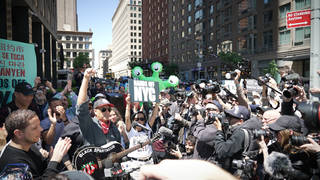
AMY GOODMAN: This is Democracy Now!'s “Expanding the Debate” special. I'm Amy Goodman. We’re joined by three third-party guests shut out of last night’s presidential debate at Hofstra University. Here in New York, we have Green Party presidential nominee Dr. Jill Stein. She tried to get into the debate last night with her running mate, Cheri Honkala. She and Cheri Honkala were arrested. They were detained for more than eight hours. In fact, they were handcuffed to chairs for that time. Justice Party nominee Rocky Anderson is the former mayor of Salt Lake City. And in Rocky Mount, Virginia, we’re joined by Constitution Party nominee Virgil Goode, former six-term congressman who was first elected as a Democrat, later switched to the Republican Party. We did invite Gary Johnson, the former New Mexico governor, on—he’s the Libertarian presidential nominee—but he declined our invitation. We’re re-airing parts of Tuesday night’s second presidential debate, pausing the videotape to give third-party candidates a chance to respond to the same questions put to the major-party candidates. We return to debate moderator Candy Crowley of CNN.
CANDY CROWLEY: I want to move us along here to Susan Katz, who has a question. And, Governor, it’s for you.
SUSAN KATZ: Governor Romney, I am an undecided voter, because I’m disappointed with the lack of progress I’ve seen in the last four years. However, I do attribute much of America’s economic and international problems to the failings and missteps of the Bush administration. Since both you and President Bush are Republicans, I fear a return to the policies of those years should you win this election. What is the biggest difference between you and George W. Bush, and how do you differentiate yourself from George W. Bush?
MITT ROMNEY: President Bush and I are—are different people, and these are different times. And that’s why my five-point plan is so different than what he would have done.
I mean, for instance, we can now, by virtue of new technology, actually get all the energy we need in North America without having to go to the—the Arabs or the Venezuelans or anyone else. That wasn’t true in his time. That’s why my policy starts with a very robust policy to get all that energy in North America, become energy secure.
Number two, trade. I’ll crack down on China. President Bush didn’t. I’m also going to dramatically expand trade in Latin America. It’s been growing about 12 percent per year over a long period of time. I want to add more free trade agreements so we’ll have more trade.
Number three, I’m going to get us to a balanced budget. President Bush didn’t. President Obama was right. He said that that was outrageous to have deficits as high as half-a-trillion dollars under the Bush years. He was right. But then he put in place deficits twice that size for every one of his four years. And his forecast for the next four years is more deficits, almost that large. So that’s the next area I’m different than President Bush.
And then let’s take the last one, championing small business. Our party has been focused on big business too long. I came through small business. I understand how hard it is to start a small business. That’s why everything I’ll do is designed to help small businesses grow and add jobs. I want to keep their taxes down, on small business. I want regulators to see their job as encouraging small enterprise, not crushing it.
And the thing I find most troubling about “Obamacare” — well, it’s a long list, but one of the things I find most troubling is that when you go out and talk to small businesses and ask them what they think about it, they tell you it keeps them from hiring more people.
My priority is jobs. I know how to make that happen. And President Bush had a very different path for a very different time. My path is designed in getting small businesses to grow and hire people.
CANDY CROWLEY: Thanks, Governor. Mr. President?
PRESIDENT BARACK OBAMA: Well, first of all, I think it’s important to tell you that we did come in during some tough times. We were losing 800,000 jobs a month when I started. But we have been digging our way out of policies that were misplaced and focused on the top doing very well and middle-class folks not doing well. Now we’ve seen 30 consecutive—31 consecutive months of job growth, 5.2 million new jobs created. And the plans that I talked about will create even more.
But when Governor Romney says that he has a very different economic plan, the centerpiece of his economic plan are tax cuts. That’s what took us from surplus to deficit. When he talks about getting tough on China, keep in mind that Governor Romney invested in companies that were pioneers of outsourcing to China, and is currently investing in countries—in companies that are building surveillance equipment for China to spy on its own folks. That’s—Governor, you’re the last person who’s going to get tough on China.
And what we’ve done when it comes to trade is not only sign three trade deals to open up new markets, but we’ve also set up a task force for trade that goes after anybody who is taking advantage of American workers or businesses and not creating a level playing field. We’ve brought twice as many cases against unfair trading practices than the previous administration, and we’ve won every single one that’s been decided. When I said that we had to make sure that China was not flooding our domestic market with cheap tires, Governor Romney said I was being protectionist, that it wouldn’t be helpful to American workers. Well, in fact, we saved a thousand jobs. And that’s the kind of tough trade actions that are required.
But the last point I want to make is this. You know, there are some things where Governor Romney is different from George Bush. George Bush didn’t propose turning Medicare into a voucher. George Bush embraced comprehensive immigration reform; he didn’t call for self-deportation. George Bush never suggested that we eliminate funding for Planned Parenthood. So, there are differences between Governor Romney and George Bush, but they’re not on economic policy. In some ways, he’s gone to a more extreme place when it comes to social policy. And I think that’s a mistake. That’s not how we’re going to move our economy forward.
AMY GOODMAN: Back to Dr. Jill Stein of the Green Party.
DR. JILL STEIN: Well, I just want to note that the lines get very blurred when you try to distinguish between even the policies of George Bush and Barack Obama on so many key areas, not to mention, you know, that the distinctions are very hard to find between Mitt Romney and George Bush. There’s been enormous bipartisan collaboration on deregulation, on tax breaks for the very wealthy, and on the explosion of dirty energy as supposedly the route to a new economy. So, we’ve gotten ourselves into great crises under both parties. And in many ways, Barack Obama expanded the bad policies of George Bush, with Wall Street bailouts that went ballistic, the continued offshoring of our jobs, the skyrocketing of student debt and home foreclosures, the expansion of the war, the attack on our civil liberties. The list goes on.
What’s very different in my policies and in Green Party policies is that we support a Green New Deal, which will put everyone back to work at the same time that it puts a halt to climate change and it makes wars for oil obsolete. And as a medical doctor, I want to note that what is good for the economy and for the planet is also good for our health. So it really creates the infrastructure for real health with a local, sustainable food system; with fresh food; with public and active transportation that allows you to get your exercise on the way to school; and with clean, renewable energy that provides, effectively, pollution prevention. So we can get healthy and save an enormous amount of money, as well, by preventing, what, 75 percent of our expenditures under what’s really a sick care system, not a healthcare system. We move to the fundamentals of health, as well, through the Green New Deal.
AMY GOODMAN: Constitution Party presidential candidate, Virgil Goode.
VIRGIL GOODE JR.: Thank you. Dr. Jill Stein is correct in so many areas. Not much difference between Obama, Romney and Bush. I’ll give you a few specifics. Romney, Obama and Bush will do nothing to control the increasing number of green card—well, 1.2 million green card holders admitted to the United States every year. Three-fourths of that number are taking U.S. jobs. Obama is no on my position, Romney is no on my position, and Bush was no on my position. We need a moratorium on bringing in so many foreign workers until unemployment is under 5 percent, and giving them green cards.
Troubled Asset Relief Program, bailout for the—otherwise known as bailout for the big banks and Wall Street—Obama voted yes; Bush was the big pusher of that.
Free trade—Obama, Romney and Bush, big promoters of that. I was a consistent opponent of CAFTA, NAFTA, and PNTR with China.
In the area of education, you had Bush pushing No Child Left Behind and Obama going along with it afterwards. I voted no on No Child Left Behind, because I recognize the federal government should not be the controller and dictator of public education. That should be at the state and local level.
AMY GOODMAN: Rocky Anderson.
VIRGIL GOODE JR.: Big difference between me—
AMY GOODMAN: We’re going to have to leave it there. Rocky Anderson?
ROCKY ANDERSON: Bipartisan corporatism and militarism is what now defines both the Republican and Democratic parties. Barack Obama was partially correct when he said our debt problem is due to these massive Bush budget-busting tax cuts, but what he left out was the military budget, the wars and the cost of cleaning up after the economic disaster facing this country starting in 2008. And they still haven’t done anything to make sure that we don’t face that kind of economic meltdown again.
We need significant regulation of Wall Street and the financial industry. That’s not happening under President Obama. It certainly isn’t going to happen under President—if there is a President Romney. They’re—nobody is talking about breaking up the banks that are too big to fail. Nobody is talking about enforcement. There hasn’t been one prosecution for the massive fraud on Wall Street during the Obama administration. So we’re getting set up again, because these folks are serving the interests of Wall Street rather than serving the public interest. We need to get back to leadership like we had under FDR, like we cleaned up after the Depression, putting people to work and putting the people of this country first.
AMY GOODMAN: We go to the final question, which was about misperceptions you want to correct, and Mitt Romney answered it.
MITT ROMNEY: Thank you, and that’s an opportunity for me, and I appreciate it.
In the nature of a campaign, it seems that some campaigns are focused on attacking a person rather than prescribing their own future and the things they’d like to do. In the course of that, I think the president’s campaign has tried to characterize me as—as someone who’s very different than who I am.
I care about 100 percent of the American people. I want 100 percent of the American people to have a bright and prosperous future. I care about our kids. I understand what it takes to—to make a bright and prosperous future for America again. I spent my life in the private sector, not in government. I’m a guy who wants to help, with the experience I have, the American people.
My—my passion probably flows from the fact that I believe in God. And I believe we’re all children of the same god. I believe we have a responsibility to care for one another. I—I served as a missionary for my church. I served as a pastor in my congregation for about 10 years. I’ve sat across the table from people who were out of work, and worked with them to try and find new work or to help them through tough times.
I went to the Olympics when they were in trouble to try and get them on track. And as governor of my state, I was able to get 100 percent of my people insured, all my kids, about 98 percent of the adults. I was able also to get our schools ranked number one in the nation, so 100 percent of our kids would have a bright opportunity for a future.
I understand that I can get this country on track again. We don’t have to settle for what we’re going through. We don’t have to settle for gasoline at four bucks. We don’t have to settle for unemployment at a chronically high level. We don’t have to settle for 47 million people on food stamps. We don’t have to settle for 50 percent of kids coming out of college not able to get work. We don’t have to settle for 23 million people struggling to find a good job.
If I become president, I’ll get America working again. I will get us on track to a balanced budget. The president hasn’t. I will. I’ll make sure we can reform Medicare and Social Security to preserve them for coming—coming generations. The president said he would. He didn’t.
CANDY CROWLEY: Governor—
MITT ROMNEY: I’ll get our incomes up. And by the way, I’ve done these things. I served as governor and showed I could get them done.
CANDY CROWLEY: Mr. President, last two minutes belong to you.
PRESIDENT BARACK OBAMA: Barry, I think a lot of this campaign, maybe over the last four years, has been devoted to this notion that I think government creates jobs, that that somehow is the answer. That’s not what I believe. I believe that the free enterprise system is the greatest engine of prosperity the world’s ever known. I believe in self-reliance and individual initiative and risk takers being rewarded. But I also believe that everybody should have a fair shot, and everybody should do their fair share, and everybody should play by the same rules, because that’s how our economy is grown. That’s how we built the world’s greatest middle class. And—and that is part of what’s at stake in this election. There’s a fundamentally different vision about how we move our country forward.
I believe Governor Romney is a good man, loves his family, cares about his faith. But I also believe that when he said behind closed doors that 47 percent of the country considered themselves victims who refuse personal responsibility, think about who he was talking about: folks on Social Security who have worked all their lives; veterans, who’ve sacrificed for this country; students, who are out there trying to hopefully advance their own dreams, but also this country’s dreams; soldiers who are overseas fighting for us right now; people who are working hard every day, paying payroll tax, gas taxes, but don’t make enough income. And I want to fight for them. That’s what I’ve been doing for the last four years, because if they succeed, I believe the country succeeds.
And when my grandfather fought in World War II and he came back and he got a GI Bill and that allowed him to go to college, that wasn’t a handout. That was something that advanced the entire country. And I want to make sure that the next generation has those same opportunities. That’s why I’m asking for your vote, and that’s why I’m asking for another four years.
AMY GOODMAN: Constitution Party’s presidential candidate Virgil Goode, less than 30 seconds, final comment.
VIRGIL GOODE JR.: Thank you. Virgil Goode is the candidate for you. I’m pro-life, pro-traditional marriage. Balance the budget now, not 10 years down the road. Jobs in America for American citizens first. Quit bringing in so many foreign workers. Stop the super PACs from controlling our federal election, and have term limits. The right way for America.
AMY GOODMAN: Rocky Anderson.
ROCKY ANDERSON: What hasn’t been discussed during these debates, nobody is talking about what’s going to impact future generations the very most, and that is the climate crisis. We have to address this if we’re going to really show that we care about our children and future generations. Poverty doesn’t—that word doesn’t even escape the lips of either of these candidates. This is a major problem in this country, greater poverty rates than since 1965. There is so much more work to be done.
AMY GOODMAN: Dr. Jill Stein.
DR. JILL STEIN: I think the biggest misperception in this race is that there are only two candidates in this race and that there’s only one choice, which is for a corporate- and Wall Street-sponsored future. In fact, there are many other candidates. I urge people to go to my website, jillstein.org, find out more. You can sign a petition there to open up the debates so that everyone can actually hear that they have real choices. And my campaign is providing that choice for a Green New Deal, for jobs, for ending unemployment, for healthcare and education and housing—
AMY GOODMAN: We have to leave it there.
DR. JILL STEIN: —as a human right.
AMY GOODMAN: And it’s good to see you unhandcuffed.
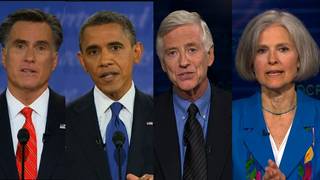



 Top
Top
Media Options