






 Watch Full Show

President Trump has gutted the U.S. government’s support for AIDS healthcare around the world while ordering an end to commemorations of World AIDS Day, observed annually on December 1. Cuts to U.S. foreign aid are having a disproportionate impact on LGBTQ+ communities in many countries, says journalist and scholar Steven Thrasher, speaking from Uganda. “There are people who’ve been harmed very immediately,” he says. Thrasher, who teaches at Northwestern University, also comments on the school’s $75 million payout to the Trump administration to settle a discrimination probe and restore frozen federal funding, calling it a “travesty.”
Related Story
 StoryJul 27, 2012Rev. Canon Byamugisha Makes History as 1st African Religious Leader to Reveal HIV-Positive Status
Transcript
AMY GOODMAN: This is Democracy Now!, democracynow.org. I’m Amy Goodman, with Juan González.
President Trump has gutted AIDS healthcare while ordering an end to commemorations of World AIDS Day, which is observed around the world Monday, December 1st.
For more on this, we’re joined by journalist Steven Thrasher in Kampala, Uganda. But first, we want to go to a clip Steven shared with us of one of many Kampala residents who congratulated incoming New York City Mayor Zohran Mamdani after his election victory last month. Mamdani was born in Kampala.
TURINAWE SAMSON: Hello. My name is Turinawe Samson. I’m here in Uganda, Kampala. I would like to congratulate you, Mamdani, upon winning that seat of mayor in New York City. In Uganda here, we are very happy and grateful for this milestone you’ve made, and we understand that you will serve people genuinely from your heart as you have been promising. We trust you, and we believe something will happen positive to everyone, that makes New York City a better place for each and every person. No matter the problem, something can be done. Thank you, Mayor Mamdani.
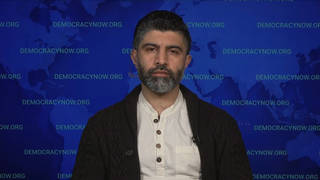
AMY GOODMAN: For more from Kampala, Uganda, we’re joined by Steven Thrasher, acclaimed journalist, author of The Viral Underclass: The Human Toll When Inequality and Disease Collide. He’s the inaugural Daniel Renberg chair for social justice in reporting at the Medill School of Journalism and a faculty member of Northwestern University’s Institute of Sexual and Gender Minority Health and Wellbeing, working on a series called Global Stop Work Order about how the Trump administration’s cuts are affecting LGBTQ+ health and HIV/AIDS in Africa, Europe, the Middle East and North America. The series is supported by a Pulitzer Center Global Reporting Grant and the Fund for Investigative Journalism. He has a new piece for The Intercept with Afeef Nessouli. It’s called “Trump Gutted AIDS Health Care at the Worst Possible Time.” If you can lay out what you found, Steven? Thanks for joining us from Uganda.
STEVEN THRASHER: Thanks for having me, Amy.
As you showed from that clip, Uganda is the home of Zohran Mamdani, who’s been very good on LGBT issues, but Uganda is a very, very difficult place. They have a law called the AHA Act, which makes, quote-unquote, “aggravated homosexuality” punishable by death. And so it’s extremely difficult to get LGBTQ people the healthcare that they need, and it’s very difficult to deal with HIV/AIDS. And the Trump administration has made it even worse, because a lot of USAID money was being used to pay for outreach.
And the things that we found so far as globally, here in Uganda — Afeef has seen the same thing in the Middle East; I’ve seen it in South Africa, as well, and in the United States — is that this is an immediate crisis of LGBTQ employment. There are people who’ve been harmed very immediately, people who are trans, who have been forced into — off their medications, and they experience body dysmorphia. Trans men might begin periods again. This is extremely distressing, causes depression and suicide. And there are people who’ve had advanced issues around AIDS that have died, unfortunately. But for the most part, HIV is a very slow-acting virus, and so if somebody becomes infected at age 20, it might be 10 years before we know that they’re sick. But that same 20-year-old who’s losing their job right now are thrown into an immediate distress.
And the Trump administration has really attacked LGBTQ employment around the world. In the same way that the federal workforce has seen a huge, disparate impact on Black women in the United States, that dynamic is playing out around the world, because often the only kind of employment that LGBTQ people, especially trans women, can get is working in the healthcare sector, the kind of work that USAID supported, and they’ve been thrown out of jobs in devastating numbers over the last year.
JUAN GONZÁLEZ: And, Steve, could you talk about some of the particular examples? You mentioned South Africa, also Lebanon. What’s been happening on the ground with these cuts?
STEVEN THRASHER: So, in South Africa, I met with a colleague who worked at an HIV prevention organization that went from a staff of 86 people to just four people. Ninety-five percent of them were let go. And my colleague told me that if I were to go on a gay meetup app called Grindr, that I would see many of his colleagues working there, because they have nothing else to do. South Africa has 36% or so unemployment for the general population, but it’s well into the majority for LGBTQ people. And so, these people have nothing else to do but sex work. And there’s nothing wrong with sex work, but it’s also a real tragedy that these are people who have been trained to do important work. They’ve been doing really important epidemiological work, public health work, going into communities where rates of HIV are very high, and now they have nothing to do. And maybe they can only do sex work, or they’re not doing anything at all. So, that’s been really disastrous.
The person in the clip that you showed, Samson, at the beginning, he works with a group called Universal Love Alliance, that I’ve gotten to shadow and volunteer a bit with. I’m a phlebotomist and helped out with lab tech work on outreach we did. And we went to a place where we saw 200 sex workers and were able — and this is in Uganda — and were able to give them all condoms and lubricants, which are in very short supply since USAID was cut off.
And to put into perspective how necessary and how out-of-reach these things are, when Trump was inaugurated — and not even when he was inaugurated, when he was elected, that empowered the government in Uganda to get even more regressive, because they knew what was coming, and they saw the Trump administration as supporting a very moralist standpoint from the government. So they stopped the importation of lubricants, because they said that that was being used for immoral sex, being used by sex workers and by homosexuals. And lubricants are very important to make sure that people have healthy sex, that there’s not tearing, that condoms don’t break. So, that object has basically been barred from being imported into the government, and they don’t manufacture it here, so it’s very hard for people to get it. Condoms are also extremely expensive. A condom can cost 50 cents or $1. And I found in my outreach trips that I’ve gone on that sex workers are sometimes only making 50 cents or a dollar, so it’s prohibitively expensive, and they’re less likely then to be able to use condoms now that USAID money has been taken away.
And on this outreach where we went and gave away these resources to 200 people, we also were able to test 86 people for HIV and a host of STIs. And for me from the United States, this was an incredibly, you know, successful outreach, to be able to reach so many people at once. We found three positive HIV cases, six inconclusive and 77 that were negative. And most of those who were negative —
JUAN GONZÁLEZ: And, Steve —
STEVEN THRASHER: Yeah.
JUAN GONZÁLEZ: Steve, I hate to interrupt you, but we only have about a minute left, and I wanted to ask you about something closer to home. Northwestern University, your university, on Friday announced a $75 million — a deal to pay $75 million to the federal government to settle allegations of antisemitism and to reverse all policies implemented in something called the Deering Meadow Agreement. Could you lay out what that is and your response to that, for Northwestern to get back its more than $700 million in federal funding?
STEVEN THRASHER: Yeah, it was a real travesty for Northwestern to do this. The students made a good-faith agreement and really solid principles that the university has just rejected and kind of, on Thanksgiving weekend, shown how the United States government is known for breaking agreements with groups.
But these two stories are actually quite — you know, quite connected. I was saying that there are ways that we could be giving more resources to help deal with HIV public health in the United States and around the world. Scientists at Northwestern University and other universities and U.S. pharmaceutical companies are making lots of money that is dependent upon this kind of work that’s being done. And so, Northwestern is throwing away tens of millions of dollars. The money that was given for the LGBT chair that I hold has basically been wasted because I haven’t been allowed to teach for two years.
And it’s — you know, it’s a real tragedy to see how people around the world, LGBTQ people of color usually, have been doing really, really important work on behalf of U.S. universities, on behalf of the United States government — this isn’t just aid; this is, you know, payment for the ways that people are doing research and volunteering their bodies to be tested for medications. Meanwhile, back in the United States, a university like Northwestern is just throwing away tens of millions of dollars to a fascist regime.
AMY GOODMAN: We want to thank you, Steven Thrasher, for joining us, author of The Viral Underclass: The Human Toll When Inequality and Disease Collide. We’ll link to your Intercept piece, “Trump Gutted AIDS Health Care at the Worst Possible Time.”
A belated happy birthday to Deena Guzder. On Thursday, December 4th, I’ll be at the Bay Street Theater in Sag Harbor, doing the Q&A after Steal This Story, Please! I’m Amy Goodman, with Juan González.



 Top
Top
Media Options