






 Watch Full Show

WTO/99 is a new “immersive archival documentary” about the 1999 protests in Seattle against the World Trade Organization that uses 1,000+ hours of footage from the Independent Media Center and other archives. The historic WTO protests against corporate power and economic globalization were met with a militarized police crackdown and National Guard troops. We feature clips from the film and discuss takeaways that have relevance today. “These issues haven’t gone away,” says Ian Bell, director of WTO/99. We also speak with Ralph Nader, who is featured in the movie.
Related Story
 StorySep 02, 2025Trump’s Tariffs Struck Down: Attorney Neal Katyal & Oregon AG Dan Rayfield Respond
Transcript
AMY GOODMAN: This is Democracy Now!, democracynow.org. I’m Amy Goodman, with Juan González.
We end today’s show with a new immersive archival documentary about the historic 1999 protests in Seattle against the World Trade Organization, corporate power and economic globalization. The film’s scenes of the militarized police response and National Guard troops in the streets of Seattle seem eerily familiar. It uses more than a thousand hours of footage from the Independent Media Center and other archives.
This is the trailer for WTO/99.
DAN RATHER: One hundred thirty-five nations are gathering in Seattle for the World Trade Organization meeting.
PROTESTER 1: The TV stations, they’re not informing people why there is a protest. This explains why there is a protest.
PROTESTER 2: My personal reason for marching is I want to see fair labor practices.
PROTESTER 3: Globalization has already gone too far.
PROTESTER 4: Not in our city! Not in our state!
PROTESTER 5: By nonviolently shutting down the World Trade Organization.
PROTESTER 6: I don’t think they understood there were really going to be 70,000 people.
POLICE OFFICER: If we’re going to clear this, we’re going to need at least five more squads.
PROTESTER 5: The police are protecting millionaires who are killing our environment, our future and our kids.
MAYOR PAUL SCHELL: This is the last thing I want to do, is be a mayor of a city where I had to call the National Guard.
PROTESTER 5: You have the right to be here. Raise your hand if you care.
AMY GOODMAN: Before the 1999 protests, Congress debated a bill to support the creation of the World Trade Organization as an international judicial body to govern global trade. This is Senator Bernie Sanders at the time in another clip from WTO/99.
REP. BERNIE SANDERS: I think there is an important issue of sovereignty. The American people are increasingly alienated from the political process. And the World Trade Organization only takes more and more power out of the hands of local government and state government, and it gives it to nameless bureaucracies abroad that operate in secrecy.
AMY GOODMAN: When more than 40,000 people tried to shut down the WTO meeting in Seattle, they used nonviolent direct action but were met with massive amounts of tear gas. In this clip from WTO/99, we hear a police announcement to protesters.
POLICE OFFICER: Seattle Police Department. You are being ordered to leave the area. Go westbound on Pike, and go north on 6th. We are going to start using chemical agents now.
AMY GOODMAN: Democracy Now! was in the streets of Seattle. One scene in WTO/99 features my questioning of a Seattle police lieutenant wearing a gas mask.
AMY GOODMAN: Lieutenant Sanford, the person with the orange gun, that’s rubber bullets?
LT. SANFORD: I have to be honest. I don’t know what’s in it. I would have to ask him specifically.
AMY GOODMAN: Could you ask him?
LT. SANFORD: I could. It’s probably either chemical agents or rubber bullets, something like that.
AMY GOODMAN: Could you ask? Just wanted to know what it is.
LT. SANFORD: Sure.
AMY GOODMAN: Thanks.
POLICE OFFICER: Let’s have you scoot back. Scoot back, please.
AMY GOODMAN: Yeah.
LT. SANFORD: It has a whole variety of things that go in it.
AMY GOODMAN: You mean, could it have chemical agents and rubber bullets together?
LT. SANFORD: Absolutely.
AMY GOODMAN: Despite the police crackdown, protesters in Seattle had an overwhelming sense of victory. A dramatic scene in WTO/99 features legendary consumer advocate Ralph Nader.
RALPH NADER: Thank you. Thank you very much.
PROTESTER: Run for president!
RALPH NADER: I’m sure you realize what a historic week this is here in Seattle. And I’m sure you realize that never before in American history has any — has any cause for justice brought together so many people from so many different occupations and backgrounds. Why? Why is it that although there are all — a lot of the groups represented here often disagree with one another on a daily basis — why is it they’re all together on this? Because the World Trade Organization is a principal threat to democracy in the world.
AMY GOODMAN: Scenes from the new documentary WTO/99, which starts screening this Friday at DCTV here in New York City at the Firehouse Cinema. We’re joined now by the film’s director, Ian Bell. Ralph Nader is still with us.
Ian, talk about why you’ve taken this on, what, more than a quarter of a century later. Talk about this, really, archival extravaganza that documents what happened on the ground in Seattle.
IAN BELL: So, we took this on from — kind of came from a number of conversations me and my editing partner were having around the 2016 election. We were really interested to see if there were deeper seeds to the shifts of the labor vote, and thought that maybe we could learn a little bit about going back to WTO and the events of 1999.
The film really started when we came across a project that was happening in Seattle of the organization and digitization of the Independent Media Center footage. An organization called MIPoPS was digitizing about 400 hours. And we were lucky enough to connect with them in the middle of that project and ultimately get the access to that footage after they were finished.
JUAN GONZÁLEZ: And, Ian, you mentioned the Independent Media Centers, but really the WTO protests were perhaps the birth of citizen journalism on a mass scale. The importance of having all of this archival footage? And could you talk, for those people who don’t know or weren’t around then, the importance of the IMCs and how that movement spread across the country and the world?
IAN BELL: Yeah. One thing that we were really struck by was, you know, small digicams were becoming more ubiquitous in the late '90s, and because of this technology and the efforts of the IMC at the time, we have all this footage that has been preserved by people in their shoe boxes, people collecting them and gathering them together and then ultimately giving them to archivists. And what's so important about what they did was we’re able to — and you see it in the film — we’re able to see the events as they unfolded on the ground, as people who were in the crowds were seeing it, watching the interactions between protesters and the police. And the footage covered the whole week, almost every minute of the week. And we’re able to then cut that together and compare it to the way it was being covered by local media.
And I think what IMC — the real gift that the IMC provided to us, who now — you know, in the future, is seeing that local media wasn’t up to the task to show the people at home what was unfolding. And we’re able to cut between those two sources, including national and international news, in real time to give people a sense of the narratives that were being constructed by those who maybe weren’t asking the right questions or any questions, or weren’t curious enough to know exactly why people were coming to the streets.
JUAN GONZÁLEZ: And, Ralph Nader, looking back now, more than 25 years, a quarter of a century, the importance of those WTO protests in terms of shaping movements for progress and for radical change in the United States?
RALPH NADER: It punctured the myth of free trade. It wasn’t free trade between countries. It was corporate-managed trade that went beyond trade to subordinate higher standards for consumer, labor, environment and make them viewed as nontariff trade barriers, and therefore illegal. So, this is — these are pull-down trade agreements, enforced by WTO and NAFTA, and the Seattle protests blew that out of the water. And it began a change in Congress to eventually get us out of even worse entanglements, like the Pacific trade agreement, even before Trump took the issue away from the Democrats and ran with it.
AMY GOODMAN: Ralph, I wanted to go to one of the large corporations that were targeted there, in addition to the WTO. The film shows protesters targeting Starbucks’ flagship location on 9th and Pike in Seattle, then a clip of local news coverage featuring the response of then-46-year-old Starbucks Coffee CEO Howard Schultz.
ANCHOR: Howard Schultz says he can’t figure out why one of his stores was targeted. We talked with him at last night’s Sonics game.
HOWARD SCHULTZ: We’ve really tried, as a business, to develop a corporate conscience, not only domestically, but around the world, especially where we buy coffee. So, to hit Starbucks, really, we have to question why.
AMY GOODMAN: That’s so interesting, Ian Bell. In this last 30 seconds, we just covered a protest outside Starbucks in Brooklyn, tomorrow a major one outside the Empire State Building. Mahmood Mamdani, right? I mean, Zohran Mamdani, the mayor-elect of New York City, and Bernie Sanders were both there. The significance of 26 years ago and today, as we end this conversation?
IAN BELL: These issues haven’t gone away. I think what’s been fascinating for us as we made the film, we could see so many of the issues that are galvanizing the youth movements and other movements that are trying to reform or change the direction of the Democratic Party. They were there and filling the streets 26 years ago, and the power structure at the time didn’t listen to the people then. I hope that they begin to listen to them now.
AMY GOODMAN: I want to thank you so much for being with us, Ian Bell, director of the new documentary WTO/99, and longtime corporate critic Ralph Nader. WTO/99 starts screening Friday at DCTV’s Firehouse Cinema here in New York. I’ll be hosting a Q&A with Ian after the 7:30 screening.
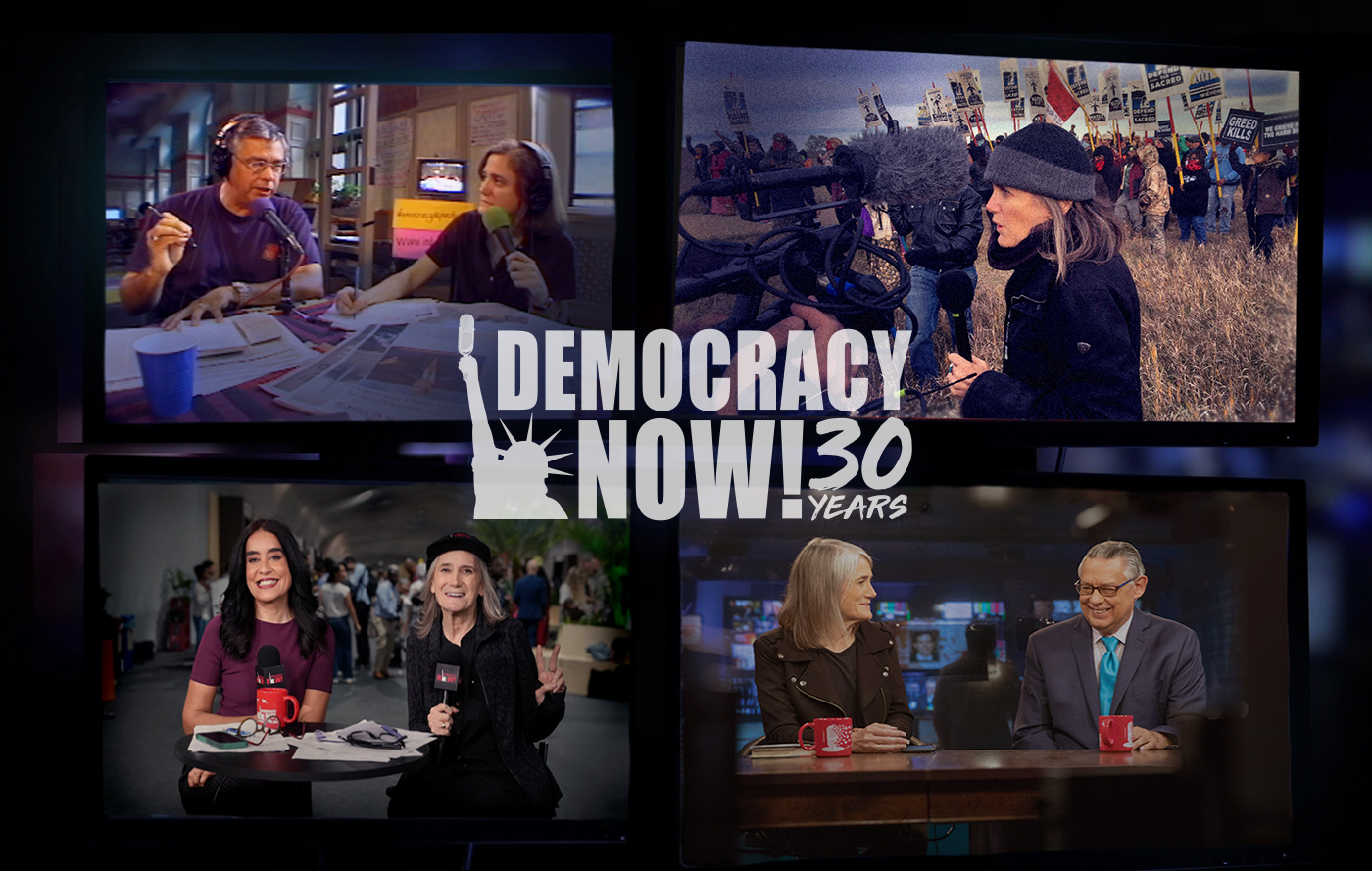
Also, tomorrow, December 4th, Thursday, I’ll be doing the Q&A after the 7:30 screening of Steal This Story, Please!, about Democracy Now!'s 30 years, at the Bay Street Theater in Sag Harbor at the Hamptons Doc Fest there. Happy birthday to Emily Gosselin! Again, I'll be in Sag Harbor Thursday night. I’m Amy Goodman, with Juan Gonzalez. Thanks for joining us.



 Top
Top
Media Options